
Quartz
Clarity and the six-sided crystal. April’s birthstone — the stone the Earth grew most abundantly.
Quartz (rock crystal) is one of the most abundant minerals in the Earth’s crust. SiO₂ (silicon dioxide) crystallizes in the trigonal system into six-sided prisms, ranging from clear “rock crystal” to stones full of expressive inclusions — no two landscapes alike. April’s birthstone, it has been a symbol of cleansing, harmony and amplification since antiquity: the most fundamental of natural stones, and one of the deepest.
Quartz is the April birthstone. See all April birthstones →
◆ Quartz — Stone Meanings
- Cleansing
- Harmony
- Amplification
- Protection
- Intuition
- Latent potential
- Purity
- Clarity
◆ About Quartz
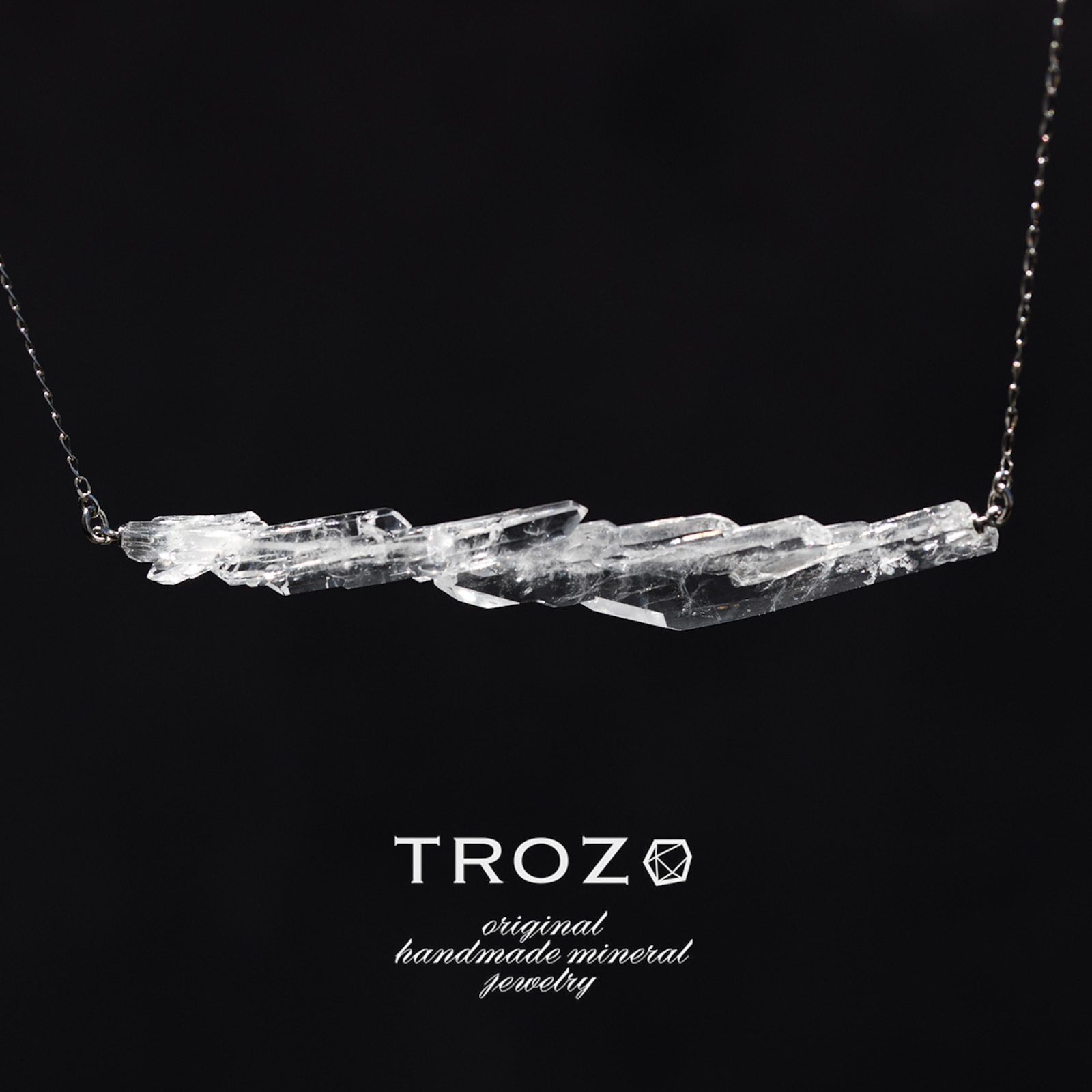
Quartz (rock crystal) is one of the most abundant minerals in the Earth’s crust. Its formula is SiO₂ (silicon dioxide); it crystallizes in the trigonal system, growing in its natural form into a sharp six-sided prism capped by a six-sided point. The clear, colorless variety has been called “rock crystal” since ancient times and used by humankind as a symbol of purity.
Known as the “parent of all stones” and the “stone of cleansing”, quartz is traditionally associated with cleansing, harmony, amplification, protection, intuition and latent potential. It is one of the most widely cherished stones in the world, worn as a charm and given as natural-stone jewelry.
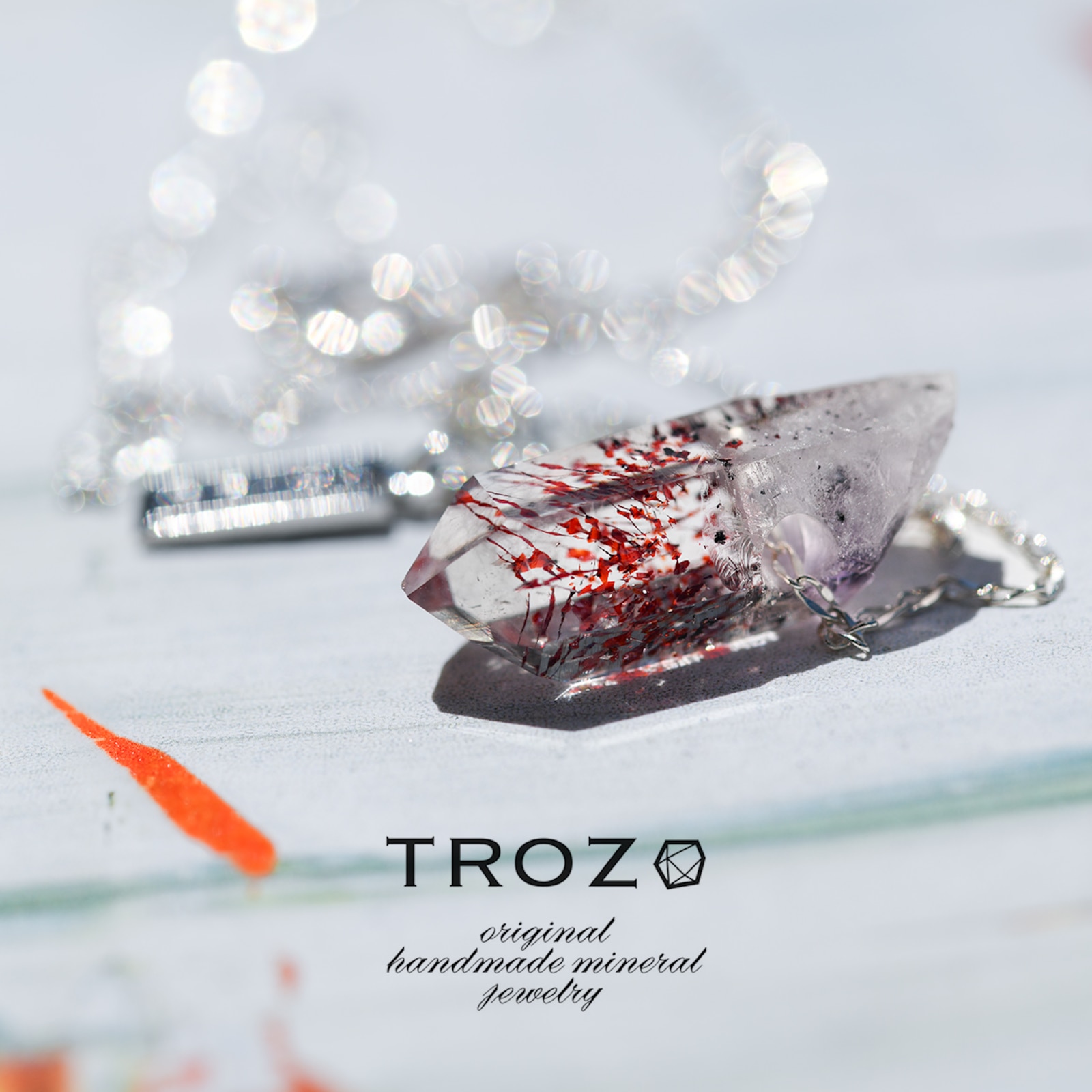
Set as raw stone, the combination of clarity, the sharpness of the six-sided prism and the expression of its inclusions becomes the character of the design. Stones that hold cloud-like milky veils, flashes of rainbow, needle inclusions or phantom crystals are each entirely one of a kind — often more compelling than perfect transparency.
The purity of clear crystal, the small universe held in its inclusions, the beauty of the natural six-sided form: simple yet endlessly deep, quartz is a raw stone that quietly speaks.
◆ Mineral Data
- English name
- Quartz / Rock Crystal
- Chemical formula
- SiO₂ (silicon dioxide)
- Mineral class
- Silicate mineral
- Crystal system
- Trigonal (natural six-sided prisms)
- Mohs hardness
- 7
- Specific gravity
- 2.65
- Main sources
- Brazil, Madagascar, USA (Arkansas), Russia, the Himalayas, Japan (Kofu in Yamanashi, Nakatsugawa in Gifu, Kasugai in Aichi and others)
- Color range
- Colorless and milky white, plus varieties such as amethyst (purple), citrine (gold), rose (pink) and smoky (brown)
- Notable trait
- Piezoelectricity — it generates a charge under pressure and vibrates with great precision under voltage, which is why it is used as the reference in quartz watches and communications equipment
- Birthstone
- April (varies by organization)
◆ One of the most abundant minerals on Earth
A basic building block of the crust — crystallized SiO₂.
Quartz makes up roughly 12% of the Earth’s crust by weight and, with the feldspars, is among the most abundant minerals of all. It occurs throughout igneous, metamorphic and hydrothermal settings and often grows into its natural six-sided form. The clear crystal is called rock crystal, and differences in trace elements, natural radiation and inclusions give rise to varieties such as amethyst (purple), citrine (gold), rose quartz and smoky quartz. It is the most fundamental of natural stones, cherished and used by people since the earliest times.
◆ The crystal that makes electricity — piezoelectricity
A stone that generates a charge under pressure and keeps near-perfect time under voltage.
Quartz produces a voltage when compressed and, conversely, vibrates at an extraordinarily stable frequency when a voltage is applied — the piezoelectric effect. Discovered by the Curie brothers in 1880, this property underpins modern quartz watches (quartz oscillators), communications equipment and sensors. A crystal the Earth grew over vast stretches of time still keeps our clocks and connects our signals — a quiet story carried inside the natural stone you wear.
◆ Choosing raw quartz jewelry
Choose your character by clarity, size and the expression of the inclusions.
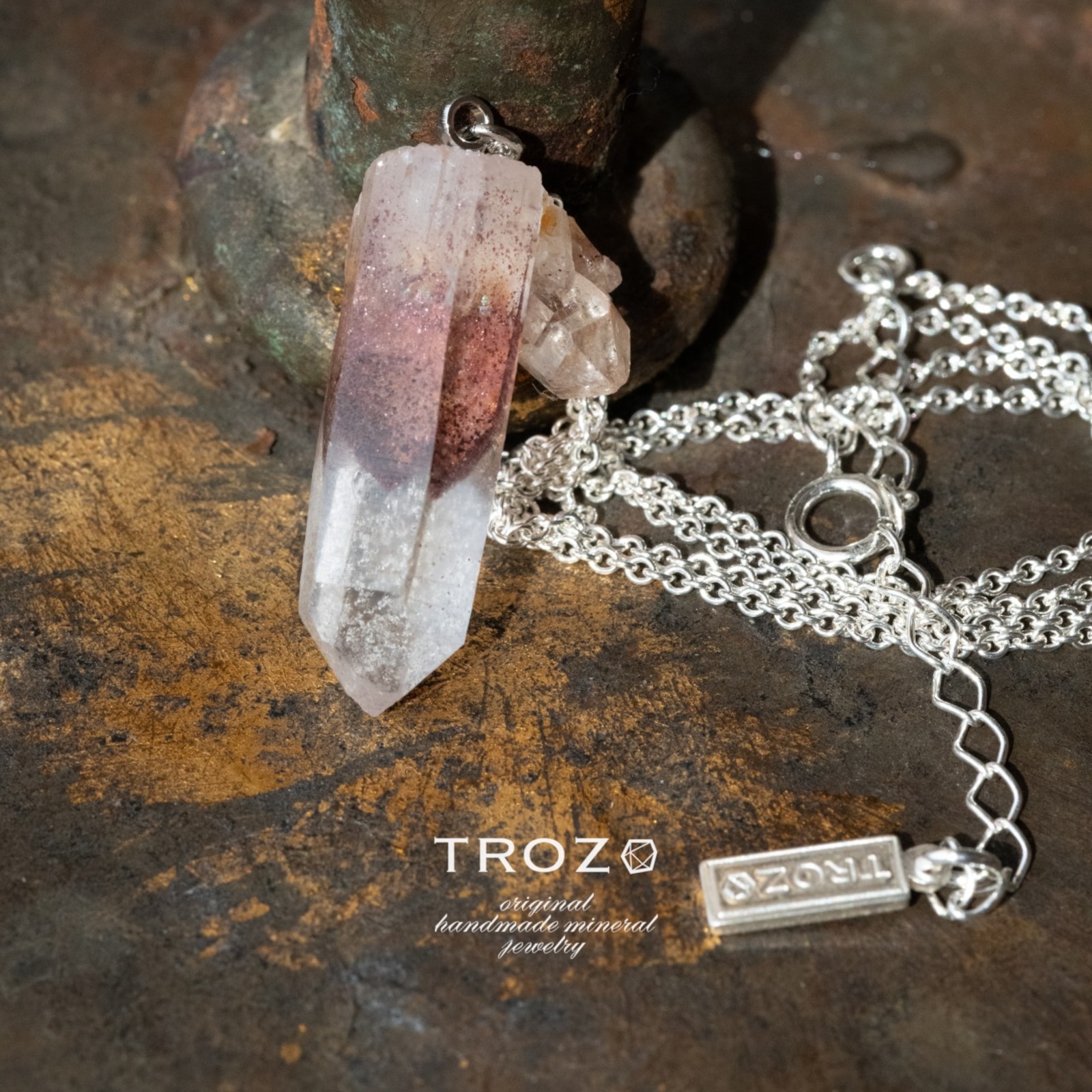
At Mohs 7 quartz is one of the harder natural stones, with ample strength for everyday wear and well suited to raw-stone jewelry. Rather than flawless transparency, stones that hold an “inner landscape” — cloud-like milky veils, flashes of rainbow, needle inclusions of rutile or tourmaline, or phantom crystals — have a presence all their own. As a rough guide for everyday wear, 10–15 mm suits a ring and 20–40 mm a necklace or brooch.
TROZO sets quartz without polishing away its character, letting the natural clarity and inclusions lead the design. We offer pieces for those who would like to choose clarity, size and expression from stock, as well as pieces where the meeting with the stone is left to chance. It is a material you can wear for years, so choose freely to suit your lifestyle.
◆ Quartz Raw-Stone Jewelry
Handmade raw stone & mineral pieces — TROZO
◆ Frequently Asked Questions about Quartz
Q What is the difference between quartz and rock crystal?
Quartz is the mineral name; rock crystal refers specifically to its clear, colorless crystal. They are the same mineral — depending on color and condition it also goes by names such as amethyst (purple), citrine (gold), rose quartz and smoky quartz.
Q What does quartz symbolize?
Quartz is traditionally associated with cleansing, harmony, amplification, protection, intuition, latent potential, purity and clarity. Long called the “parent of all stones” and the “stone of cleansing”, it has been widely cherished as a charm and as natural-stone jewelry.
Q How hard is quartz?
Its Mohs hardness is 7, which is hard for a natural stone or mineral. It has ample strength for everyday jewelry, though it can chip if rubbed against still-harder stones such as diamond or struck sharply.
Q What is piezoelectricity, and how is it linked to quartz watches?
Quartz generates a small electric charge under pressure and, conversely, vibrates at an extremely stable frequency when a voltage is applied — the piezoelectric effect. Because that vibration is so regular, a quartz oscillator is used as the reference frequency in watches, and underpins modern communications equipment and sensors.
Q What kinds of jewelry can quartz become?
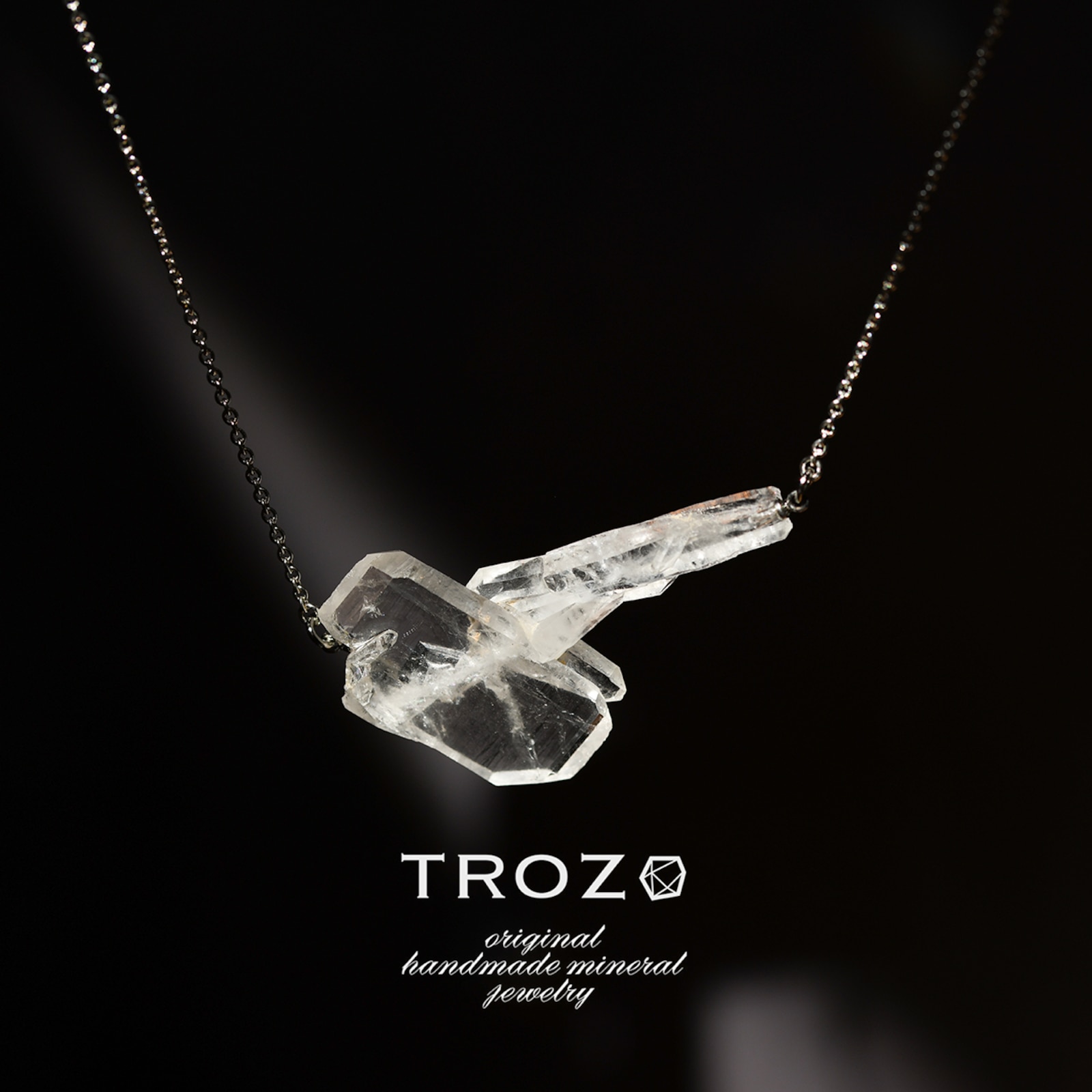
As natural-stone jewelry, quartz is used for raw-stone earrings, necklaces, rings, brooches and ear cuffs. TROZO makes quartz jewelry that keeps the raw stone unpolished so its clarity and inclusions lead the design — both pieces you can choose by clarity and size from stock, and pieces where the meeting with the stone is left to chance.
Q Where does quartz come from?
It is found across the world — Brazil, Madagascar, the USA (Arkansas), Russia and the Himalayas among others. In Japan, rock crystal from Kofu (Yamanashi), Nakatsugawa (Gifu) and Kasugai (Aichi) is well known, and Kofu in particular has a long history as a center of crystal cutting.
Q How do I cleanse quartz?
Quartz is Mohs 7 and water-resistant, so it can be cleansed with water or running water. It works well with many methods — sunlight, moonlight, running water, sage smoke or resting on a quartz cluster — and has itself long been treated as a stone that cleanses other stones.
EXPLORE THE SHOP
Explore the world of Quartz
Discover more pieces than we can show here at the TROZO shop.
Shop Quartz