
Staurolite
The fairy cross — a natural stone carved into a cross by nature.
Staurolite (the “cross stone”) is a rare natural stone that grows naturally into a cross by penetration twinning. Its formula is Fe₁.₅Al₉Si₄O₂₂(OH)₂, monoclinic, Mohs 7–7.5. The name is from the Greek *stauros* (cross) + *lithos* (stone). In Patrick County, Virginia, USA, it is called the “fairy cross”, with the legend that fairies’ tears turned to stone — and it was long worn as a talisman by Crusaders.
◆ Staurolite — Stone Meanings
- The granting of wishes
- Protection from evil
- Bonds
- Healing
- Guardianship
- Faith
- Hope
- Loyalty
◆ About Staurolite
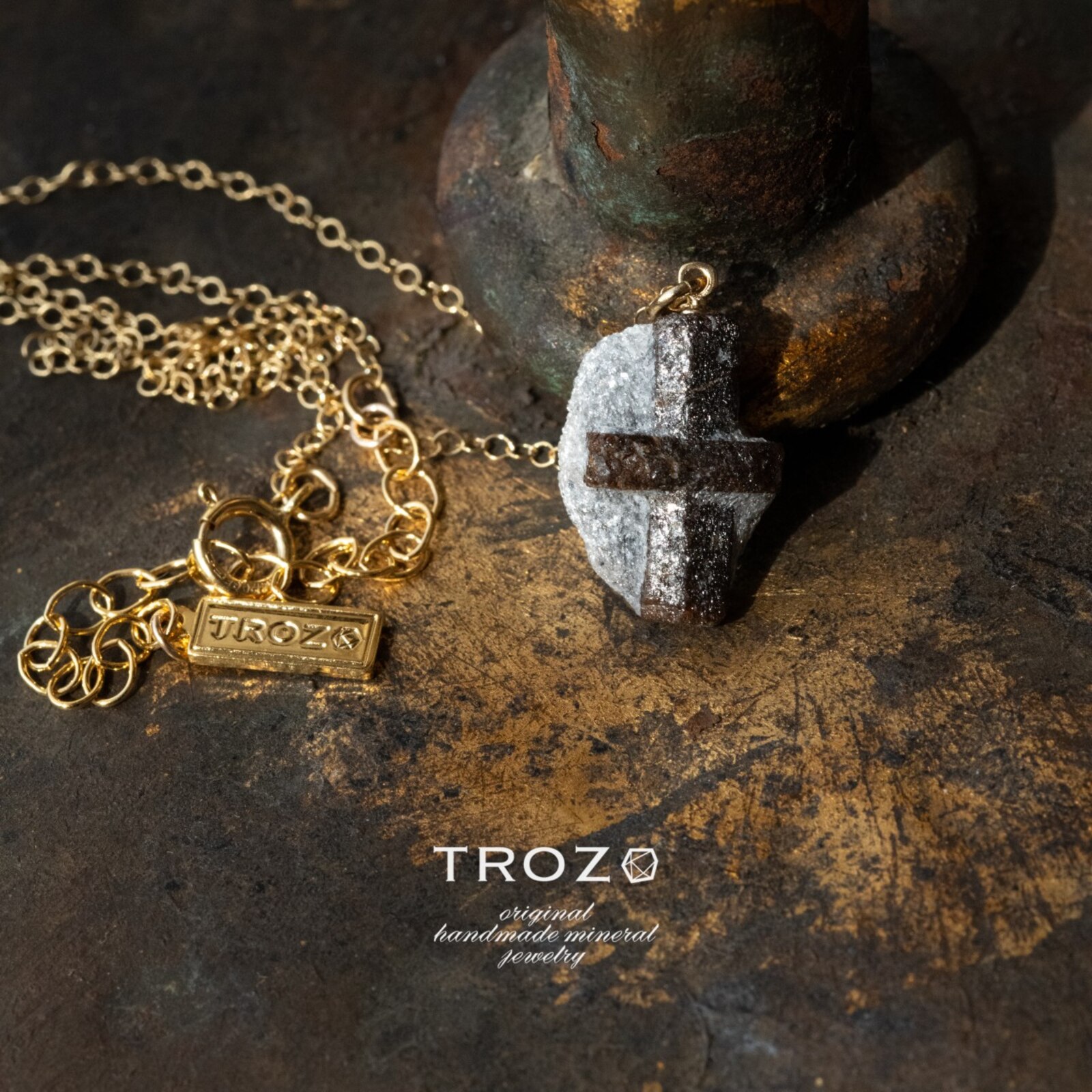
Staurolite (the “cross stone”) is a rare natural stone that grows naturally into a cross by penetration twinning, in which two crystals interpenetrate. Its formula is Fe₁.₅Al₉Si₄O₂₂(OH)₂ (an iron-aluminium silicate), it is monoclinic and hard at Mohs 7–7.5, crystallizing over long ages in metamorphic rock.
The name “Staurolite” comes from the Greek *stauros* (cross) and *lithos* (stone), as does its Japanese name. The geometric cross, born deep within the Earth, comes with no cutting or working at all — a form the Earth itself carved, “nature’s handiwork” that no polishing could produce.
Called the “fairy cross”, it carries in Patrick County, Virginia, USA the legend that “the tears the fairies shed in grief at the death of Christ fell to the earth and became these crystals”. In medieval Europe Crusaders wore it as a talisman, and in Christian lands it has been loved as a symbol of faith and protection.
Its associations include the granting of wishes, protection from evil, bonds, healing and guardianship. The sharpness of the cross, the landscape of the inclusions, the color by source — even among staurolite, no two raw stones share the same form.
◆ Mineral Data
- English name
- Staurolite
- Chemical formula
- Fe₁.₅Al₉Si₄O₂₂(OH)₂ / (Fe,Mg,Zn)₁.₅–₂Al₉(Si,Al)₄O₂₂(O,OH)₂
- Mineral class
- Nesosilicate mineral
- Crystal system
- Monoclinic (forms cross-shaped crystals by penetration twinning)
- Mohs hardness
- 7 – 7.5
- Specific gravity
- 3.65 – 3.83
- Main sources
- USA (Patrick County, Virginia; New Mexico), Russia (Kola Peninsula), France, Switzerland, Brazil, Japan (Unazuki in Toyama, Mt. Nijō in Nara, Iwate and others)
- Color range
- Brown to red-brown to black-brown (varying with iron content)
- Notable trait
- A rare mineral that forms cross-shaped crystals naturally by penetration twinning — a near-90° “Greek cross” or a ~60° “Saint Andrew’s cross”. Also called the “fairy cross”
◆ Nature’s cross, carved by penetration twinning
The 90° cross and the 60° cross — a geometry the Earth makes.
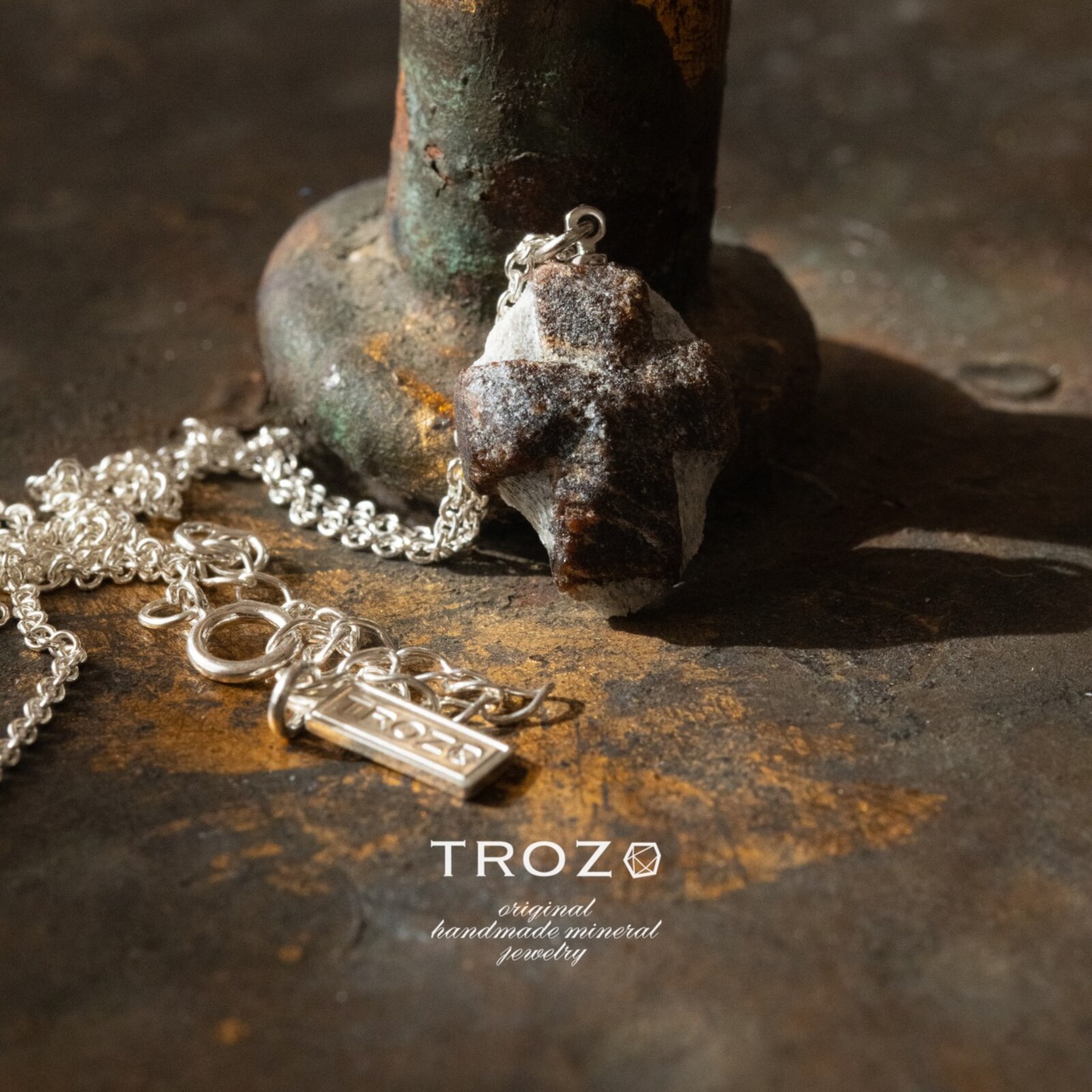
Staurolite’s cross-shaped crystal is born of penetration twinning, in which two crystal axes interpenetrate. One crossing near 90° is a “Greek cross”, one at about 60° a “Saint Andrew’s cross”, the angle and sharpness varying with source and growth setting. A well-formed cross is rare and prized by raw-stone collectors and crystal lovers — a natural geometry the Earth shaped over long ages.
◆ The fairy cross — the legend of Patrick County, Virginia
A Crusader’s talisman, the story of fairies’ tears.
The name “Staurolite” comes from the Greek *stauros* (cross) and *lithos* (stone). In Patrick County, Virginia, USA, there survives a lovely legend that “the fairies shed tears in grief at the death of Christ, and the tears that fell to the earth became these crystals” — and from this story comes the byname “fairy cross”. In medieval Europe, Crusaders wore it as a charm of faith and protection from evil, and it remains hugely popular in Christian lands — a natural stone in which faith and story dwell deeply.
◆ Choosing raw staurolite jewelry
Choose by the sharpness of the cross, the color and the size.
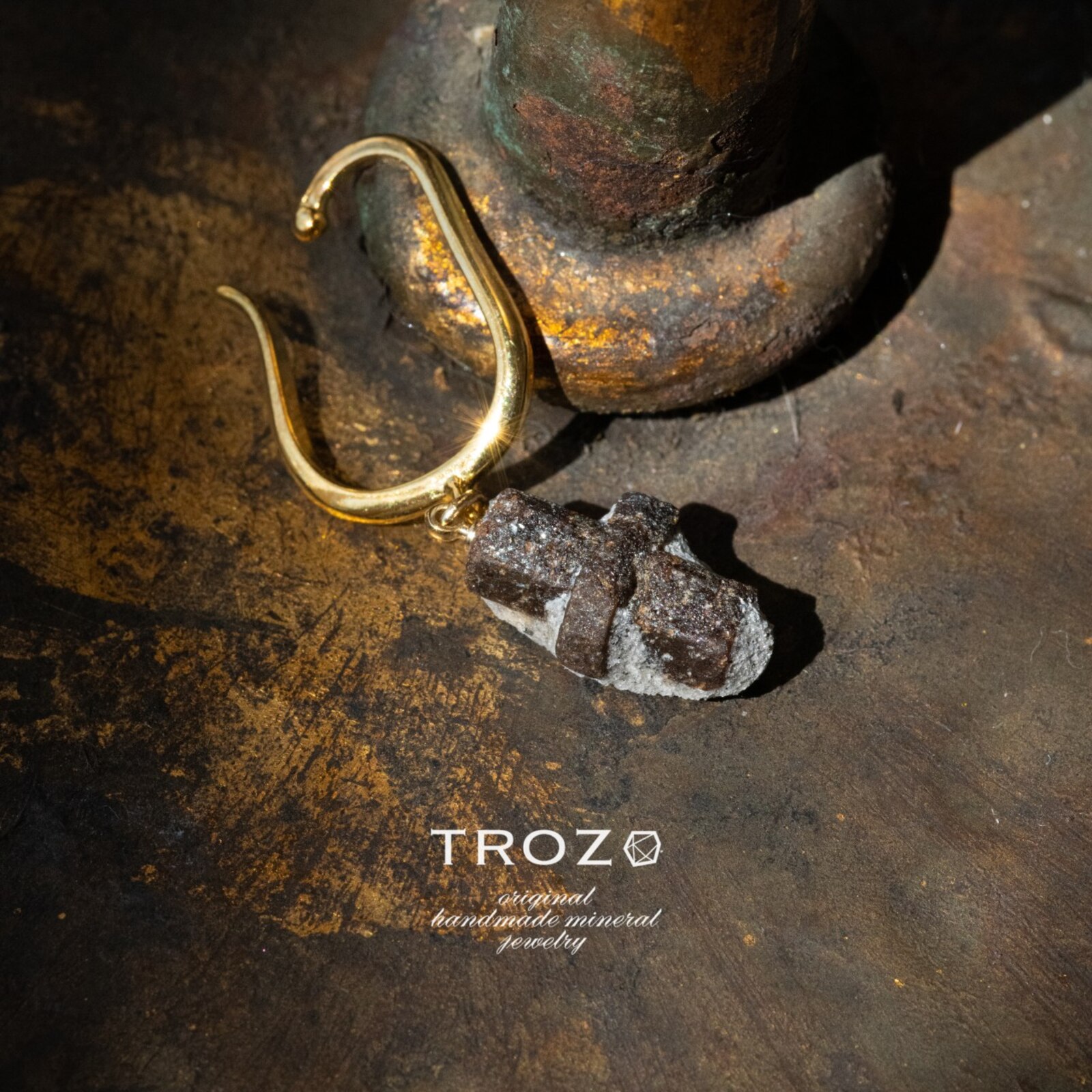
At Mohs 7–7.5 staurolite is hard, with the strength to stand up to everyday wear. Raw-stone jewelry varies greatly in character with the sharpness of the cross’s angle (90° or 60°), how well-formed the crystal is, the color (brown to red-brown to black-brown) and the size. A stone showing a well-formed cross is rare, with a presence all its own, and makes a piece of symbolic meaning as a talisman or gift.
TROZO sets staurolite without polishing away its character, letting the natural cross form and color lead the design. We offer pieces for those who would like to choose the sharpness of the cross and the size from stock, as well as pieces where the meeting with the stone is left to chance — a stone to keep for years, as a charm of faith, of bonds, and of guardianship over new beginnings.
◆ Staurolite Raw-Stone Jewelry
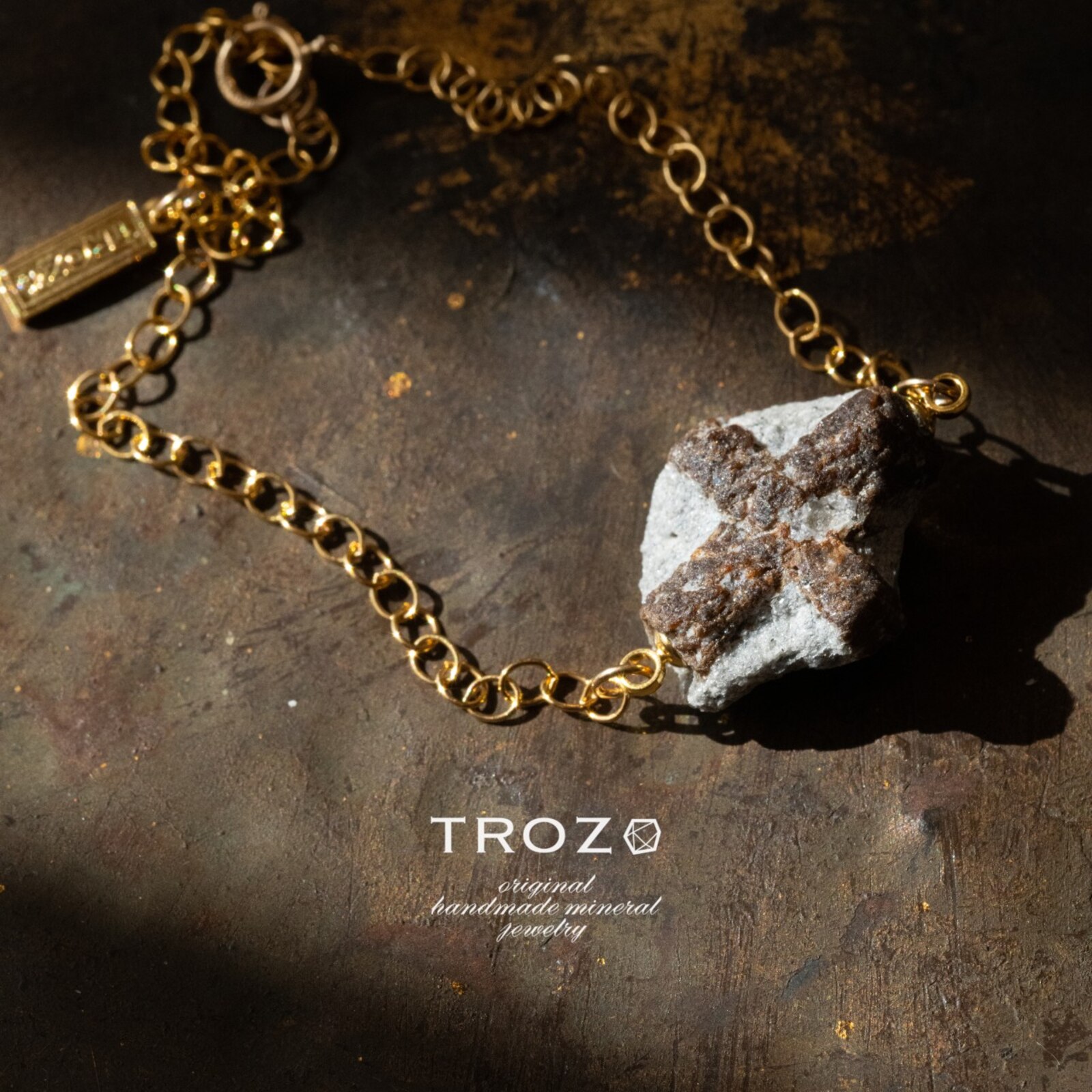
Handmade raw stone & mineral pieces — TROZO
◆ Frequently Asked Questions about Staurolite
Q What does staurolite symbolize?
Staurolite (the cross stone) is traditionally associated with the granting of wishes, protection from evil, bonds, healing, guardianship, faith, hope and loyalty. Worn by Crusaders in medieval Europe and called the “fairy cross”, it is a natural stone that is a symbol of faith and protection.
Q Why is it called the “fairy cross”?
It comes from a legend of Patrick County, Virginia, USA: that staurolite is the tears the fairies shed in grief at the death of Christ, fallen to the earth and turned to crystal — and from this lovely tale comes the byname “fairy cross”. Patrick County is indeed one of the world’s notable staurolite sources, and the legend is still told there today.
Q Does the cross form naturally?
Yes — it crystallizes into a cross naturally. This is the effect called penetration twinning, in which two crystal axes interpenetrate to form a cross. With no cutting or working at all, it is a natural cross the Earth shaped over long ages. A crossing near 90° is called a “Greek cross”, one at about 60° a “Saint Andrew’s cross”.
Q How hard is staurolite?
Its Mohs hardness is 7–7.5, hard among natural stones and minerals, with ample strength for everyday jewelry. Avoiding hard knocks and abrasion keeps its beauty longer.
Q What kinds of jewelry can staurolite become?
As natural-stone jewelry, staurolite is used for raw-stone earrings, necklaces, rings, brooches and ear cuffs. Because of its symbolic cross form, it is often favored as a pendant or necklace. TROZO makes staurolite jewelry that keeps the raw stone unpolished so its cross form and color lead the design — both pieces you can choose by the sharpness of the cross and the size from stock, and pieces where the meeting with the stone is left to chance.
Q Where does staurolite come from?
It is found in the USA (Patrick County, Virginia; New Mexico), Russia (the Kola Peninsula), France, Switzerland and Brazil. In Japan, small amounts can be collected at Unazuki in Toyama, Mt. Nijō in Nara and in Iwate. Patrick County, Virginia is the most famous as the home of the “fairy cross” legend.
Q Are there fakes of staurolite?
Because a well-formed natural cross by penetration twinning is rare, imitations do circulate (a cross pattern made of resin or cement, or a cross carved into another mineral). The genuine stone has a monoclinic crystal structure, a slightly rough surface, and a gradation of brown to black-brown. TROZO works only with natural staurolite.
EXPLORE THE SHOP
Explore the world of Staurolite
Discover more pieces than we can show here at the TROZO shop.
Shop Staurolite