
Amethyst
Purple born from a color center. February’s birthstone — a natural stone of quiet nobility.
Amethyst is the purple variety of quartz. Its formula is SiO₂ and it crystallizes in the trigonal system; the color comes from a color center, created when trace iron and the slow, natural irradiation of the Earth act together, giving everything from pale lilac to deep violet. February’s birthstone, it has been loved since antiquity and carries associations of sincerity, peace of mind and nobility.
Amethyst is the February birthstone. See all February birthstones →
◆ Amethyst — Stone Meanings
- Sincerity
- Peace of mind
- Nobility
- Intellect
- Guardian of love
- Intuition
- Calm
- Cleansing
◆ About Amethyst
Amethyst is the purple variety of quartz. Its formula is SiO₂ (silicon dioxide) and, like quartz, it crystallizes in the trigonal system into six-sided prisms. Only the color differs: trace iron within the crystal, exposed to natural radiation deep in the Earth over long ages, forms a “color center” that gives everything from pale lilac to deep violet.
Purple was a color of nobility from Greek and Roman times, and amethyst was set into the jewelry of royalty and the regalia of the church. Today it is widely loved as February’s birthstone, associated with sincerity, peace of mind, nobility, intellect and the guardianship of love — a classic choice as a charm and as a gift.
As a member of the quartz family, amethyst is known to turn to citrine (golden quartz) when heated to around 450 °C, and where purple and gold meet within a single crystal you have ametrine. The same SiO₂ crystal, yet so rich a spectrum of color — that is the quartz family.
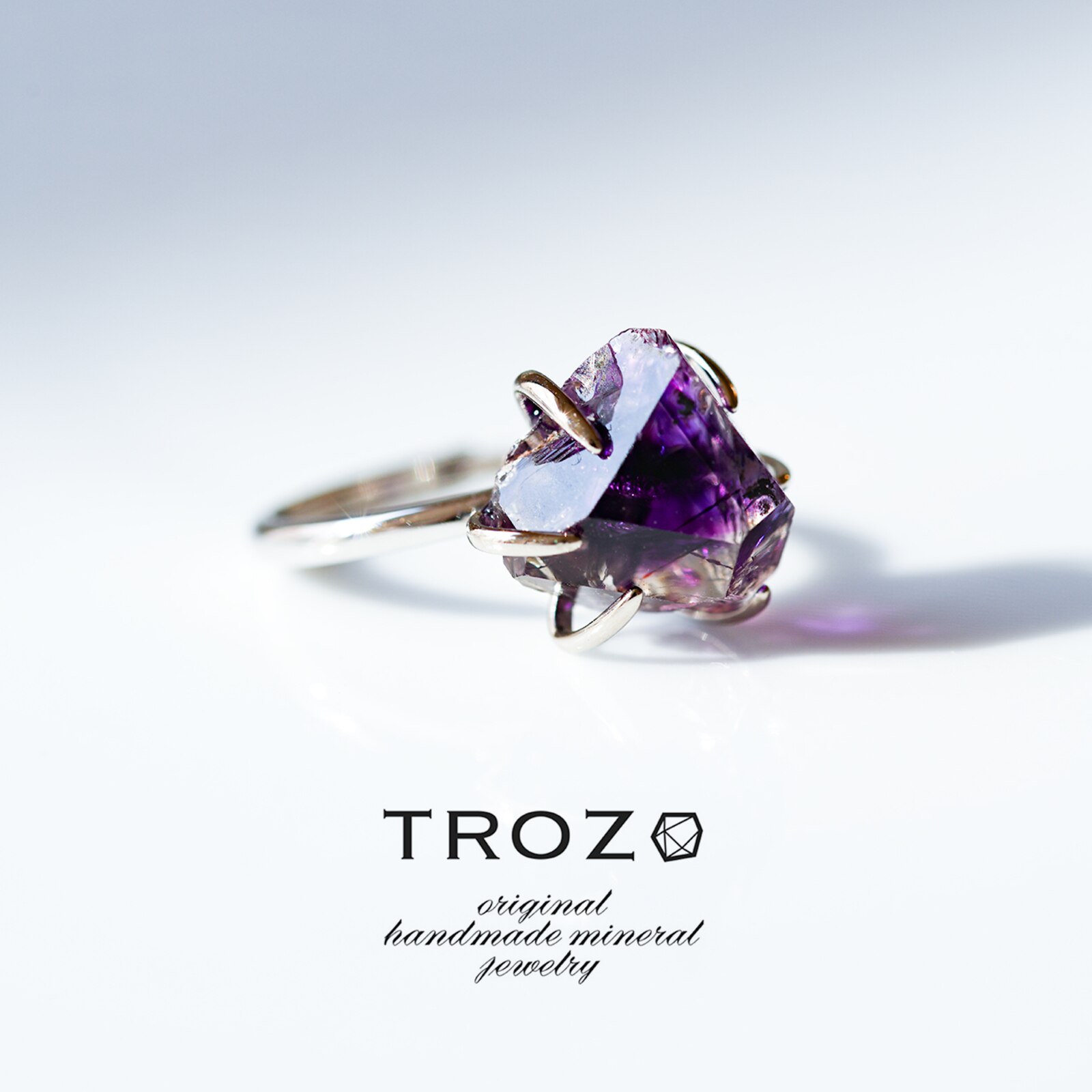
Depth of purple, the landscape of the inclusions, the sharpness of the natural form, the character of each source: set as raw stone, all of this — which polishing would erase — becomes the character of the design. Even among amethyst, no two raw stones share the same scene.
◆ Mineral Data
- English name
- Amethyst
- Chemical formula
- SiO₂ (silicon dioxide — the purple variety of quartz)
- Mineral class
- Silicate mineral
- Crystal system
- Trigonal (natural six-sided prisms)
- Mohs hardness
- 7
- Specific gravity
- 2.65
- Main sources
- Brazil, Uruguay, Zambia, Namibia, Mozambique, Madagascar, Mexico (Veracruz, Guerrero), Bolivia and others
- Color range
- Pale lilac to deep violet; chevron (banded); green amethyst (heat-altered); ametrine (purple + gold bicolor)
- Notable trait
- The purple comes from trace iron plus a radiation-induced color center; heating to about 450 °C turns it into citrine
- Birthstone
- February
◆ Where the purple comes from — the story of the color center
A color born of trace iron and the Earth’s own natural radiation.
Amethyst’s purple arises when trace iron ions (Fe³⁺) within the crystal, exposed to natural radiation over long ages, undergo a charge transfer with neighboring oxygen atoms. This is called a color center: it absorbs light at a particular (yellow) wavelength and sends its complement, purple, to our eyes. That clear violet landscape is the result of the Earth’s slow chemistry, built up over tens of millions of years underground.
◆ February’s birthstone, loved even by royalty
From ancient Greece to today, purple has been the color of grace.
Amethyst has been prized since Greek and Roman times. In the West, where purple was the color of nobility, it was set into the jewels of royalty and the ceremonial jewelry of the church; in Egypt it served as an amulet, and in medieval Europe it appeared on the rings of clergy. Today it is widely loved as February’s birthstone — a stone of long and noble lineage, associated with sincerity, peace of mind, nobility and the guardianship of love.
◆ Choosing raw amethyst jewelry
Choose by depth of purple, clarity and the character of the source.
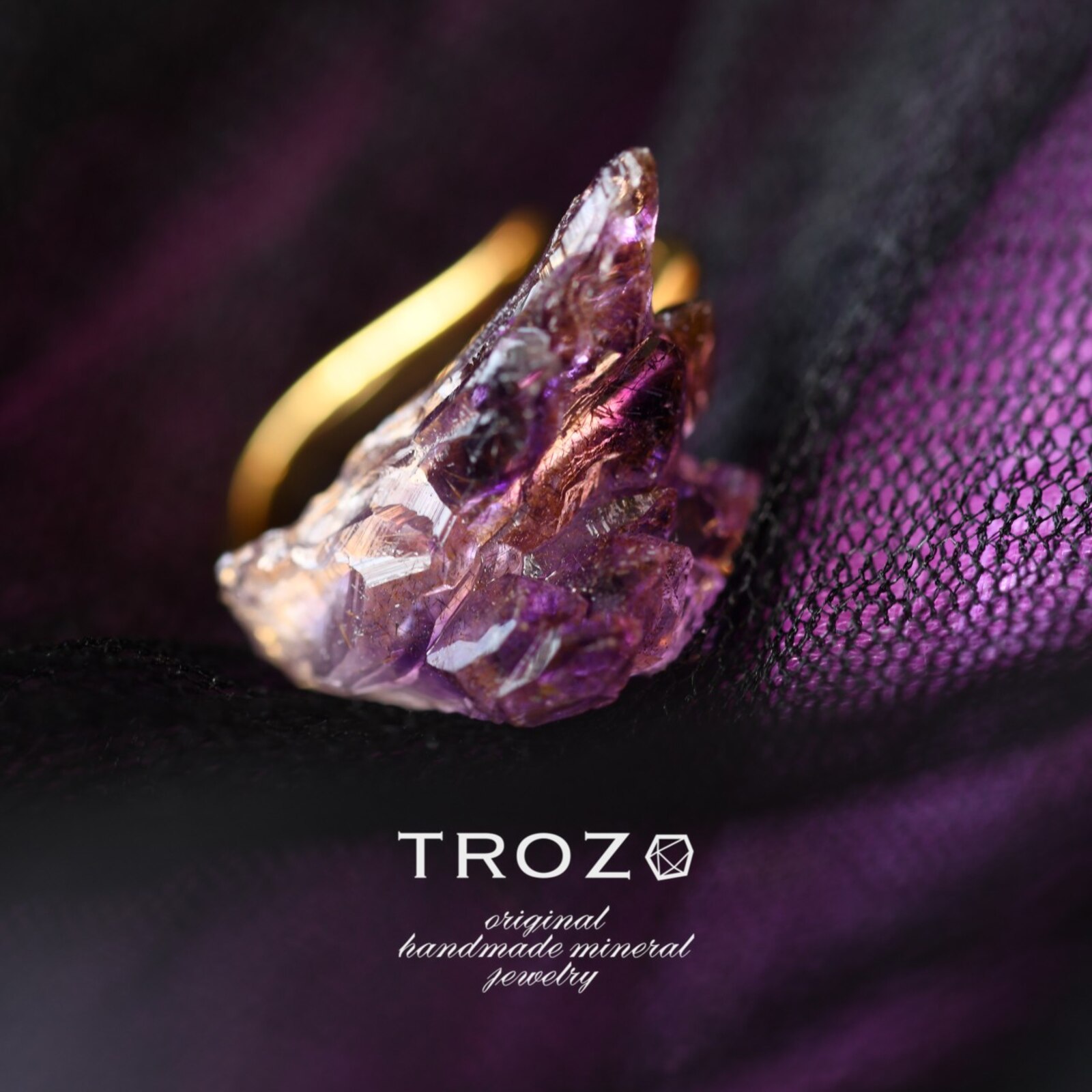
At Mohs 7 amethyst is hard, with ample strength for everyday wear. The character of a raw stone turns on the depth of its purple (pale lilac to deep violet), its clarity, the way any chevron banding runs, and the sharpness of its natural form. Uruguayan material is a deep, dark violet, Zambian leans toward wine-red, Brazilian shows vivid banded purple — the way the expression shifts by source is part of amethyst’s pleasure.
TROZO sets amethyst without polishing away its character, letting the natural violet landscape and inclusions lead the design. We offer pieces for those who would like to choose color and size from stock, as well as pieces where the meeting with the stone is left to chance. One note: amethyst can fade with prolonged ultraviolet exposure, so storing it out of long spells of direct sun keeps its beauty longer.
◆ Amethyst Raw-Stone Jewelry
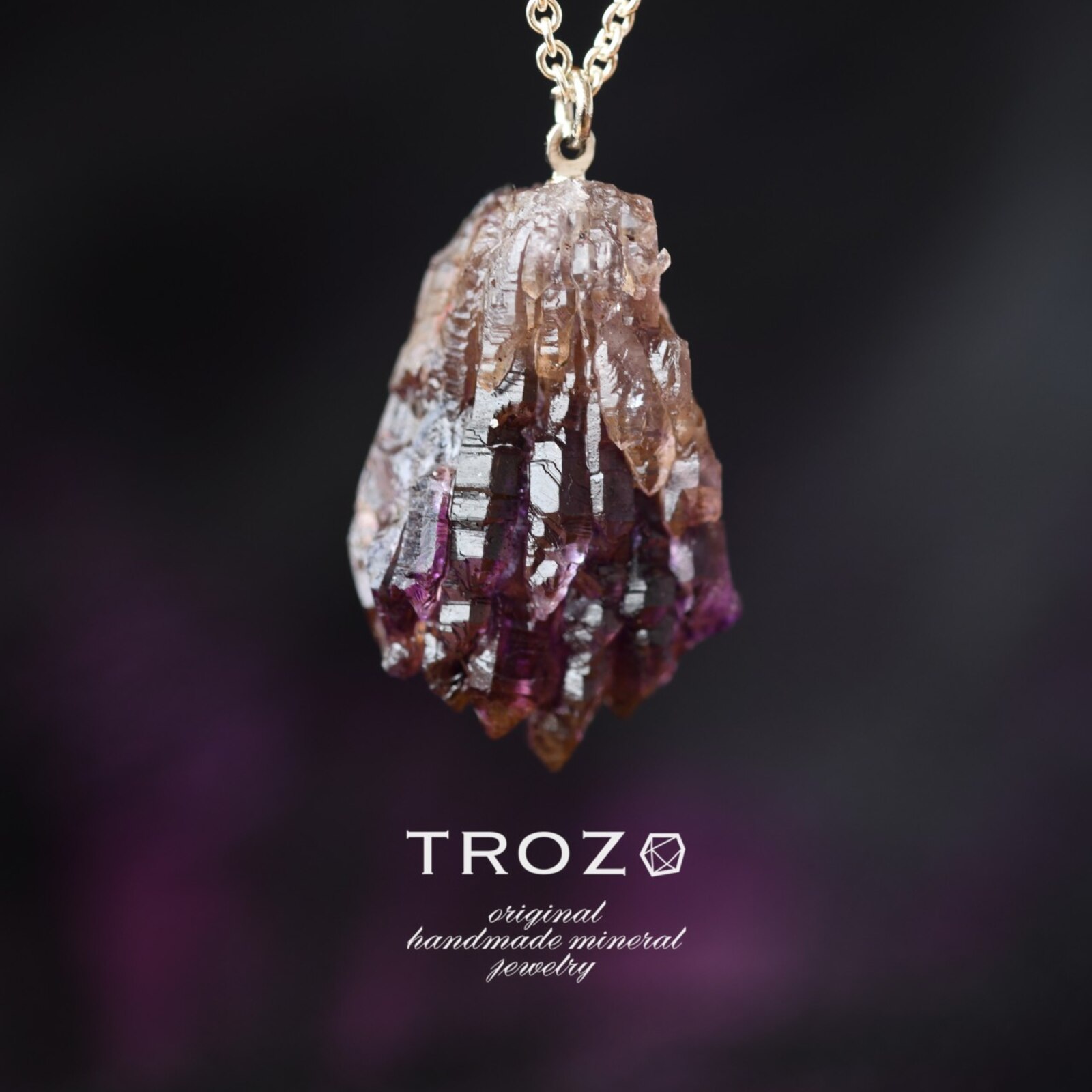
Handmade raw stone & mineral pieces — TROZO
◆ Frequently Asked Questions about Amethyst
Q What does amethyst symbolize?
Amethyst is traditionally associated with sincerity, peace of mind, nobility, intellect and the guardianship of love. Long called a “guardian stone of love”, it has been cherished as a charm and as natural-stone jewelry, and is the classic birthstone for February.
Q What is the difference between amethyst and quartz?
Amethyst is the purple variety of quartz. As a mineral it is the same SiO₂ (silicon dioxide), sharing Mohs 7, the trigonal system and a specific gravity of 2.65. Only the color differs — the purple comes from trace iron and a color center formed by natural radiation underground.
Q How hard is amethyst?
Its Mohs hardness is 7, which is hard for a natural stone or mineral. It has ample strength for everyday jewelry, though it can chip if rubbed against still-harder stones such as diamond or struck sharply.
Q What kinds of jewelry can amethyst become?
As natural-stone jewelry, amethyst is used for raw-stone earrings, necklaces, rings, brooches and ear cuffs. TROZO makes amethyst jewelry that keeps the raw stone unpolished so its violet landscape and inclusions lead the design — both pieces you can choose by color and size from stock, and pieces where the meeting with the stone is left to chance.
Q Where does amethyst come from?
It is found in Brazil, Uruguay, Zambia, Namibia, Mozambique, Madagascar, Mexico (Veracruz, Guerrero) and Bolivia, among others. Uruguayan material is a deep dark violet, Zambian leans to wine-red and Brazilian shows vivid banded purple — the expression of the purple shifts with the source.
Q How should I look after amethyst?
Amethyst can lose color (fade) with prolonged ultraviolet exposure, so storing it out of long spells of direct sunlight keeps its beauty longer. It can be rinsed with water, but avoid sudden temperature changes (hot or ice-cold water); wipe gently with a soft cloth to clean.
EXPLORE THE SHOP
Explore the world of Amethyst
Discover more pieces than we can show here at the TROZO shop.
Shop Amethyst