
Ametrine
Purple and gold within one crystal — found only at the Anahí mine in Bolivia.
Ametrine (also Bolivianite) is a quartz-family variety, SiO₂, trigonal, Mohs 7. It is the rare stone in which amethyst (purple) and citrine (gold) coexist within one crystal, divided by a straight boundary along the crystal axes — its name a blend of the two. The color comes from the behavior of iron: the same Fe³⁺ becomes purple where it forms an Fe⁴⁺ color center under radiation and a temperature gradient during growth, and gold where it does not. The world’s only commercial source is the Anahí mine in eastern Bolivia, named for a 16th–17th-century Ayoreo princess.
◆ Ametrine — Stone Meanings
- Union of opposites
- Harmony of intuition and reason
- Light and shadow
- Stillness and motion
- Balance of spirit and matter
- Inspiration
- Healing and stability
- Creativity
◆ About Ametrine
Ametrine (also Bolivianite) is a quartz-family variety, SiO₂ (silicon dioxide). It is trigonal (space group P3₁21/P3₂21), Mohs 7, SG 2.65–2.66, refractive index 1.544–1.553. The name “Ametrine” is a blend of amethyst and citrine, for the way the two colors coexist within a single crystal. The quartz family — colorless rock crystal, purple amethyst, gold citrine, pink rose quartz, smoky quartz — all share the formula SiO₂ yet vary in hue with trace elements and the radiation environment; ametrine holds the place of the one natural variety in which purple and gold coexist within one crystal.
Ametrine’s curious two colors are explained by the behavior of the iron ion Fe³⁺. Fe³⁺ taken into the quartz lattice, exposed to natural (ionizing) radiation during growth, loses an electron to form an Fe⁴⁺ color center, absorbing yellow light and showing purple (amethyst); where Fe⁴⁺ does not form, Fe³⁺ remains and the stone shows gold (citrine) as the complement. That the same iron is sorted into purple and gold by the uneven distribution of temperature gradient and radiation dose during growth, both proceeding within one crystal at once, is why ametrine is called a “twin-mineral phenomenon”. The color boundary appears straight and sharp, along the crystallographic directions (the symmetry of the r and z faces) in natural stones, while synthetic or treated material has a diffuse, irregular boundary — a clue for telling them apart.
Essential to any account of ametrine is its one commercial natural source — the Anahí mine, in the Pantanal de Bolivia near the Brazilian border, Germán Busch Province, Santa Cruz Department, eastern Bolivia. Rediscovered in the 1960s, reaching the market in the 1970s and worked commercially in earnest from 1989, it has yielded over 100 tonnes of ametrine to date (the mine runs roughly 44% amethyst, 33% ametrine, 23% citrine). The mine’s name comes from the legend that the 16th–17th-century Spanish conquistador Don Felipe de Urriola y Goitia fell in love with Princess Anahí, daughter of a chief of the local Ayoreo people, and was given the mine as a dowry — but when Anahí was mortally wounded in a raid, she pressed an ametrine crystal into Felipe’s hand as a token of eternal love. The two colors, purple and gold, are said to symbolize a heart torn between love of her people and love of her husband.
Commercial natural ametrine is effectively almost 100% from the Anahí mine, a near-monopoly but for trace material from Brazil (Minas Gerais) and India (Andhra Pradesh). Meanwhile the market holds much synthetic ametrine, made by partial heating and irradiation of synthetic quartz, and heat-treated amethyst; the clues for telling them apart are the straightness of the color boundary (natural is sharp along the crystal axes, synthetic diffuse) and a source certificate from a lab such as GIA. At Mohs 7 it is hard, with ample durability for everyday wear, but strong heat or long direct sun can change the color of the citrine part, so store it out of direct sun.
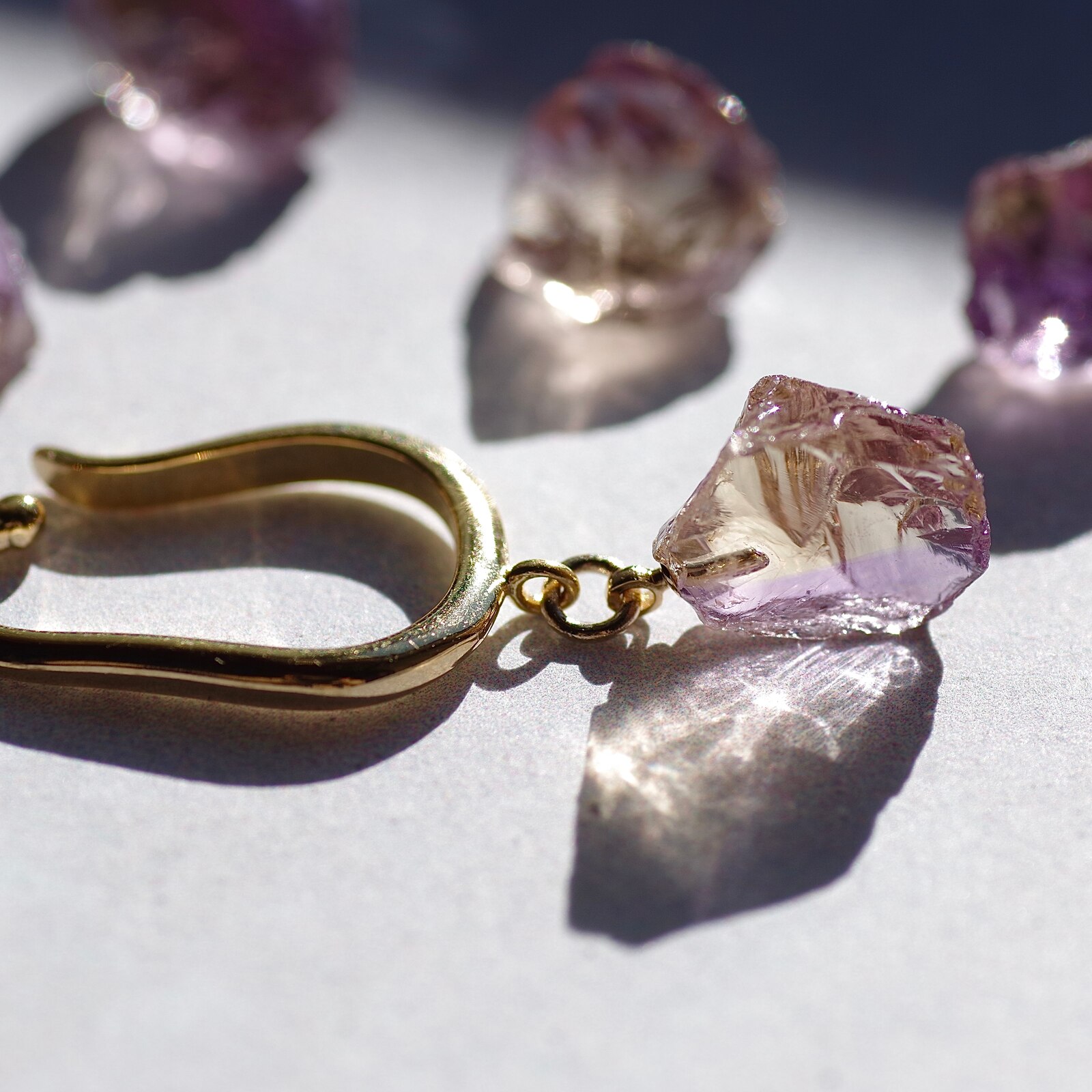
◆ Mineral Data
- English name
- Ametrine (a blend of amethyst + citrine) / Bolivianite (for the Anahí mine, its one source) / trystine, bicolor quartz
- Chemical formula
- SiO₂ (silicon dioxide)
- Mineral class
- Tectosilicate — a quartz-family variety. Within the quartz hue series (rock crystal / amethyst / citrine / rose quartz / smoky quartz), it holds the unique place of “the one natural variety with purple and gold in a single crystal”
- Crystal system
- Trigonal (space group P3₁21/P3₂21 — α-quartz)
- Mohs hardness
- 7
- Specific gravity
- 2.65 – 2.66
- Refractive index
- 1.544 – 1.553
- Main sources
- The Anahí mine, Germán Busch Province, Santa Cruz Department, eastern Bolivia — the Pantanal de Bolivia, near the Brazilian border, the world’s only commercial natural source. Trace: Brazil (Minas Gerais), India (Andhra Pradesh), Canada (Thunder Bay, Ontario), USA (Nevada)
- Color range
- Purple (amethyst zone, from an Fe⁴⁺ color center) + gold/orange (citrine zone, Fe³⁺ as-is), coexisting in one crystal along a straight boundary set by the crystallographic symmetry of the r and z faces
- Notable trait
- The world’s only natural variety with purple and gold in a single quartz crystal. Color from an Fe³⁺ → Fe⁴⁺ color center — the same iron sorted into purple (Fe⁴⁺) and gold (Fe³⁺) by uneven temperature and radiation during growth. The boundary is straight along the r/z symmetry — a clue to natural origin (synthetic is diffuse). From the Anahí mine, the only commercial source — rediscovered in the 1960s, worked from 1989, over 100 tonnes mined. Named for the Ayoreo princess Anahí legend. Much synthetic and treated material on the market — source certificates and boundary straightness are the clues
- Birthstone
- Not an official Japanese (Zenhokyo) or wedding-anniversary stone. Sometimes cited as a zodiac stone for Pisces in trade references, though not an official designation
◆ The same iron, here purple, there gold — the physics of the Fe³⁺ color center
Radiation and a temperature gradient during growth paint one crystal in two colors.
Ametrine’s curious two colors are a natural phenomenon of geochemistry, explained by the behavior of the Fe³⁺ ion in the crystal lattice. Fe³⁺ taken into the quartz lattice, exposed to natural (ionizing) radiation during growth, loses an electron to form an Fe⁴⁺ color center, absorbing yellow light and showing purple (amethyst). Where Fe⁴⁺ does not form, Fe³⁺ remains and shows gold (citrine) as the complement — that is, the same Fe³⁺ is sorted into purple and gold by the uneven distribution of temperature gradient and radiation dose during growth. That the color boundary runs straight and sharp along quartz’s crystallographic directions (the symmetry of the r and z faces) is an important mark of natural ametrine — a “color map remembered by the crystal faces”, reflecting the very direction of growth. Within the quartz family, this coexistence of purple and gold occurs in nature at just one mine in Bolivia — a geochemical accident known to that one place alone.
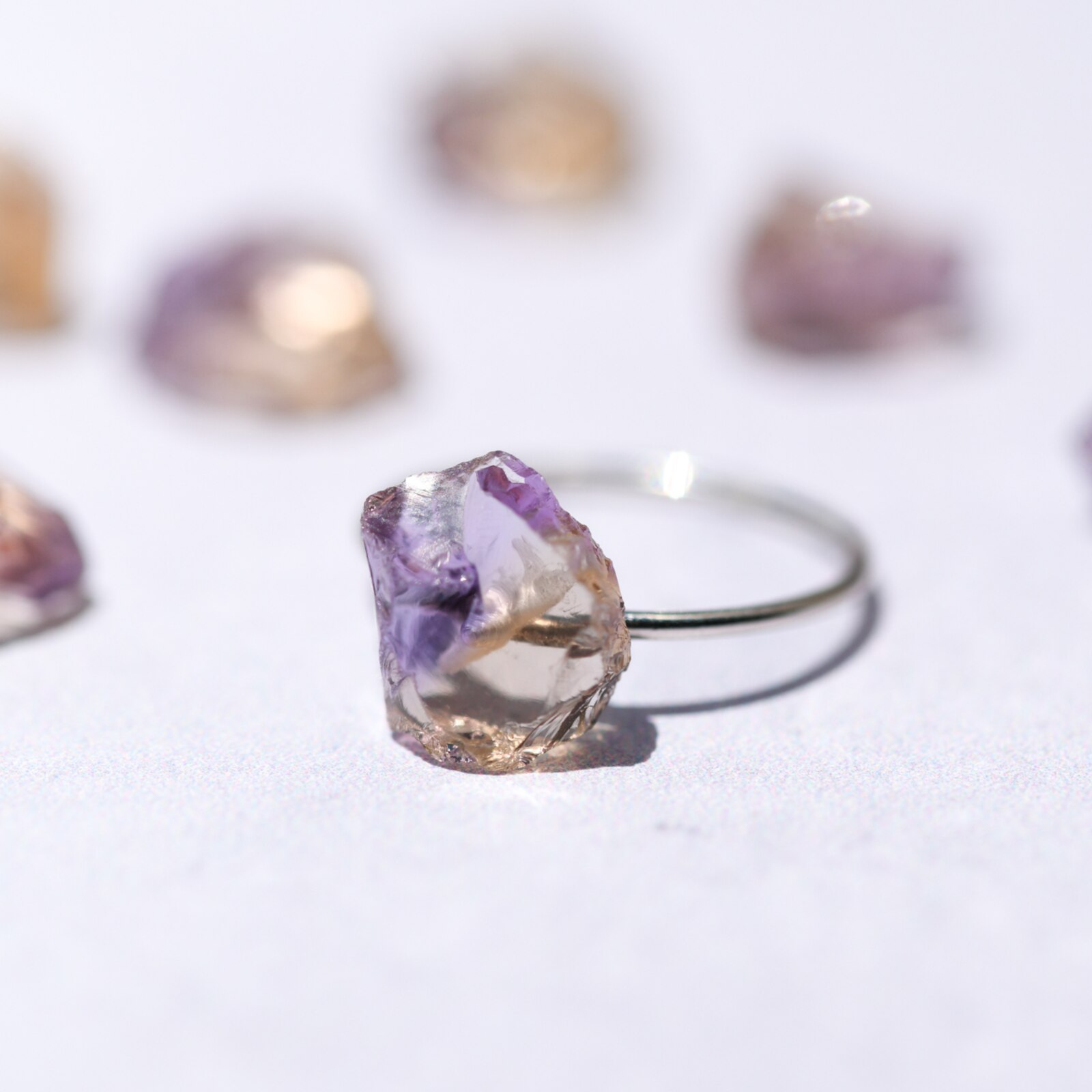
◆ The Anahí legend and the Anahí mine — the world’s only natural source
A story told in purple and gold, asleep in the Pantanal.
No account of ametrine can pass over its one commercial natural source — the Anahí mine, in the Pantanal de Bolivia near the Brazilian border, Germán Busch Province, Santa Cruz Department, eastern Bolivia. Rediscovered in the 1960s, reaching the market in the 1970s and worked in earnest from 1989, it has yielded over 100 tonnes of ametrine to date (about 44% amethyst, 33% ametrine, 23% citrine across the mine). The mine’s name comes from the tragic legend of the 16th–17th-century Spanish conquistador Don Felipe de Urriola y Goitia and Princess Anahí, daughter of a chief of the local Ayoreo people: Felipe fell in love and was given the mine as a dowry, but Anahí was mortally wounded in a raid and, at the last, pressed an ametrine crystal into his hand as a token of eternal love. The two colors, purple and gold, are said to symbolize a heart torn between love of her people and love of her husband. Commercial natural ametrine is effectively almost 100% from Anahí; the market also holds much synthetic ametrine made by partial heating and irradiation of synthetic quartz and heat-treated amethyst, so the straightness of the color boundary (sharp along the crystal axes in natural stones, diffuse in synthetic) and a source certificate are the clues to natural origin.
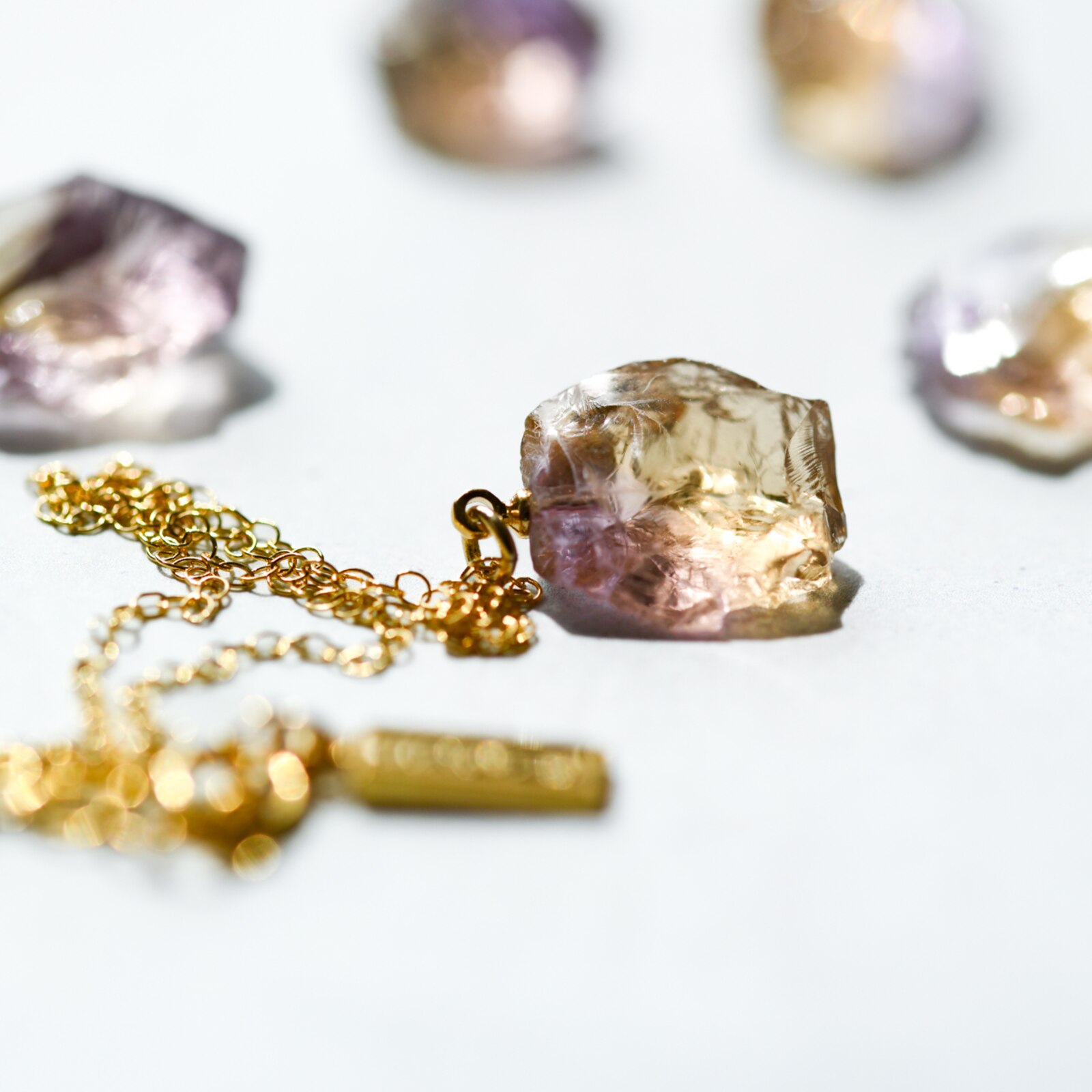
◆ Choosing raw ametrine jewelry
Choose by the balance of purple and gold, the sharpness of the boundary and the care it needs.
The pleasure of choosing raw ametrine jewelry is the area ratio and gradation of purple (the amethyst zone) and gold (the citrine zone), and the sharpness of the color boundary. In natural Anahí material the boundary runs straight and sharp along the crystallographic directions, so a raw section shows the geometric face of “purple and gold divided by a straight line”. The ratio of amethyst to citrine varies greatly from crystal to crystal — purple-dominant, gold-dominant, near half-and-half — and the rarity of being the one natural variety with purple and gold in a single crystal is ametrine’s appeal.
TROZO sets ametrine with its natural crystal faces and the boundary of two colors intact. As a quartz-family stone it is hard at Mohs 7, with ample durability for everyday wear, but strong heat or long direct sun can change the color of the citrine part, so store it out of direct sun. Cleansing with water, a brief salt bath or brief running water is fine, but a long sunbath risks fading and is best avoided. Wear “the world’s only natural stone with purple and gold together”, wrapped in the Anahí legend, in the raw-mineral jewelry TROZO makes.
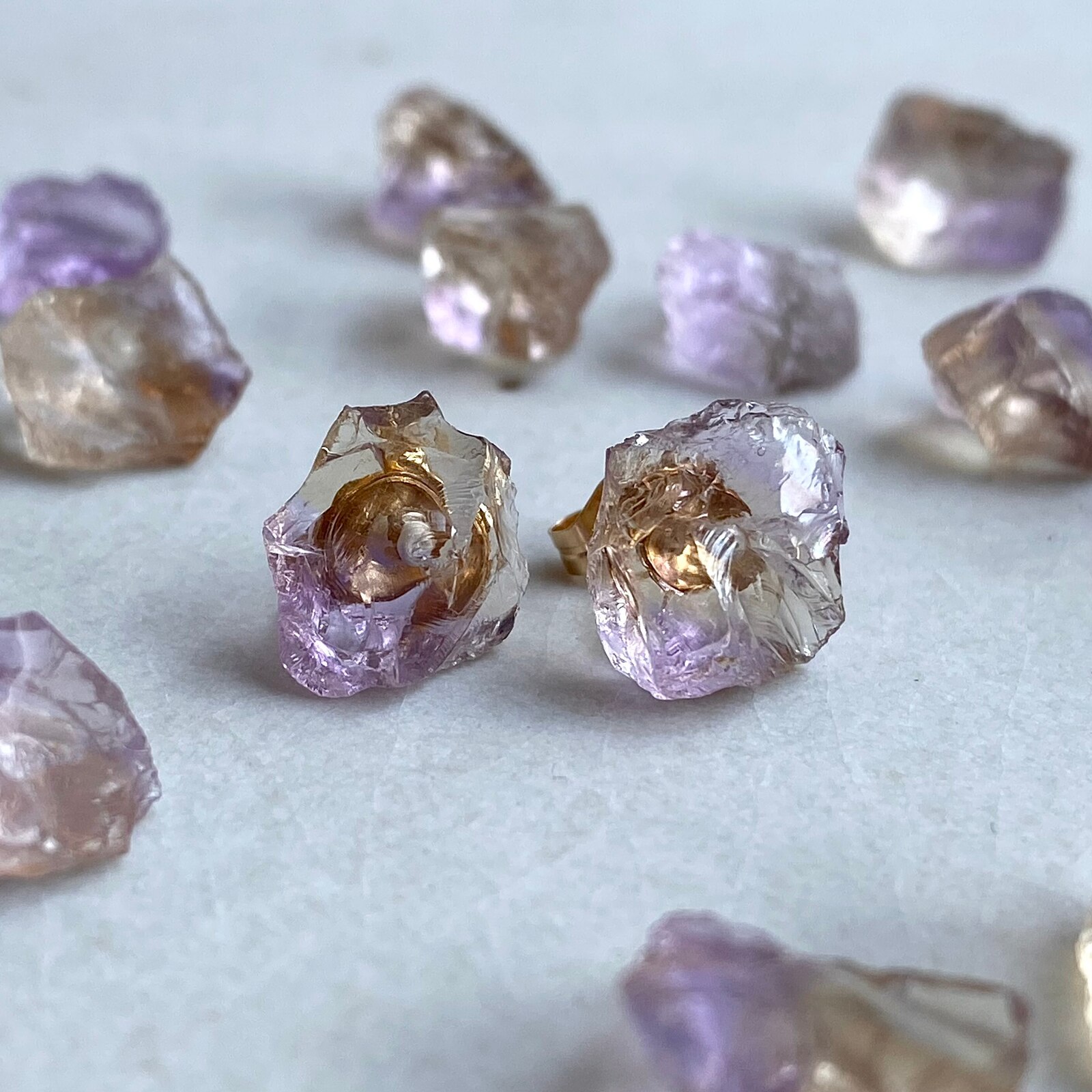
◆ Ametrine Raw-Stone Jewelry
Handmade raw stone & mineral pieces — TROZO
◆ Frequently Asked Questions about Ametrine
Q What does ametrine symbolize?
Ametrine is traditionally associated with the union of opposites, the harmony of intuition and reason, light and shadow, stillness and motion, the balance of spirit and matter, inspiration, healing and stability, and creativity. From the rare sight of amethyst (purple) and citrine (gold) within one crystal, it is cherished as a “stone that integrates opposites”.
Q Is ametrine a birthstone?
Ametrine is not a designated birthstone in Japan, nor a designated anniversary stone. Some trade sources list it as a zodiac stone for Pisces, but this is not an official designation. In Japan it is chosen as non-birthstone mineral jewelry by those drawn to the rarity of the world’s only natural stone with purple and gold together.
Q Why do purple and gold coexist in one ametrine crystal?
Ametrine’s two colors arise from differences in the behavior of the iron ion Fe³⁺. Fe³⁺ in the quartz lattice, exposed to natural radiation during growth, forms an Fe⁴⁺ color center and shows purple (amethyst), while where it does not, Fe³⁺ remains and shows gold (citrine). The same iron is sorted into purple and gold by the uneven distribution of temperature gradient and radiation dose during growth. The color boundary runs straight along quartz’s crystallographic directions (the symmetry of the r and z faces) — the mark of natural stones.
Q How is ametrine related to amethyst and citrine?
All three are quartz-family varieties (SiO₂, trigonal) colored by the iron ion Fe³⁺. The difference is the state of the Fe³⁺ — amethyst is purple from an Fe⁴⁺ color center formed under natural radiation, citrine gold from Fe³⁺ left as it is, and ametrine the rare variety in which both coexist within one crystal along the crystallographic directions. Ametrine is the one mineral that achieves the coexistence of purple and gold in nature within the quartz hue series.
Q Where is ametrine found — what is the Anahí mine in Bolivia?
Commercial natural ametrine is effectively almost 100% from the Anahí mine, in the Pantanal de Bolivia near the Brazilian border, Germán Busch Province, Santa Cruz Department, eastern Bolivia. Rediscovered in the 1960s and worked in earnest from 1989, it has yielded over 100 tonnes of ametrine. The mine’s name comes from the tragic legend of the 16th–17th-century Spanish conquistador Don Felipe de Urriola y Goitia and Princess Anahí, daughter of an Ayoreo chief — the two colors said to symbolize a heart torn between love of her people and love of her husband. There is trace material from Brazil and India, but the world’s natural ametrine is mainly from Anahí.
Q How can I tell natural ametrine from synthetic or treated material?
The market holds much synthetic ametrine made by partial heating and irradiation of synthetic quartz and heat-treated amethyst. The clues are: the straightness of the color boundary (natural Anahí material has a sharp, straight boundary along the crystallographic r/z directions, while treated material has a diffuse, irregular boundary); a source certificate (a lab report such as GIA, certifying Anahí origin); and inclusions (Anahí-specific inclusions under the microscope). For a sure natural stone, choose a trusted lab and a supply chain with source documentation.
Q What care does ametrine need?
As a quartz-family stone, ametrine is hard at Mohs 7, with ample durability for everyday wear. But strong heat or long direct sun can change the color of the citrine part, so store it out of direct sun. Steam cleaners and sudden temperature changes can induce cracks around inclusions and the color boundary, so they are best avoided. Cleansing with water, a brief salt bath or brief running water is fine, but a long sunbath risks fading and is best avoided.
Q What kinds of jewelry can ametrine become?
As natural-stone jewelry, ametrine is used for raw-stone earrings, necklaces, rings, brooches and ear cuffs. As a quartz-family stone at Mohs 7 it is hard and easy to handle as jewelry. TROZO makes ametrine jewelry that keeps the raw stone unpolished so its crystal faces and the boundary of purple and gold lead the design — both pieces you can choose by color balance and the look of the boundary from stock, and pieces where the meeting with the stone is left to chance.
EXPLORE THE SHOP
Explore the world of Ametrine
Discover more pieces than we can show here at the TROZO shop.
Shop Ametrine