
Pink Amethyst
A pale pink quartz variety, asleep in the evaporite geodes of Patagonia, Argentina.
Pink Amethyst is a quartz-family variety, SiO₂, of a pale pink to salmon color — trigonal, Mohs 7, a rare stone. Its color comes from a color center of trace iron Fe³⁺ under natural radiation together with fine hematite (α-Fe₂O₃) inclusions dispersed in the crystal. Its one major source is the El Choique mine in Pehuenches, Neuquén Province, Patagonia, Argentina — pink quartz crystals blooming in geodes within Late Cretaceous evaporite (anhydrite/gypsum). A newcomer of the late 2010s, established as the trade name “Pink Amethyst” after analysis at Caltech and elsewhere.
◆ Pink Amethyst — Stone Meanings
- Gentle love
- Self-love
- Healing
- Inner peace
- Emotional cleansing
- Activation of the heart chakra
- Delicacy
- Compassion
◆ About Pink Amethyst
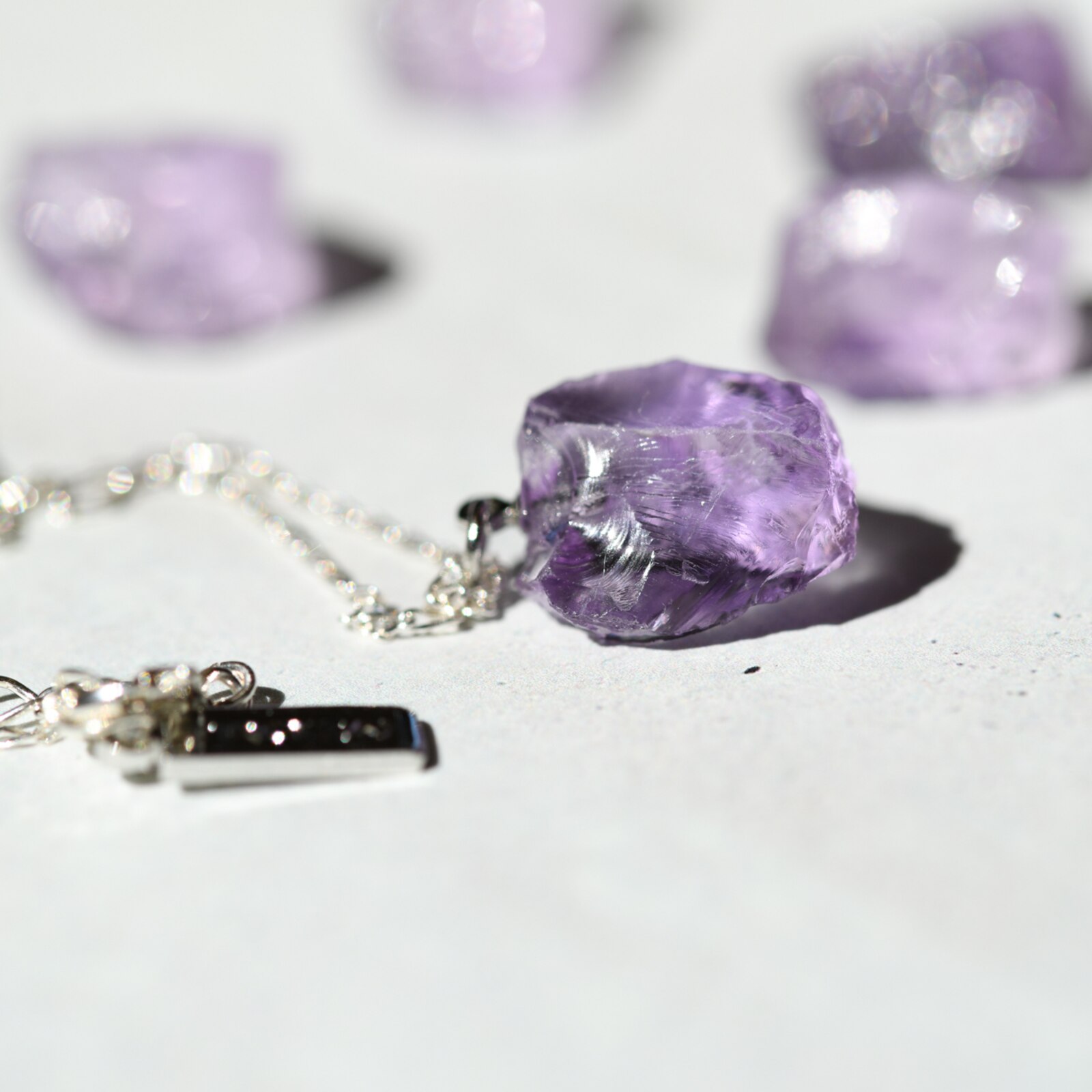
Pink Amethyst is a pale pink color variety of the quartz family, SiO₂. It is trigonal (space group P3₁21/P3₂21), Mohs 7, SG 2.60–2.65, refractive index 1.544–1.553 — sharing the standard quartz-family values of colorless rock crystal, purple amethyst and gold citrine. The name combines “Pink + Amethyst” as a variety (trade) name, established in the late 2010s as pale pink quartz reached the market and the trade settled on “Pink Amethyst”. Some in the mineralogical community note the tension with the definition of “true amethyst = purple”, and strictly it is best understood as a pale pink variety of iron-color-center quartz with fine hematite inclusions.
Pink Amethyst’s pale pink arises from a combination of factors. First, trace iron Fe³⁺ taken into the lattice forms a color center under natural radiation (gamma rays) — placing it in the iron-color group shared with amethyst, citrine and ametrine. In addition, a feature peculiar to pink amethyst — fine hematite (α-Fe₂O₃) inclusions dispersed in the crystal — has been confirmed by analysis at the California Institute of Technology (Caltech), contributing further to the pink hue. That the same iron-based coloring gives amethyst a deep purple and pink amethyst a pale pink comes down to differences in the temperature, radiation dose and inclusions of the growth environment: in a low-temperature, low-radiation setting the color center does not develop to deep purple but stops at pale pink — a mechanism being clarified in geochemistry.
Pink Amethyst’s one major source is the El Choique mine in Pehuenches Department, Neuquén Province, in the Patagonia region of Argentina. Effectively all commercial natural material comes from here. The geology is highly distinctive: the host is Late Cretaceous evaporite (about 100–66 million years old) — beds of salt rock such as anhydrite and gypsum, deposited as an ancient shallow sea dried — with geodes developed within. This is wholly unlike the basalt-origin geodes (of volcanic rock) that yield amethyst in Brazil and Uruguay: that fine hematite particles were stably taken in, in the low-temperature setting of evaporite, is the geological background of pink amethyst’s peculiar pale pink. The mine is on private land and not open to the public.
In the market, take care over confusion with rose quartz. Both are pink quartz, but they differ in coloring mechanism and occurrence: rose quartz is a massive mineral colored by light scattering and absorption from fine fibrous, dumortierite-like inclusions (Ti+Fe), with almost no visible crystal faces. Pink Amethyst, by contrast, is crystalline, colored by an iron color center plus fine hematite inclusions, with small-to-medium crystals clustered in geodes and clearly visible faces — the decisive difference. As a quartz-family stone it is hard at Mohs 7, with ample durability for everyday wear, but its iron-color-center color can fade under long direct sun, so store it out of direct sun. Dyed quartz and heat-treated amethyst are also sold falsely on the market, so a “Patagonia, Argentina” source note is a clue to natural origin.
◆ Mineral Data
- English name
- Pink Amethyst (a variety/trade name, established in the late 2010s)
- Chemical formula
- SiO₂ (silicon dioxide) + trace iron Fe + fine hematite α-Fe₂O₃ inclusions
- Mineral class
- Tectosilicate — a quartz-family color variety. In the quartz iron-color group (amethyst purple / citrine gold / ametrine purple+gold / pink amethyst pale pink) — distinct from rose quartz, a massive quartz colored by titanium via dumortierite-like fibrous inclusions
- Crystal system
- Trigonal (space group P3₁21/P3₂21 — α-quartz, the same as colorless quartz, amethyst and citrine)
- Mohs hardness
- 7
- Specific gravity
- 2.60 – 2.65
- Refractive index
- 1.544 – 1.553
- Main sources
- The El Choique mine, Pehuenches Department, Neuquén Province, in the Patagonia region of Argentina — the world’s only major commercial source, on private land, from Late Cretaceous evaporite (anhydrite/gypsum) geodes; effectively a monopoly at commercial volumes
- Color range
- Pale pink to salmon to a faintly violet pink; lower in saturation and more transparent than rose quartz. Colored by an Fe³⁺ color center plus fine hematite α-Fe₂O₃ inclusions
- Notable trait
- The world’s only major source, the El Choique mine (Patagonia, Argentina). From geodes in Late Cretaceous evaporite (anhydrite/gypsum) — wholly unlike amethyst’s basalt geodes (Brazil/Uruguay). Colored by Fe³⁺ + a radiation color center + fine hematite α-Fe₂O₃ inclusions (per Caltech analysis). Crystalline (geode clusters), unlike massive rose quartz (titanium-colored). A newcomer of the late 2010s, established as the trade name Pink Amethyst; mineralogically debated against “true amethyst = purple”
- Birthstone
- Not an official Japanese (Zenhokyo) or wedding-anniversary stone. Sometimes presented as a variety of February’s amethyst, but not a designation of its own
◆ A pale pink drawn by iron and hematite — compared with amethyst
The same iron, a different environment, a different color.
Pink Amethyst’s pale pink arises from three things combined — iron Fe³⁺ + natural radiation + fine hematite (α-Fe₂O₃) inclusions. Fe³⁺ taken into the lattice forms a color center under natural gamma rays — that much is the physics of the quartz iron-color group shared with purple amethyst, gold citrine and two-colored ametrine. Pink amethyst’s peculiar feature is the fine hematite dispersed in the crystal; that this contributes to the pink hue has been confirmed by analysis at Caltech, and it is thought to be one of the factors that stop the color at pale pink rather than letting it develop to purple. That the same iron-based coloring divides into amethyst’s deep purple and pink amethyst’s pale pink comes down to differences in the temperature, radiation dose and amount and grain size of hematite of the growth environment: in a low-temperature setting of weak radiation with fine hematite stably taken in, the color center’s development is held back and stops at pale pink — a mechanism being clarified in geochemistry. Within one quartz family, a slight geochemical difference divides purple from pale pink — pink amethyst is the curious color variety that sits on that line.
◆ The evaporite geodes of Patagonia — the geology of the El Choique mine
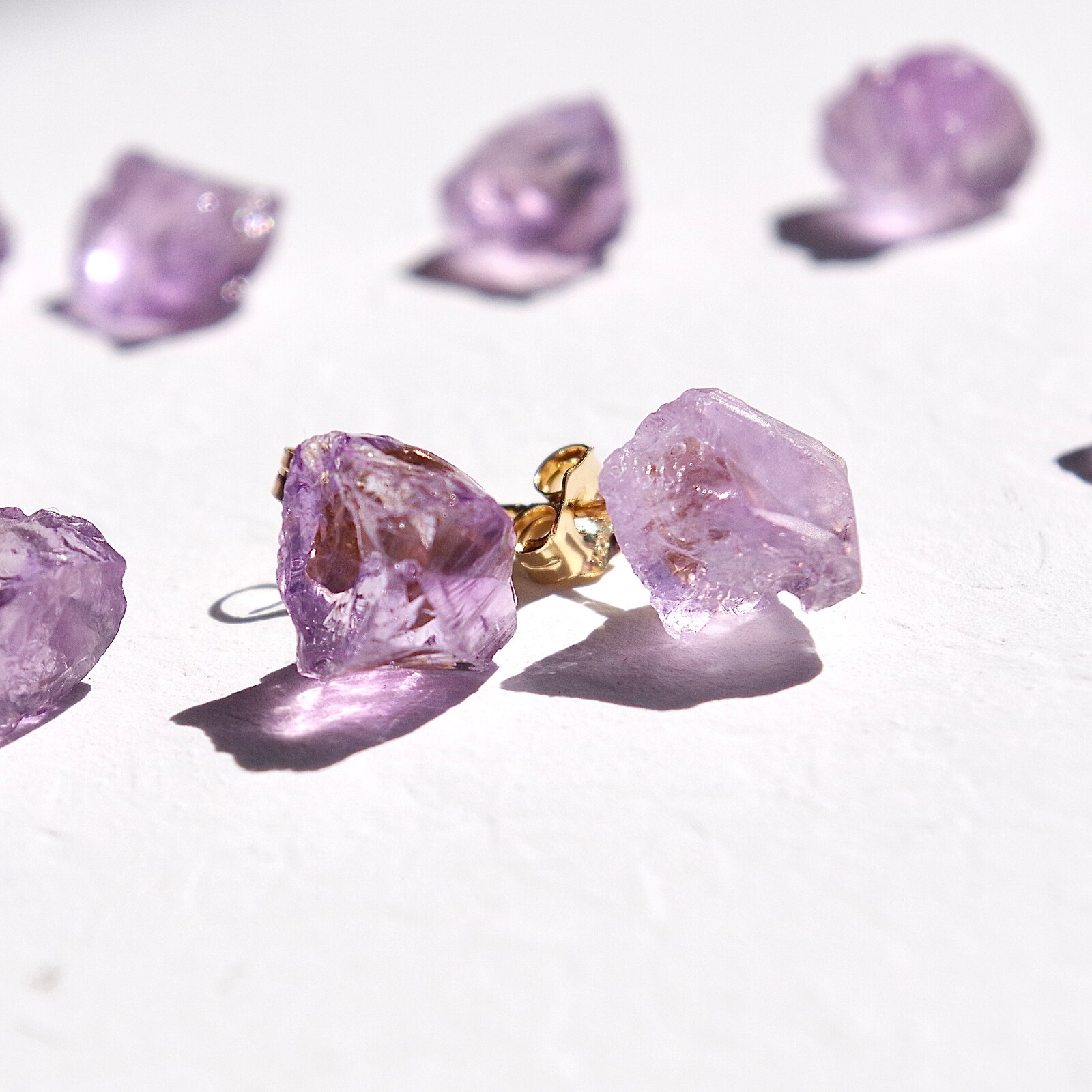
Within geodes born of an ancient shallow sea dried in the Late Cretaceous.
Pink Amethyst’s one major source is the El Choique mine in Pehuenches Department, Neuquén Province, in the Patagonia region of Argentina. Effectively all commercial natural pink amethyst comes from here. The host geology is most distinctive: Late Cretaceous evaporite (about 100–66 million years old) — beds of salt rock such as anhydrite and gypsum, deposited as an ancient shallow sea dried — with geodes developed within. This stands in contrast to the amethyst of Brazil and Uruguay, which occurs in geodes of basalt origin (ancient volcanism) — the same quartz color variety, yet a wholly different geological history, “volcanic rock vs evaporite”, behind the difference between purple and pale pink. In the low-temperature, low-pressure setting of evaporite, as silica dissolved in groundwater crystallized over long ages, fine hematite was stably taken in — that pink amethyst is found “only in the Patagonia region of Argentina” is the accident of such a special geology. The El Choique mine, on private land and not open to the public with limited output, makes pink amethyst a scarce presence even in today’s specimen market.
◆ Choosing raw pink amethyst jewelry
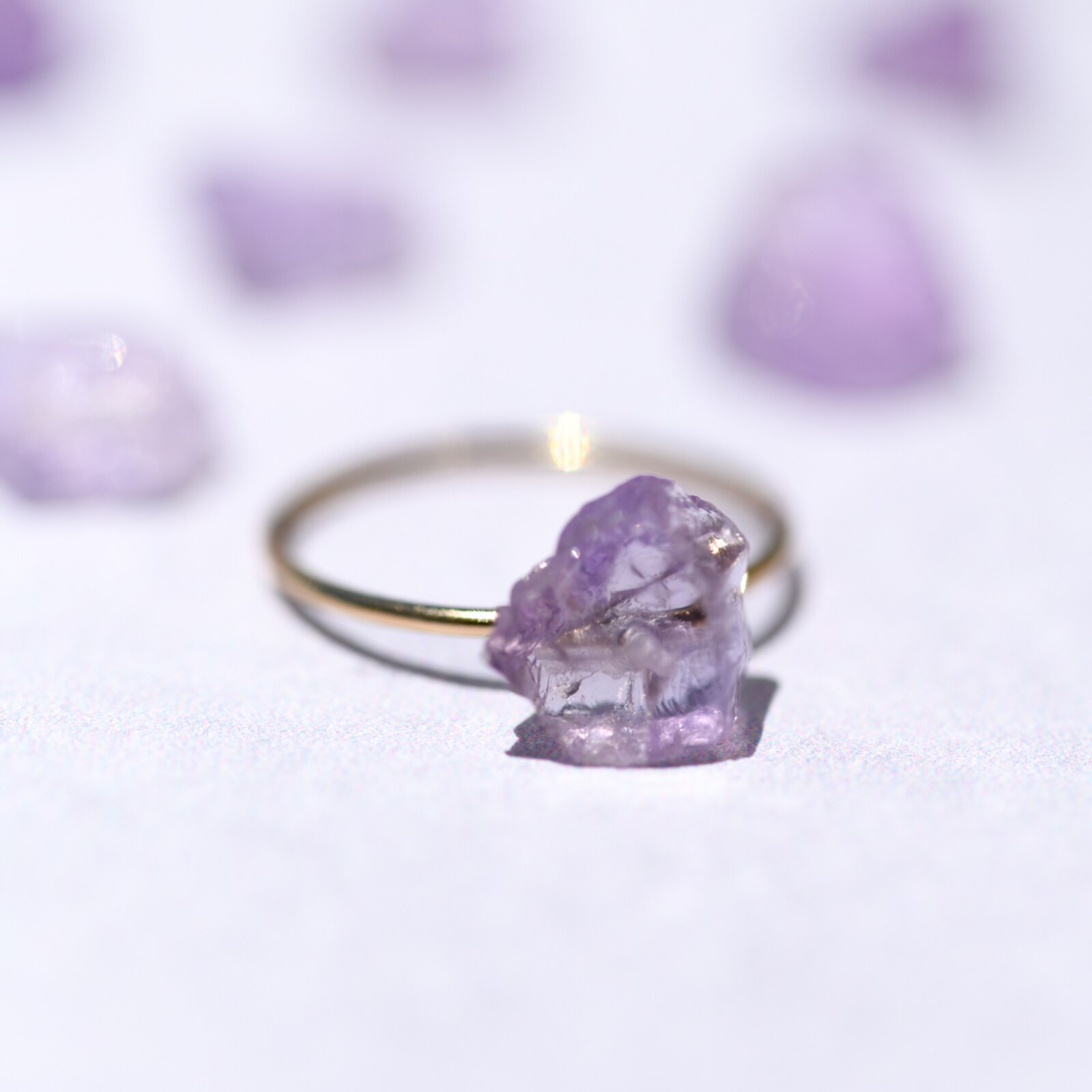
The transparency of the crystalline form, the pale-pink hue, the delicacy of the iron color center.
The pleasure of choosing raw pink amethyst jewelry is the balance of crystal-face transparency and pale-pink hue. The small-to-medium crystals clustered in geodes have a brilliance and translucency of crystal faces that massive rose quartz lacks, and held to the light the pale pink glows softly — a character all its own. The depth of color varies greatly from specimen to specimen, from salmon pink to a very faint, near-colorless pink, the geochemical conditions of growth written straight into the hue. Compared with the whole quartz iron-color group (amethyst, citrine, ametrine), you can enjoy the distinctive place of pale pink.
TROZO sets pink amethyst with its natural crystal faces and pale-pink hue intact. As a quartz-family stone it is hard at Mohs 7, with ample durability for everyday wear, but its iron-color-center color can fade under long direct sun, so store it out of direct sun. Strong heat can change it to a citrine-like yellow-orange, so steam and ultrasonic cleaners are best avoided. Cluster specimens may keep salt between the crystals, so keep any salt bath brief and prefer running water; moonlight or a quartz cluster is the recommended cleansing. Dyed quartz and heat-treated amethyst are also sold falsely on the market, so a “Patagonia, Argentina” source note is the clue to natural origin. Wear the pale pink quartz that arrives from the world’s one source, in the raw-mineral jewelry TROZO makes.
◆ Pink Amethyst Raw-Stone Jewelry
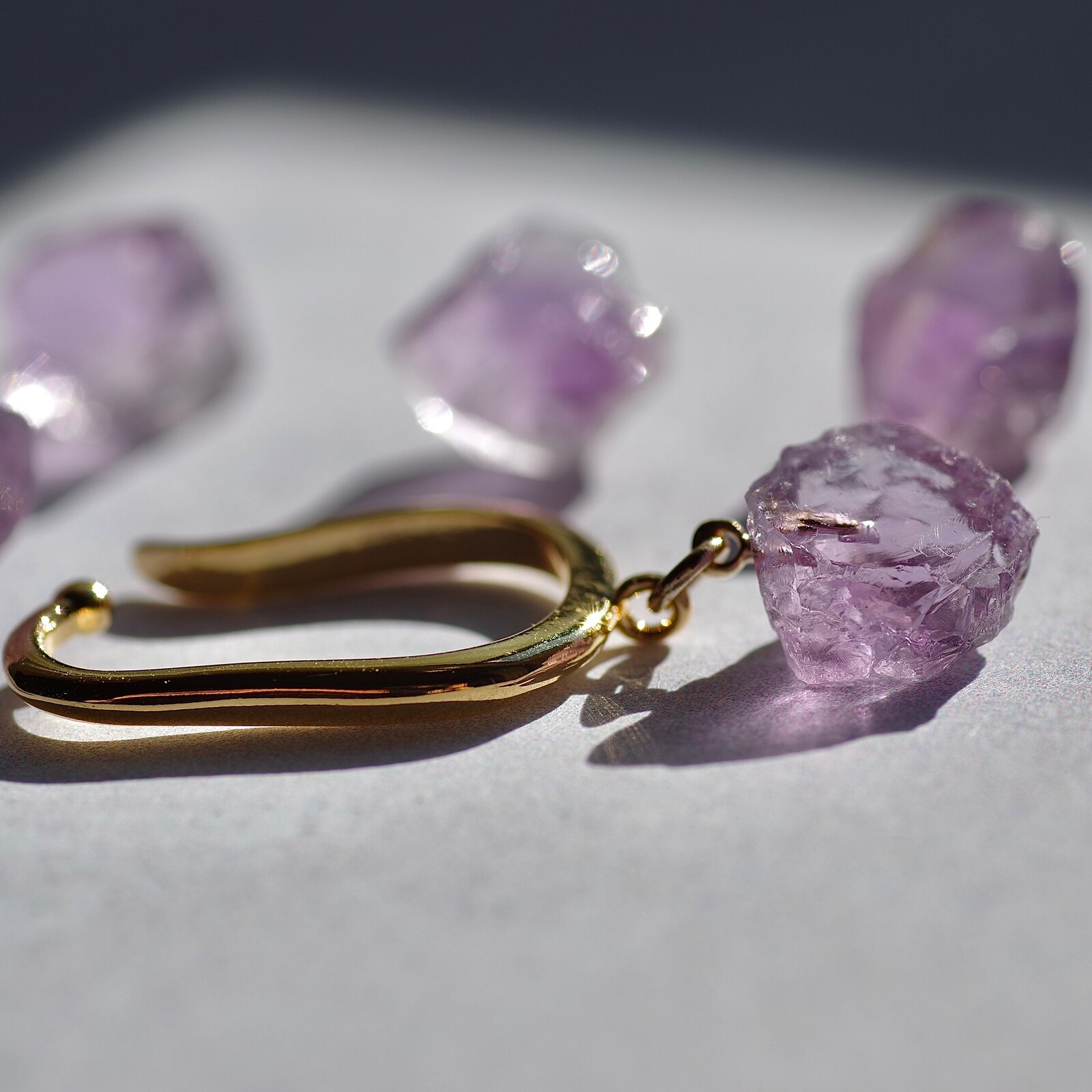
Handmade raw stone & mineral pieces — TROZO
◆ Frequently Asked Questions about Pink Amethyst
Q What does pink amethyst symbolize?
Pink Amethyst is traditionally associated with gentle love, self-love, healing, inner peace, emotional cleansing, activation of the heart chakra, delicacy and compassion. From its pale pink and its place as an offshoot of amethyst, it is cherished today as a “stone of gentleness and self-acceptance”.
Q Is pink amethyst a birthstone?
Pink Amethyst is not a designated birthstone in Japan, nor a designated anniversary stone. It is sometimes presented as an offshoot of February’s birthstone amethyst, but it has no independent birthstone designation. In Japan it is chosen as non-birthstone mineral jewelry by those drawn to its pale pink and the rarity of Patagonian material.
Q What is the difference between pink amethyst and rose quartz?
Both are pink quartz color varieties, but they differ decisively in coloring mechanism and occurrence. Pink Amethyst is colored by trace iron Fe³⁺ + a radiation color center + fine hematite α-Fe₂O₃ inclusions (per Caltech analysis), and is crystalline (geode clusters, with visible faces). Rose quartz is a massive mineral (almost no visible faces) colored by light scattering from fine fibrous, dumortierite-like inclusions (Ti+Fe). Pink amethyst is more transparent than rose quartz; in source, pink amethyst is limited to Patagonia, Argentina, while rose quartz is found widely (Brazil, Madagascar and more). Pink amethyst also tends to be rarer and pricier.
Q Why is it found only in Patagonia, Argentina?
Pink Amethyst is limited to its one major source, the El Choique mine in Neuquén, in the Patagonia region of Argentina, because the host geology is so special. The host is Late Cretaceous evaporite (about 100–66 million years old) — beds of salt rock such as anhydrite and gypsum from an ancient dried shallow sea — within whose geodes quartz crystallized in a special low-temperature, low-radiation setting with fine hematite, giving pink amethyst. It is a geological background unlike amethyst’s basalt-origin (volcanic) geodes; because this special geology is not reproduced elsewhere, the El Choique mine is effectively a monopoly at commercial volumes.
Q How does pink amethyst differ from amethyst (purple quartz)?
Both are quartz-family color varieties of SiO₂, trigonal, Mohs 7, and in both the lead of color is a color center of iron Fe³⁺ under natural radiation. The difference is the depth of color and pink amethyst’s peculiar added effect of fine hematite α-Fe₂O₃ inclusions. The same iron-based coloring gives amethyst a deep purple (strong radiation, the right temperature, no inclusions) and pink amethyst a pale pink (a low-temperature, low-radiation evaporite setting with fine hematite). Some in the mineralogical community hold that “true amethyst = purple”, so pink amethyst is, strictly, not “amethyst” but “a pale pink variety of iron-color-center quartz with fine hematite inclusions”.
Q When was pink amethyst discovered?
Pink Amethyst is a relatively new mineral variety, found and brought to market in the late 2010s (around 2017–2018) at the El Choique mine in Neuquén, in the Patagonia region of Argentina. At first treated as “a new source of rose quartz”, analysis at Caltech and elsewhere confirmed its distinctive coloring from fine hematite α-Fe₂O₃ inclusions, and the trade name “Pink Amethyst” took hold. As a variety less than ten years old it has no traditional lore, and is spreading fast in today’s collector and crystal markets.
Q What care does pink amethyst need?
As a quartz-family stone, pink amethyst is hard at Mohs 7, with ample durability for everyday wear. But its iron-color-center color can fade under long direct sun, so store it out of direct sun. Strong heat can change it to a citrine-like yellow-orange, so steam cleaners and sudden temperature changes are best avoided. For cluster specimens, salt may remain between the crystals, so keep any salt bath brief and prefer running water; moonlight or a quartz cluster is recommended for cleansing, and a long sunbath is best avoided for the risk of fading.
Q What kinds of jewelry can pink amethyst become?
As natural-stone jewelry, pink amethyst is used for raw-stone earrings, necklaces, rings, brooches and ear cuffs. As a quartz-family stone at Mohs 7 it is hard and easy to handle as jewelry. TROZO makes pink amethyst jewelry that keeps the raw stone unpolished so its crystal faces and pale-pink hue lead the design — both pieces you can choose by color and the look of the crystal cluster from stock, and pieces where the meeting with the stone is left to chance.
EXPLORE THE SHOP
Explore the world of Pink Amethyst
Discover more pieces than we can show here at the TROZO shop.
Shop Pink Amethyst