
Rose Quartz
The pink dedicated to Aphrodite — a generous stone, symbol of love and beauty.
Rose Quartz is the pink variety of quartz (SiO₂, trigonal, Mohs 7). Its soft pink is thought to involve trace titanium, manganese and iron — a coloring still not fully explained even today. Carried as a symbol of love and beauty since ancient Assyria and dedicated to the goddess Aphrodite, it is one of the most anciently loved of all raw stones and minerals.
◆ Rose Quartz — Stone Meanings
- True love
- True beauty
- A declaration of love
- Beauty and health
- Gentleness
- Healing
- Well-being
- Serenity
◆ About Rose Quartz
Rose Quartz is the pink variety of quartz. Its formula is SiO₂ (silicon dioxide) and, like quartz, it is a Mohs 7 mineral of the trigonal system. Only the color differs — trace titanium, manganese and iron, or a combination of ultra-fine inclusions, give the soft pink. The full coloring mechanism is still not completely explained, which is part of the stone’s depth.
Rose quartz beads have been excavated from sites of ancient Assyria (around 800–600 BC), making it one of the stones humankind has known longest. Used as an amulet and in jewelry in ancient Rome, Egypt and Greece, it endures worldwide as a symbol of love and beauty, dedicated to the goddess Aphrodite.
Its associations include true love, true beauty, gentleness and healing. The soft pink and the reassuring quality it gives the viewer make it a classic choice for a gift.
Because titanium hinders crystal growth, rose quartz is rarely found as a well-formed crystal and usually occurs as massive raw stone. That is exactly why the variation of a raw piece — gradations of clarity, the landscape of fine inclusions, the depth of color — gives each one a face all its own.
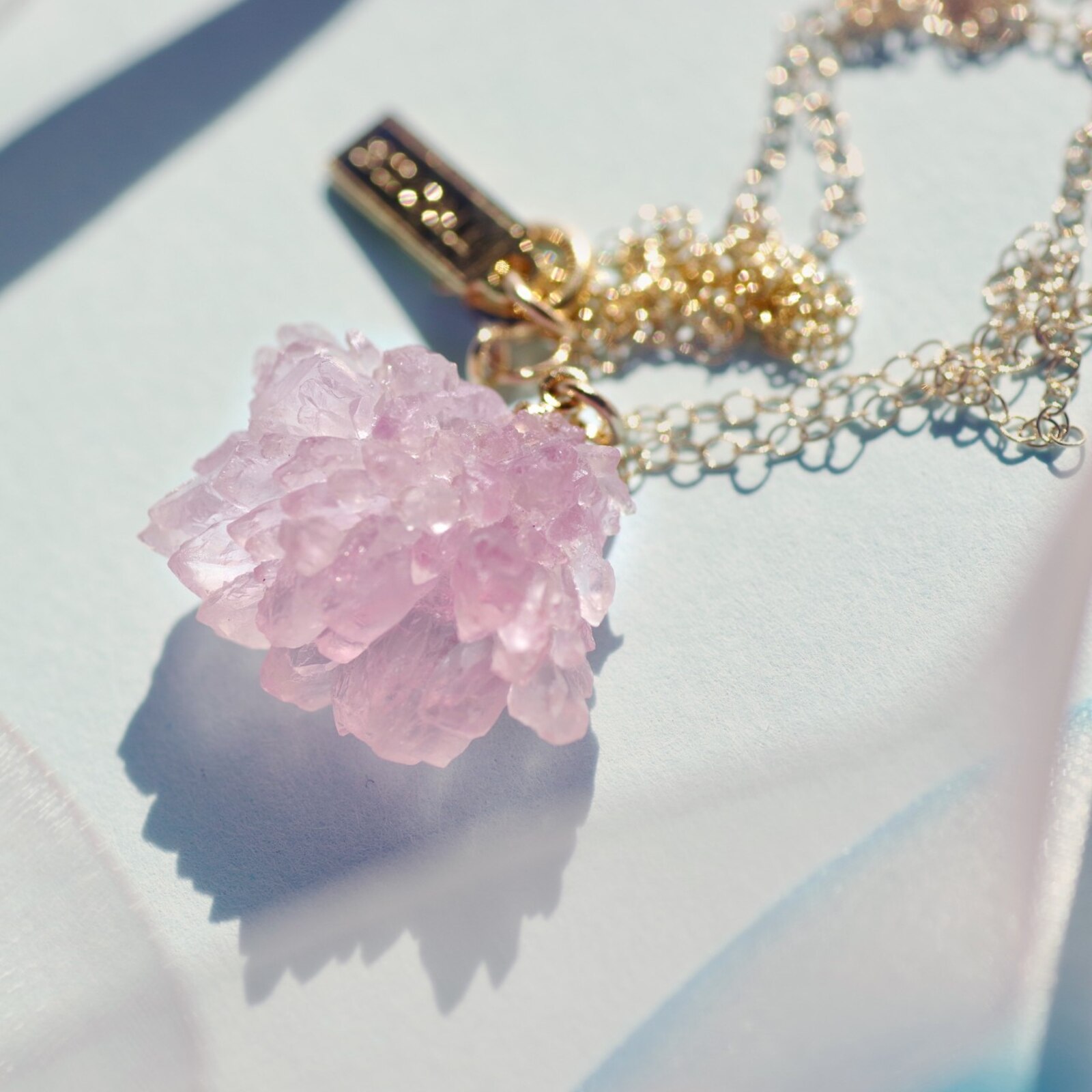
◆ Mineral Data
- English name
- Rose Quartz
- Chemical formula
- SiO₂ (silicon dioxide — the pink variety of quartz)
- Mineral class
- Silicate mineral
- Crystal system
- Trigonal (well-formed crystals rare; usually massive)
- Mohs hardness
- 7
- Specific gravity
- 2.65
- Main sources
- Brazil (Minas Gerais), Madagascar, USA (Maine, California), Sweden, Namibia and others
- Color range
- Pale lilac-pink to deep rose-pink; some stones with needle-like rutile show a star effect (asterism)
- Notable trait
- The pink is variously attributed to trace titanium, manganese and iron or to ultra-fine inclusions and is not fully explained; photosensitive and can fade under UV
◆ Aphrodite’s stone — a symbol of love and beauty since Assyria
A natural stone humankind has known since 800 BC.
Rose quartz has been excavated as beads from sites of ancient Assyria, around 800–600 BC — a stone of great antiquity. It served as an amulet and in jewelry in ancient Rome, Egypt and Greece, and in Egypt it was even believed to hold the power to keep age at bay. In Greek myth it is the stone dedicated to Aphrodite, goddess of love and beauty — bound up with legends that the gods created the rose to honor her beauty — and it endures around the world as a symbol of love and beauty to this day.
◆ The secret of the pink — a coloring still debated
Trace elements, or ultra-fine inclusions?
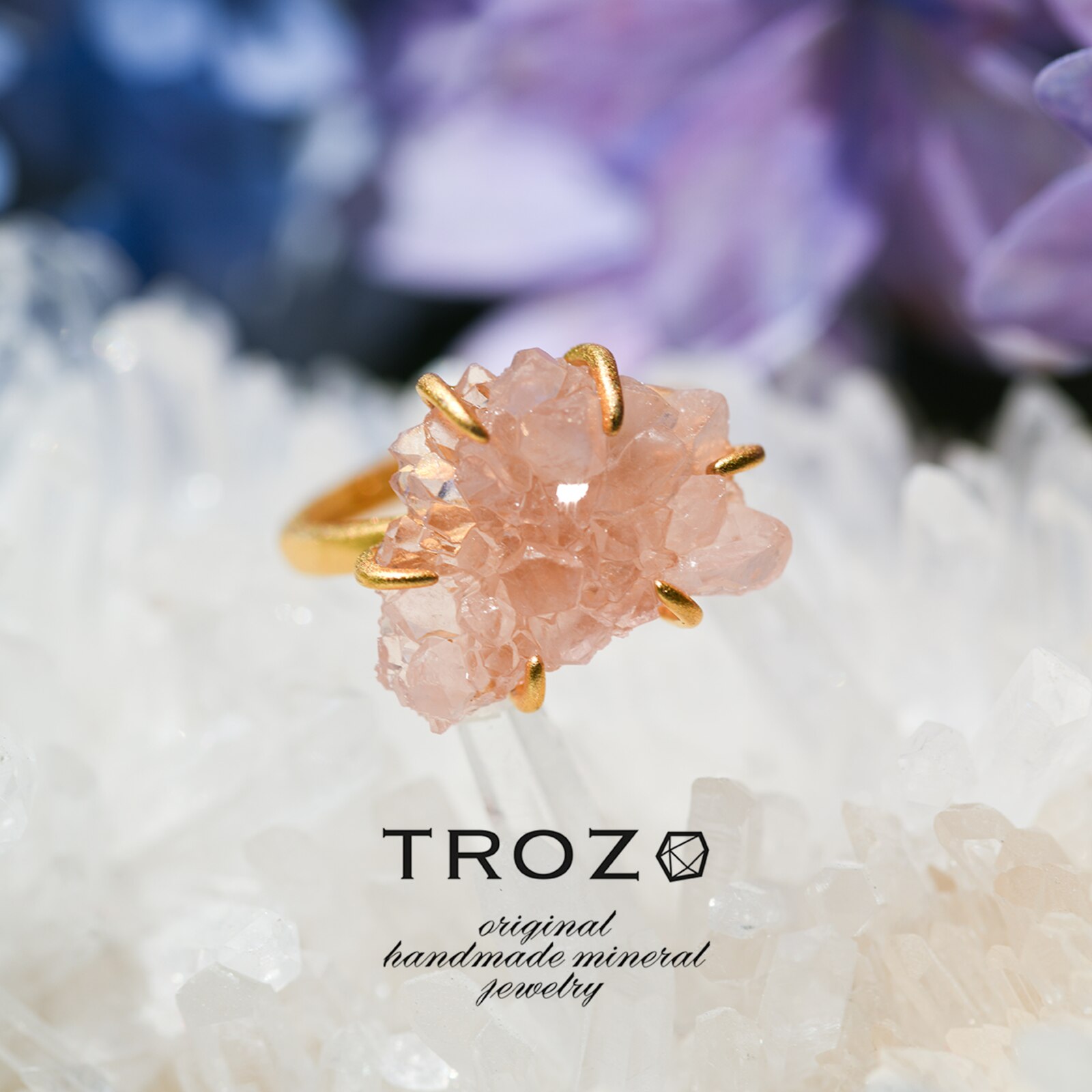
Rose quartz’s soft pink is explained by several theories — trace titanium, manganese and iron, or ultra-fine needle-like inclusions (such as dumortierite) scattering the light — and it is not fully resolved even today. Because titanium hinders the growth of the quartz crystal, rose quartz is rarely found as a clear, well-formed crystal and usually occurs as massive raw stone. Some pieces carry needle-like rutile inclusions and, at a certain angle, show a star effect (asterism).
◆ Choosing raw rose quartz jewelry
Choose by depth of pink, clarity and the landscape of the inclusions.
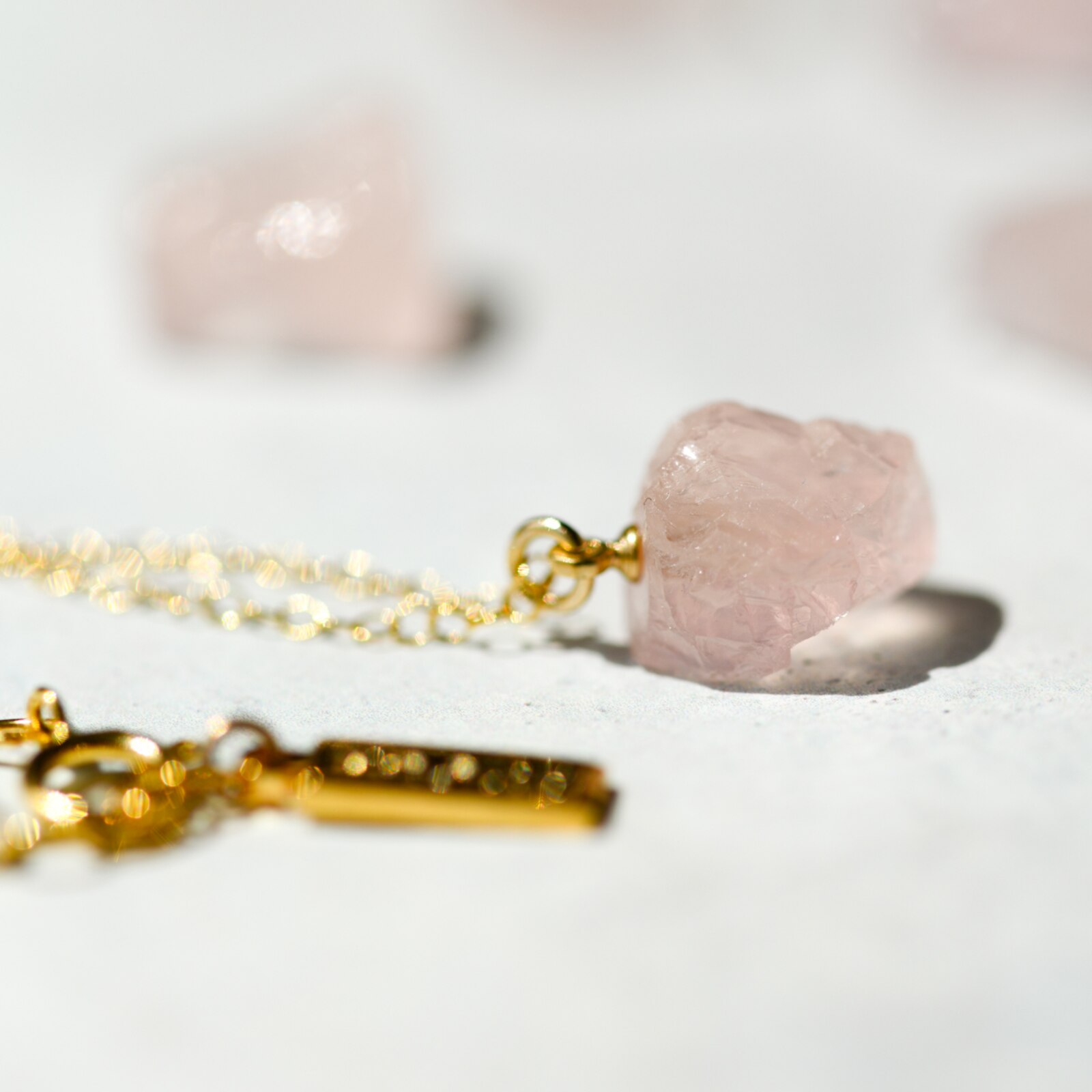
At Mohs 7 rose quartz is hard, with ample strength for everyday wear. The character of a raw stone turns on the gradation of color from pale lilac-pink to deep rose-pink, its clarity, the landscape of its inclusions and its massive form. Deeper colors carry more presence and read a touch formal, while paler tones sit gently against the skin for everyday wear. As a rough guide, 10–15 mm suits a ring and 20–40 mm a necklace or brooch.
TROZO sets rose quartz without polishing away its character, letting the natural pink landscape and inclusions lead the design. We offer pieces for those who would like to choose depth of color and size from stock, as well as pieces where the meeting with the stone is left to chance. One note: rose quartz can fade under prolonged ultraviolet light, so storing it out of long spells of direct sun keeps its beauty longer.
◆ Rose Quartz Raw-Stone Jewelry
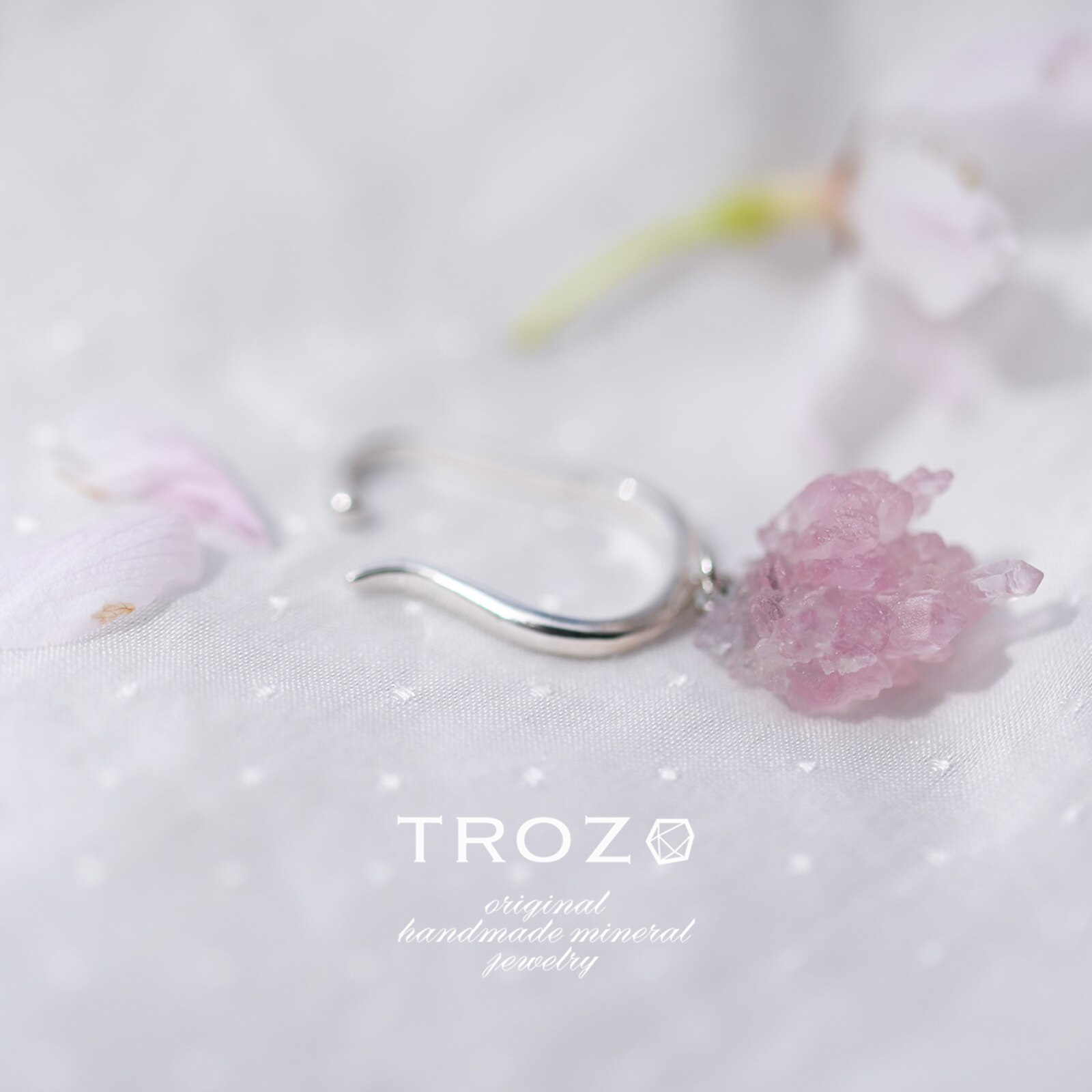
Handmade raw stone & mineral pieces — TROZO
◆ Frequently Asked Questions about Rose Quartz
Q What does rose quartz symbolize?
Rose quartz is traditionally associated with true love, true beauty, a declaration of love, beauty and health, gentleness and healing. Dedicated to the goddess Aphrodite as the “stone of love and beauty” in ancient Greece, it is widely cherished as a gift in natural-stone jewelry.
Q What is the difference between rose quartz and quartz?
Rose quartz is the pink variety of quartz. As a mineral it is the same SiO₂ (silicon dioxide), sharing Mohs 7, the trigonal system and a specific gravity of 2.65. Only the color differs — the pink is attributed to trace titanium, manganese and iron or to ultra-fine inclusions, though it is not fully explained.
Q How hard is rose quartz?
Its Mohs hardness is 7, which is hard for a natural stone or mineral. It has ample strength for everyday jewelry, though it can chip if rubbed against still-harder stones such as diamond or struck sharply.
Q Why is rose quartz rarely found as a six-sided crystal?
Titanium within the crystal hinders bonding, so rose quartz is seldom found as a well-formed crystal and usually occurs as massive raw stone. Some pieces hold needle-like rutile inclusions and can show a star effect (asterism) when cut as a cabochon.
Q What kinds of jewelry can rose quartz become?
As natural-stone jewelry, rose quartz is used for raw-stone earrings, necklaces, rings, brooches and ear cuffs. TROZO makes rose quartz jewelry that keeps the raw stone unpolished so its pink landscape and inclusions lead the design — both pieces you can choose by depth of color and size from stock, and pieces where the meeting with the stone is left to chance.
Q Where does rose quartz come from?
Brazil (Minas Gerais) supplies most of the market, with further material from Madagascar, the USA (Maine, California), Sweden and Namibia. The first crystalline rose quartz is said to have been found in pegmatite deposits in Maine, USA.
Q How should I look after rose quartz?
Rose quartz can lose color (fade) with prolonged ultraviolet exposure, so storing it out of long spells of direct sunlight keeps its beauty longer. It can be rinsed with water, but avoid sudden temperature changes (hot or ice-cold water); wipe gently with a soft cloth to clean.
EXPLORE THE SHOP
Explore the world of Rose Quartz
Discover more pieces than we can show here at the TROZO shop.
Shop Rose Quartz