
Morganite
The pink flower of the beryl family, named for J.P. Morgan — an April birthstone.
Morganite is the pink variety of beryl, the same family as emerald and aquamarine (Be₃Al₂Si₆O₁₈, hexagonal, Mohs 7.5–8). Trace manganese gives gentle tones from baby pink to salmon, apricot and lavender pink. Discovered off Madagascar in 1910, it was named by the Tiffany gemologist George F. Kunz for the American banker and gem collector J.P. Morgan. It is a modern April birthstone.
Morganite is the April birthstone. See all April birthstones →
◆ Morganite — Stone Meanings
- Love
- Gentleness
- Compassion
- Healing
- Calm of mind
- Confidence
- Freedom
- Purity
◆ About Morganite
Morganite is the pink variety of beryl, the same family as emerald, aquamarine, heliodor and goshenite. Its formula is Be₃Al₂Si₆O₁₈; it is hexagonal, Mohs 7.5–8, with a specific gravity of 2.80–2.91. Trace manganese (Mn) gives its gentle tones, from baby pink through peach and salmon to apricot and lavender pink.
Morganite was discovered in 1910 off Madagascar (and the same year near San Diego, California). George F. Kunz, chief gemologist of Tiffany & Co. at the time, named it “morganite” in 1911 for the American banker and gem-and-mineral collector J.P. Morgan (founder of the J.P. Morgan bank), whose collection was donated to the American Museum of Natural History — a rare gem to bear a banker’s name. In English it is also called “rose beryl” or “pink beryl”, and in Russian “vorobievite”.
Morganite’s tones range widely — from the palest baby pink through salmon-toned peach and apricot pink touched with orange to a deep lavender pink — shifting with manganese content and the conditions of crystal growth. Its pastel pink is called a “pink of spring”, a gentle character alongside emerald’s strong green and aquamarine’s clear blue. The hexagonal crystal faces, the landscape of inclusions and the glassy luster of beryl give raw morganite its richness when set as jewelry.
Morganite is loved today as a modern April birthstone, the pink of spring. (In Japan it was formally added, alongside coral, as an April birthstone in the gemstone-association revision of 2021, joining the main April stones, diamond and quartz.) Its gentle pink and spring feeling have made it increasingly popular in recent years.
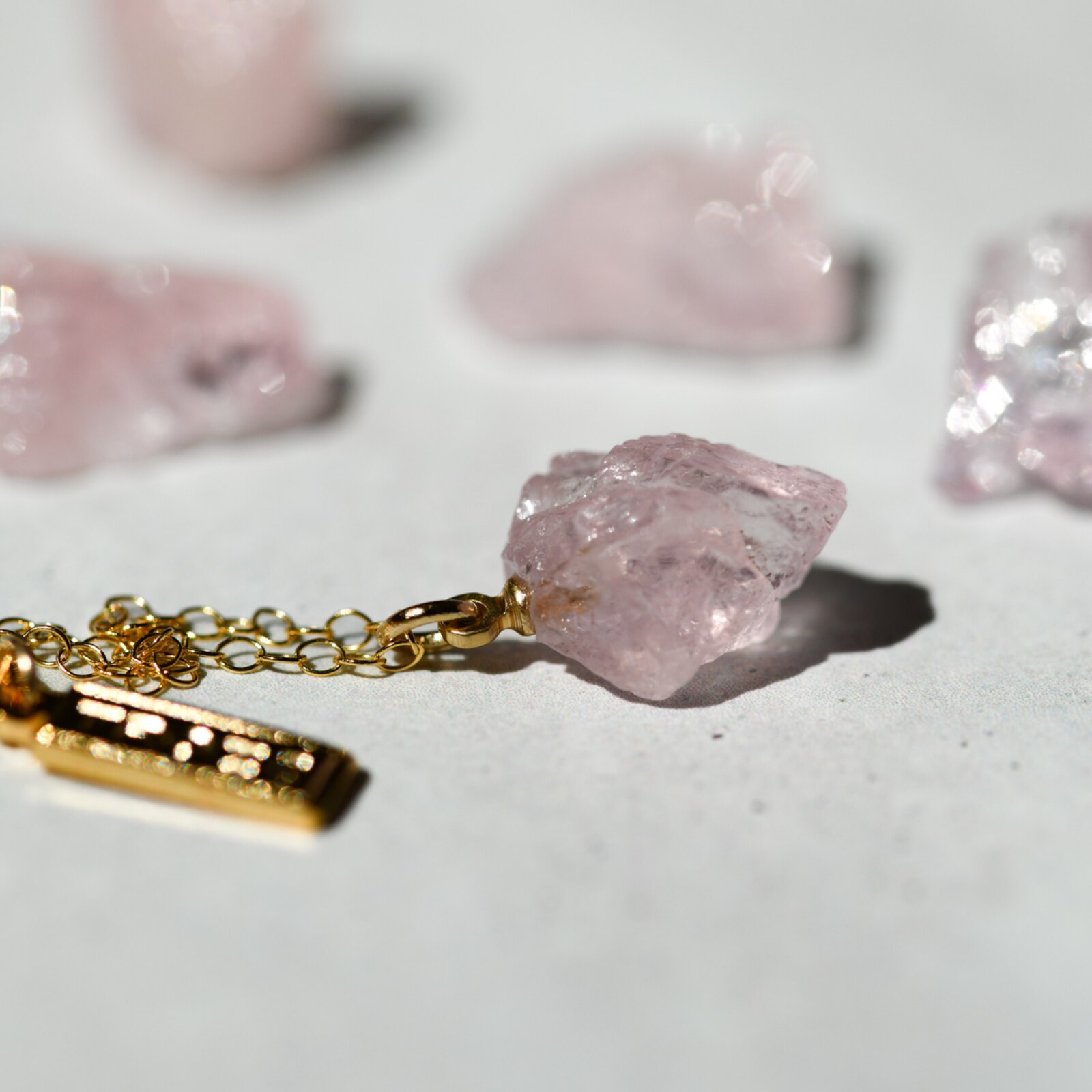
◆ Mineral Data
- English name
- Morganite (= pink beryl / rose beryl / vorobievite)
- Chemical formula
- Be₃Al₂Si₆O₁₈ (trace manganese gives the pink)
- Mineral class
- Beryl family — the same family as emerald, aquamarine, heliodor and goshenite
- Crystal system
- Hexagonal
- Mohs hardness
- 7.5 – 8
- Specific gravity
- 2.80 – 2.91
- Main sources
- Brazil (largest source, Minas Gerais), Madagascar (discovery site), Afghanistan, Namibia, Mozambique, Russia, USA (California, Maine), Pakistan
- Color range
- Baby pink, salmon pink, apricot pink, pastel pink, lavender pink; the tone shifts with manganese content
- Notable trait
- The pink variety of beryl. Discovered off Madagascar in 1910 and named by Tiffany’s G.F. Kunz for J.P. Morgan in 1911. A modern April birthstone
- Birthstone
- April (modern addition; the main April stones are diamond and quartz, with coral)
◆ The pink flower of the beryl family — kin to emerald and aquamarine
One mineral family, gems of different colors.
Morganite is a member of the same beryl family as emerald (green), aquamarine (blue), heliodor (yellow) and goshenite (colorless) — its pink variety. Against the shared formula Be₃Al₂Si₆O₁₈, the trace element decides the color: chromium and vanadium for emerald’s green, iron for aquamarine’s blue, and manganese (Mn) for morganite’s gentle tones from pale pink through peach and salmon to lavender pink. It is hexagonal, Mohs 7.5–8, with a specific gravity of 2.80–2.91 — ample hardness and toughness for jewelry.
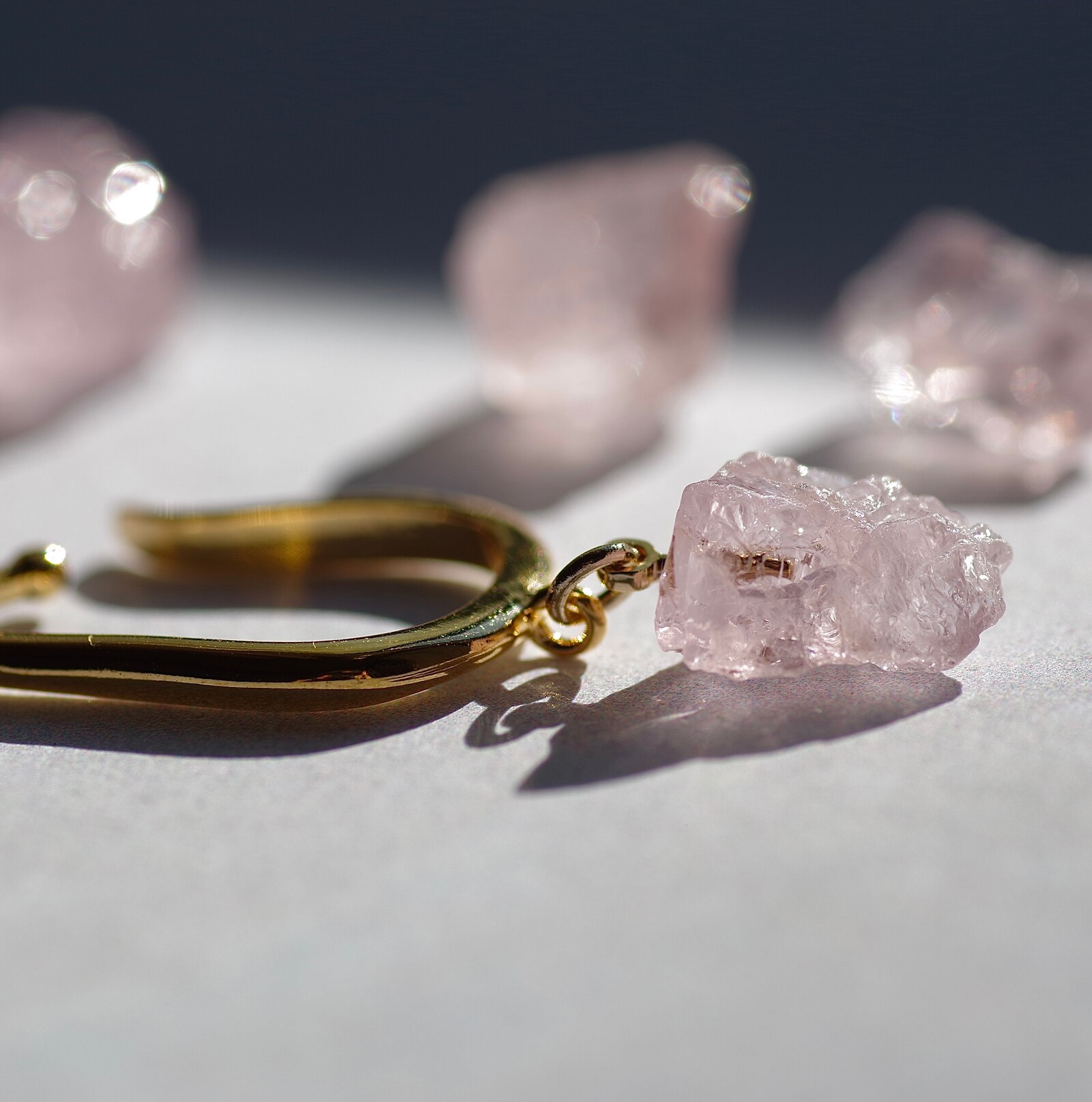
◆ A gem named for J.P. Morgan — Madagascar, 1910
A new gem from a tie between a banking magnate and Tiffany.
Morganite was discovered in 1910 off Madagascar, with material confirmed the same year near San Diego, California. George F. Kunz, chief gemologist of Tiffany & Co., named it “morganite” in 1911 in honor of the American banker and gem-and-mineral collector J.P. Morgan (founder of the J.P. Morgan bank), whose collection was donated to the American Museum of Natural History. Known as a rare gem bearing a banking magnate’s name, it is also called “rose beryl” or “pink beryl” in English and “vorobievite” in Russian.
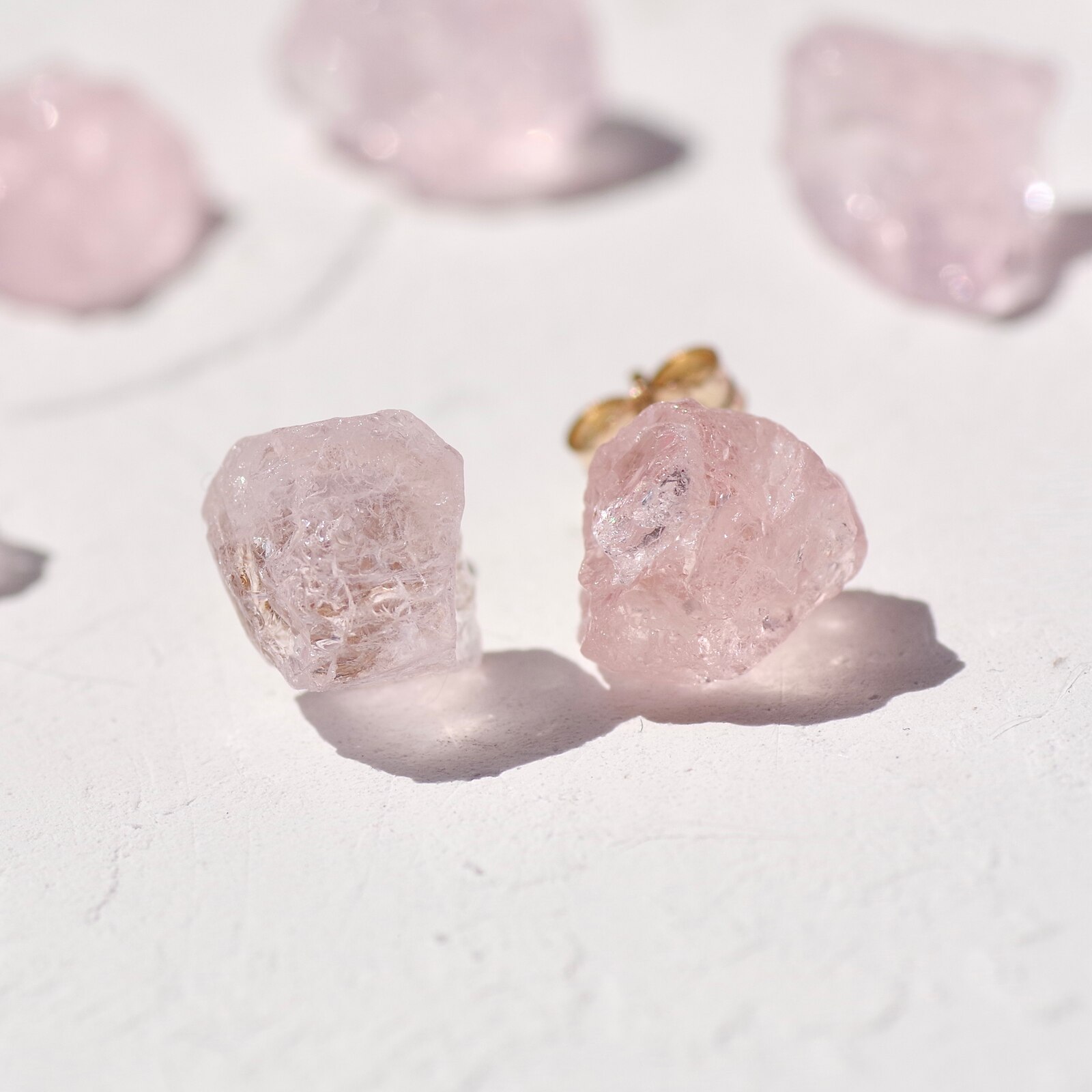
◆ A modern April birthstone
The pink of spring, in its place among today’s birthstones.
Morganite is loved today as a modern April birthstone, the pink of spring. (In Japan it was formally added, alongside coral, as an April birthstone in the gemstone-association revision of 2021, joining the main April stones, diamond and quartz — a month of wide choice.)
TROZO sets morganite with its natural color and hexagonal crystal form intact. Within the soft pinks — baby pink for some, salmon pink for others, deep lavender pink for others still — the way “the tone shifts with manganese content” becomes the character of each raw stone. As a gift for those born in April, or as everyday jewelry for anyone who would like to wear a gentle pink, we offer raw morganite rich in expression.
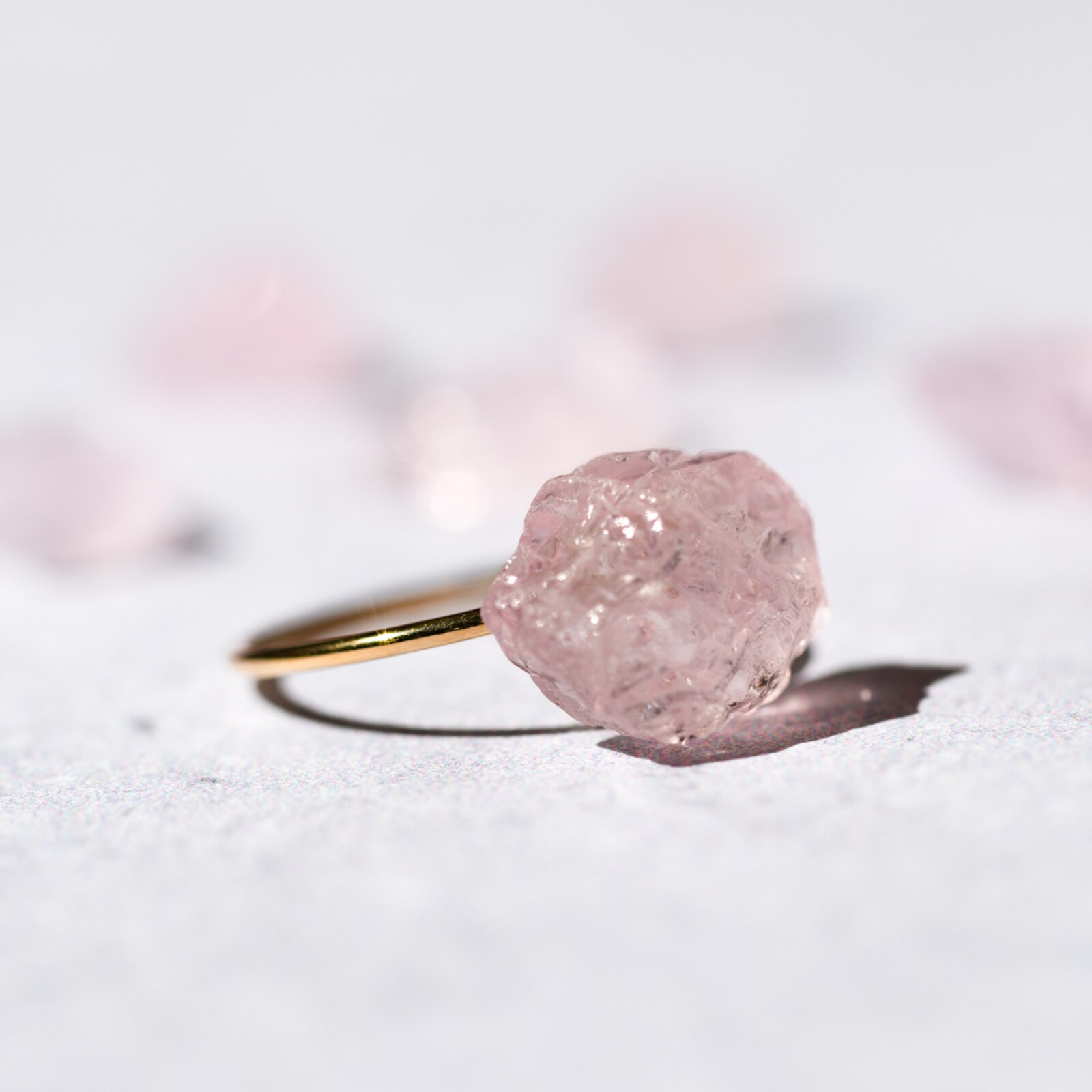
◆ Morganite Raw-Stone Jewelry
Handmade raw stone & mineral pieces — TROZO
◆ Frequently Asked Questions about Morganite
Q What does morganite symbolize?
Morganite is traditionally associated with love, gentleness, compassion, healing, calm of mind, confidence, freedom and purity. Its soft pink tones have made it a symbol of feminine love and healing.
Q What month’s birthstone is morganite?
It is a modern April birthstone. (In Japan it was formally added, alongside coral, as an April birthstone in the gemstone-association revision of 2021, joining the main April stones, diamond and quartz.)
Q How hard is morganite?
Its Mohs hardness is 7.5–8, hard among natural stones. As a member of the beryl family (with emerald and aquamarine), it has ample hardness and toughness for jewelry and everyday wear.
Q Where does the name morganite come from?
For the pink beryl discovered off Madagascar in 1910, the Tiffany & Co. chief gemologist George F. Kunz coined the name “morganite” in 1911 in honor of the American banker and gem-and-mineral collector J.P. Morgan (founder of the J.P. Morgan bank). Morgan’s gem and mineral collection was donated to the American Museum of Natural History.
Q How is morganite related to aquamarine and emerald?
All are varieties of the same beryl family. They share the formula Be₃Al₂Si₆O₁₈ and differ by trace element: manganese (Mn) gives pink → morganite, iron (Fe) gives blue → aquamarine, chromium and vanadium give green → emerald. Iron can also give yellow → heliodor, and colorless is goshenite — the beryl family is rich in color.
Q What colors does morganite come in?
From the palest baby pink through salmon-toned peach and apricot pink touched with orange to a deep lavender pink. The tone shifts with manganese (Mn) content and the conditions of crystal growth, giving each raw stone its own character.
Q Where does morganite come from?
Brazil (the largest source, Minas Gerais), Madagascar (the discovery site), Afghanistan, Namibia, Mozambique, Russia, the USA (California, Maine) and Pakistan, among others.
EXPLORE THE SHOP
Explore the world of Morganite
Discover more pieces than we can show here at the TROZO shop.
Shop Morganite