
Azurite
The same root as lapis lazuli — the blue mineral that colored medieval European painting.
Azurite is a hydrated copper carbonate, Cu₃(CO₃)₂(OH)₂, monoclinic, Mohs 3.5–4. A deep azure-to-ultramarine mineral, its name comes (via Old French *azur* and Arabic *lāzaward*, “sky-blue”) from the same root as lapis lazuli. The sister mineral of malachite, forming in the same oxidized copper zone — a slight difference of composition and CO₂ pressure splits them into blue and green. From the 15th to 17th centuries it was the most important blue pigment in Europe, painted by Giotto, Raphael, Michelangelo and the early Vermeer.
◆ Azurite — Stone Meanings
- Intuition
- Revelation
- Spiritual awakening
- Opening of the third eye
- Seeing the truth
- Inner insight
- Focus
- Creativity
◆ About Azurite
Azurite is a secondary mineral, Cu₃(CO₃)₂(OH)₂ (a hydrated copper carbonate). It is monoclinic (space group P2₁/c), Mohs 3.5–4, SG 3.77–3.89. The deep azure-to-ultramarine comes from the d–d transition of the divalent copper ion (Cu²⁺), with a pale-blue streak. Its name “Azurite” traces from Old French azur (sky-blue) to Arabic lāzaward to Persian lāžaward — the same root as lapis lazuli, a mineral that shares humankind’s very word for “blue”.
Essential to any account of azurite is its sisterhood with malachite (peacock stone). Both are secondary copper carbonates forming in the oxidized zone of copper deposits, their formulas Cu₃(CO₃)₂(OH)₂ and Cu₂(CO₃)(OH)₂ differing only slightly in the copper-to-carbonate ratio. Where the CO₂ pressure of formation is high, azurite (blue) forms; as CO₂ escapes, malachite (green) — the geochemistry of nature making two colors, blue and green, from the same copper deposit. The often-intergrown azurmalachite is popular as a lapidary material, a rare occurrence with blue and green bands in a single specimen.
Azurite was the most important blue pigment in 15th–17th-century European painting. More available than costly ultramarine from lapis lazuli, it accounts for most of the blue in the tempera, fresco and oil paintings of Giotto, Raphael, Michelangelo and the early Vermeer. Chessy-les-Mines near Lyon in France was a famous source, lending it the further name Chessylite. After Prussian blue was synthesized in 1704 it gave way to artificial blues — but for the centuries before, the blue that Europe saw was, quite literally, the blue of azurite.
Azurite’s main sources are Chessy-les-Mines, France (the 19th-century type locality, source of the name Chessylite), Morocco (Touissit, Mibladen — clear, deep-blue single crystals of the world’s finest), Namibia (the Tsumeb mine — large velvety crystals), Arizona in the USA (Bisbee, Morenci), Mexico and Australia (Broken Hill). As a carbonate it is sensitive to acid, ammonia, prolonged water, heat and direct sun, so contact with sweat, vinegar, ammonia-based cleaners and ultrasonic cleaners should be avoided. Azurite is also known to alter to malachite over long periods (decades to centuries) while keeping its crystal shape, turning green — the scientific cause of the blue-to-green change in old paintings (such as Michelangelo’s *Entombment*) and a matter of care in museum conservation.
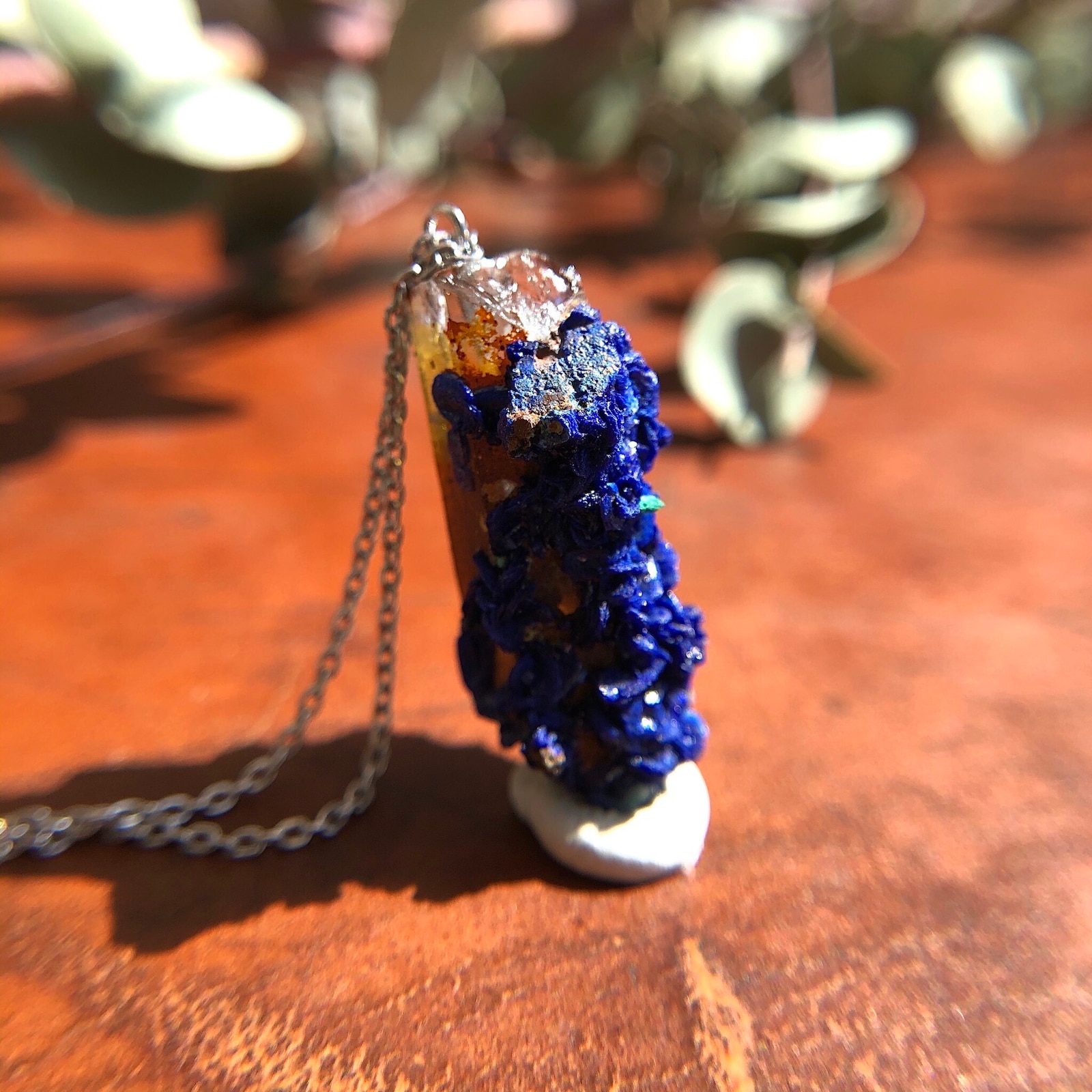
◆ Mineral Data
- English name
- Azurite (from Arabic *lāzaward* / Persian *lāžaward*, “sky-blue”, the same root as lapis lazuli; also Chessylite, for the French source)
- Chemical formula
- Cu₃(CO₃)₂(OH)₂ (hydrated copper carbonate)
- Mineral class
- Carbonate mineral (secondary copper mineral) — sister to malachite Cu₂(CO₃)(OH)₂ (the same copper carbonate, differing only in the Cu:CO₃ ratio)
- Crystal system
- Monoclinic (space group P2₁/c) — prismatic and tabular single crystals; botryoidal, stalactitic and massive aggregates
- Mohs hardness
- 3.5 – 4
- Specific gravity
- 3.77 – 3.89
- Main sources
- France (Chessy-les-Mines — type locality, source of “Chessylite”), Morocco (Touissit, Mibladen — finest clear deep-blue crystals), Namibia (Tsumeb — large velvety crystals), USA (Arizona: Bisbee, Morenci — with malachite), Mexico, Australia (Broken Hill), China, Russia
- Color range
- Deep azure to ultramarine to violet-blue (from the Cu²⁺ d–d transition); pale-blue streak; deep blue in mass, pale in thin flakes or powder
- Notable trait
- Sister mineral of malachite from the same copper deposit (only the Cu:CO₃ ratio splits them into blue and green). The same root as lapis lazuli. The key blue pigment of 15th–17th-century European painting. Famous for pseudomorphous alteration to malachite (greening) over long periods — the cause of the blue-to-green change in old paintings. As a carbonate, sensitive to acid, ammonia, prolonged water, heat and direct sun
- Birthstone
- Not an official Japanese (Zenhokyo) or wedding-anniversary stone. Long favored by mineral collectors, art-history enthusiasts and the healing-stone community
◆ The same root as lapis lazuli — a deep azure drawn by copper
*azur* / *lāzaward* — a mineral that shares the word for “sky-blue”.
The name Azurite traces from Old French azur (sky-blue) to Arabic lāzaward to Persian lāžaward — the very same root as lapis lazuli, a sibling even in language, sharing humankind’s word for “blue” (the English *azure* is of the same root). The color arises from the d–d transition of the divalent copper ion Cu²⁺: with a 3d⁹ configuration, Cu²⁺ undergoes electronic transitions in the crystal field, absorbing orange-to-red light and sending its complement, deep azure, to the eye. That malachite, with the same Cu²⁺, is a different color comes down to the difference in coordination environment (ligand field) — azurite’s structure, richer in carbonate and poorer in hydroxyl, gives Cu²⁺ a different symmetry and ligand-field splitting, shifting the absorption band to yield blue. The smallest difference of composition makes blue and green, two different worlds of color, from the same copper deposit — azurite and malachite are sister minerals that tell the very mechanism of color in geochemistry.
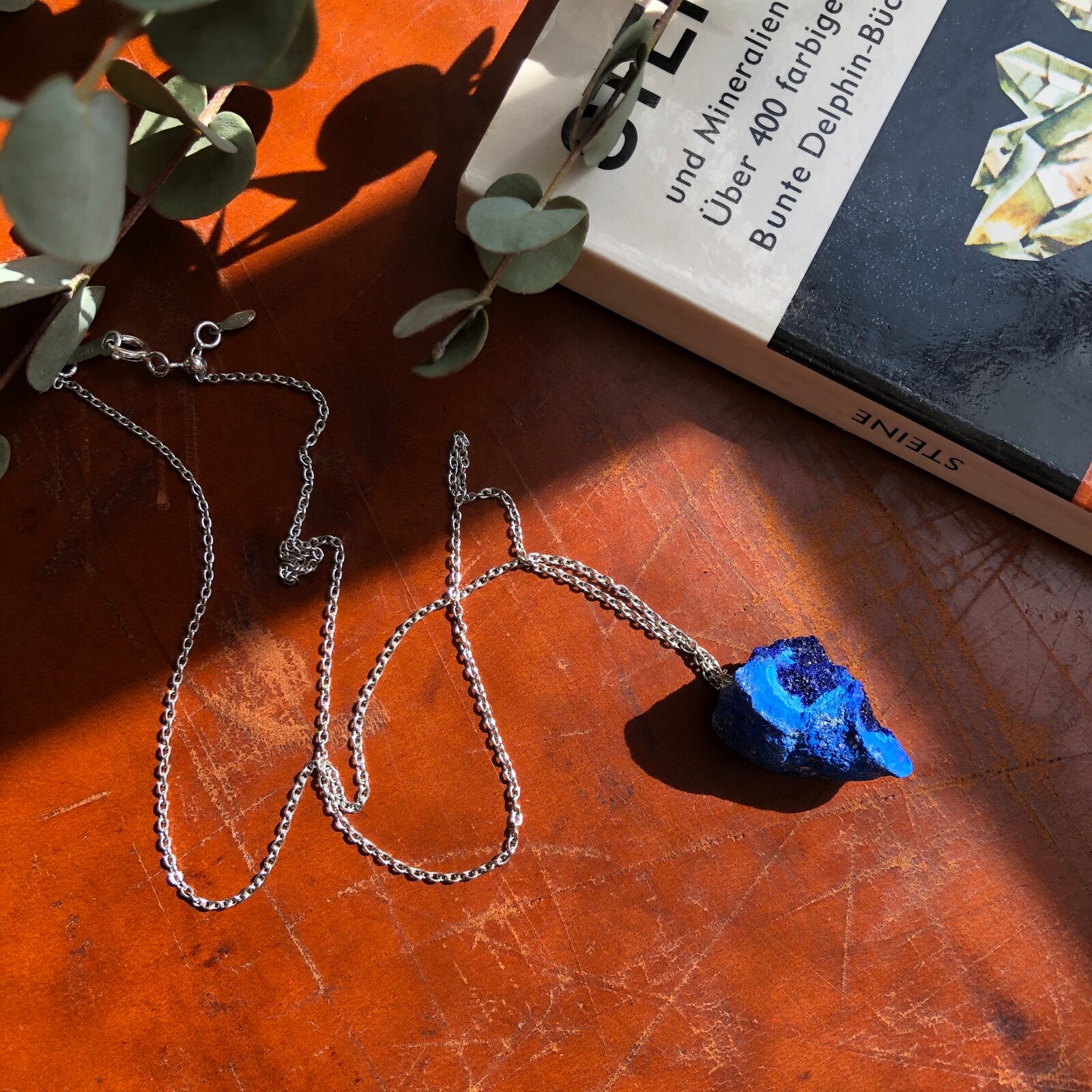
◆ The blue of medieval European painting — the rise and fall of azurite pigment
From Giotto to Vermeer, the blue Europe saw was the blue of azurite.
Azurite was the most used blue pigment in 15th–17th-century European painting. More available and cheaper than ultramarine from lapis lazuli, it accounts for most of the blue in the tempera, fresco and oil paintings of Giotto, Raphael, Michelangelo and the early Vermeer. Chessy-les-Mines near Lyon was so notable a source that the mineral gained the further name Chessylite in the 19th century. Painters even controlled the depth of color by grain size — ground fine for a paler blue, coarse for a deeper one. Yet azurite carries a fate across time: exposed to air and humidity over decades to centuries, it is pseudomorphously replaced by malachite while keeping its crystal shape, the blue turning to green. The blue robe of the Virgin in **Michelangelo’s *Entombment* is now greenish** — not paint decay but azurite replaced at the molecular level by malachite, a phenomenon today told at the border of art history and chemistry. After Prussian blue was synthesized in 1704, azurite gave way to artificial blues — but for the centuries before, the blue that Europe saw was, quite literally, the blue of azurite.
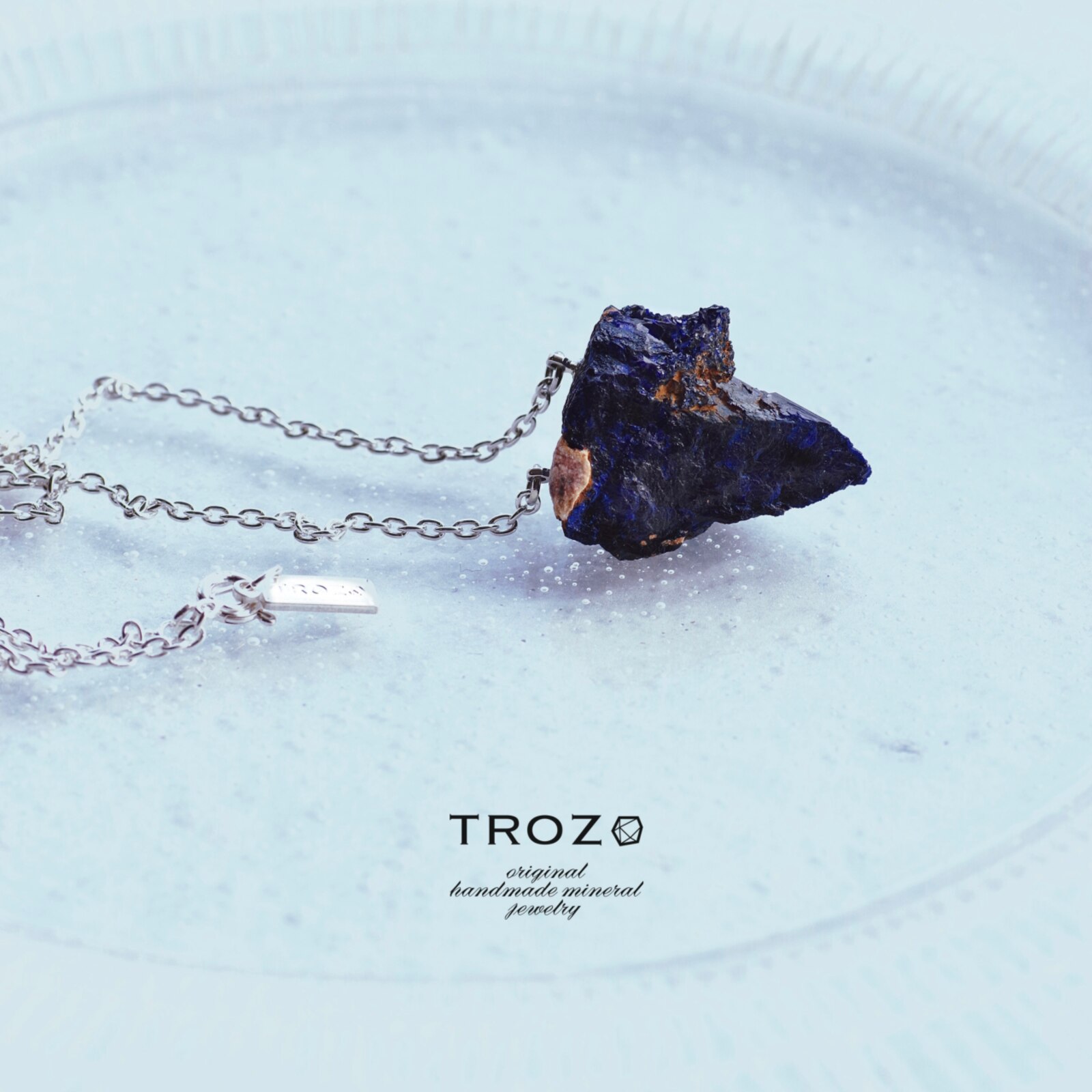
◆ Choosing raw azurite jewelry
Choose knowing the depth of azure, the crystal by source and the care it needs.
The pleasure of choosing raw azurite jewelry is the crystal expression that changes greatly by source. Moroccan (Touissit) material gives clear, deep-blue prismatic single crystals; French (Chessy) material botryoidal and spherical aggregates; Namibian (Tsumeb) material large crystals with a velvety luster; and Arizona (Bisbee) material azurmalachite intergrown with malachite — each source a different face. A two-color specimen intergrown with malachite (green) is the rare choice of enjoying, in a single stone, the contrast of sister minerals born from the same copper deposit.
TROZO sets azurite with its natural crystal faces and deep azure intact. As a carbonate it is sensitive to acid, ammonia, prolonged water, heat and direct sun, so please avoid storing it with sweat unwiped, contact with ammonia-based cleaners, ultrasonic cleaning and long spells of direct sun. Because azurite alters to malachite (greens) over long periods, separate storage somewhere with little humidity and a dry wipe after wear keep it beautiful longer. At Mohs 3.5–4 it is brittle and can break under impact, so take it off where it might be knocked and store it in its own case so it does not touch other stones. Wear the deep azure that shares lapis lazuli’s word, and the history of a pigment that colored painting, in the pieces TROZO makes.
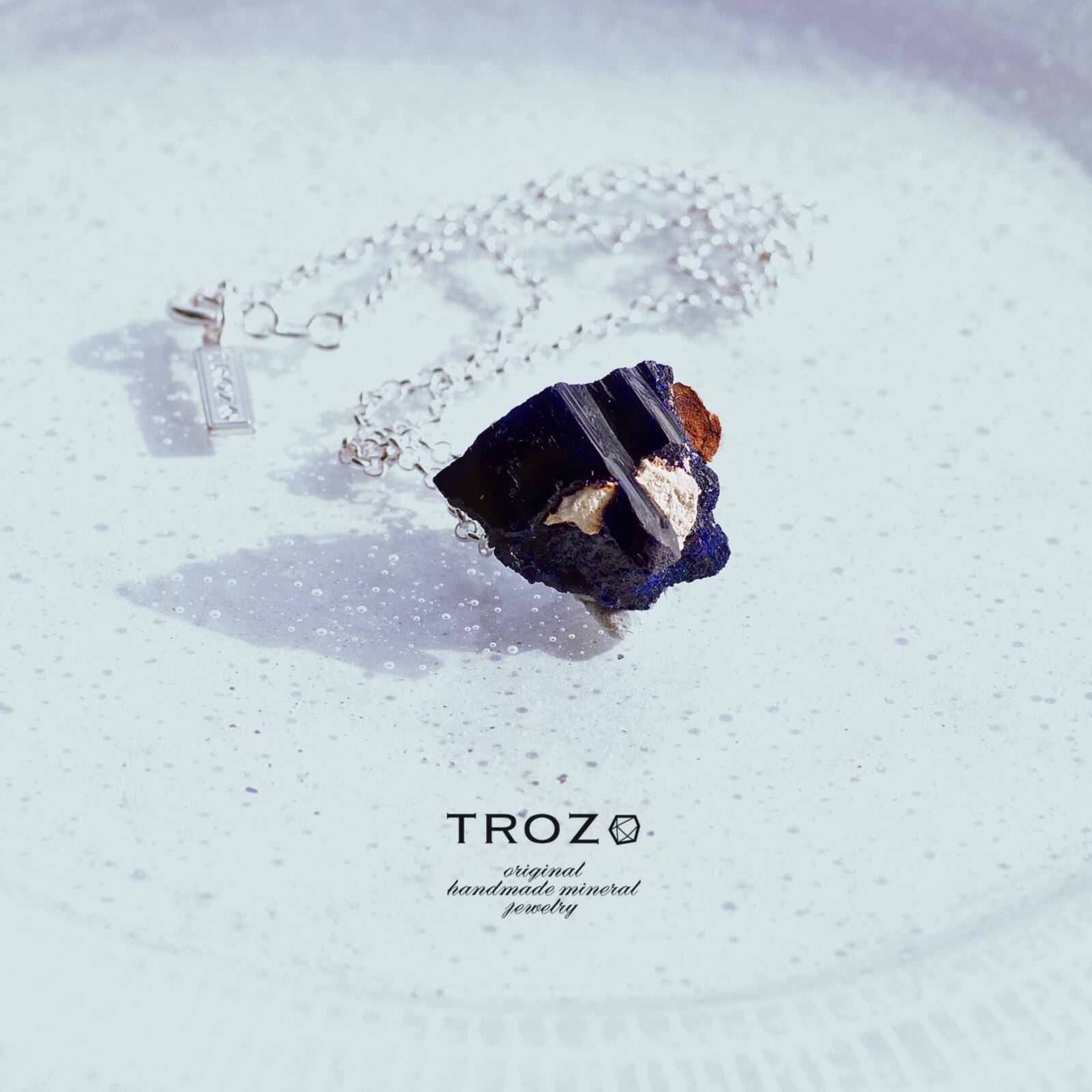
◆ Azurite Raw-Stone Jewelry
Handmade raw stone & mineral pieces — TROZO
◆ Frequently Asked Questions about Azurite
Q What does azurite symbolize?
Azurite is traditionally associated with intuition, revelation, spiritual awakening, the opening of the third eye, seeing the truth, inner insight, focus and creativity. From its long history as a treasured blue mineral and the deep azure that symbolizes the third eye, it has been cherished as a “stone that opens inner sight”.
Q Is azurite a birthstone?
Azurite is not a designated birthstone in Japan, nor a designated anniversary stone. In Japan it is chosen as non-birthstone mineral jewelry by those drawn to its blue tied directly to art history and to its sisterhood with malachite.
Q How are azurite and malachite different, and related?
Azurite Cu₃(CO₃)₂(OH)₂ and malachite Cu₂(CO₃)(OH)₂ are kindred secondary copper carbonates that form in the oxidized zone of copper deposits. They differ only in the ratio of copper to carbonate, and the CO₂ pressure of formation splits them into blue (azurite) and green (malachite) — azurite where CO₂ is abundant, malachite where it has escaped. The two frequently intergrow, including the banded blue-and-green occurrence called azurmalachite. Azurite is also known to be pseudomorphously replaced by malachite over long periods while keeping its crystal shape — famous as the cause of the blue-to-green change in museum specimens and old paintings.
Q Why has the blue in Michelangelo’s paintings turned green?
In Michelangelo’s *Entombment* and many other 15th–17th-century European paintings, blue robes are now greenish. This is not paint decay but the result of the era’s key blue pigment, azurite, being pseudomorphously replaced by malachite over decades to centuries of exposure to air and humidity. The reaction, 2Cu₃(CO₃)₂(OH)₂ + H₂O → 3Cu₂(CO₃)(OH)₂ + CO₂, takes in atmospheric moisture and releases CO₂, turning blue (azurite) to green (malachite). It is a fascinating phenomenon at the border of art history and mineralogy, and a major topic in modern art conservation.
Q What care does azurite need?
As a carbonate, azurite Cu₃(CO₃)₂(OH)₂ is sensitive to acid, ammonia, prolonged water, heat and direct sun. Avoid sweat (acidic), vinegar, lemon juice, ammonia-based cleaners, steam cleaners and ultrasonic cleaners. Because it also alters to malachite (greens) over long periods, separate storage somewhere with little humidity and a dry wipe after wear keep it beautiful longer. At Mohs 3.5–4 it is brittle and can break under impact, so take it off where it might be knocked and store it in its own case so it does not touch other stones.
Q What kinds of jewelry can azurite become?
As natural-stone jewelry, azurite is used for raw-stone earrings, necklaces and brooches. As a relatively brittle mineral at Mohs 3.5–4 it can break under impact, so take it off where it might be knocked and store it in its own case so it does not touch other stones. TROZO makes azurite jewelry that keeps the raw stone unpolished so its crystal faces and deep azure lead the design — both pieces you can choose by color and crystal form from stock, and pieces where the meeting with the stone is left to chance.
Q Where does azurite come from?
Chessy-les-Mines near Lyon, France was the 19th-century type locality and the source of the name Chessylite. Morocco (Touissit, Mibladen) yields clear deep-blue single crystals of the world’s finest, and Namibia (the Tsumeb mine) large velvety crystals. It is also found in Arizona, USA (Bisbee, Morenci — with malachite), Mexico, Australia (Broken Hill), China and Russia.
Q What is the origin of the name, and the link to lapis lazuli?
The name Azurite traces from Old French azur (sky-blue) to Arabic lāzaward to Persian lāžaward — the very same root as lapis lazuli; the English color word azure is of the same root. They are siblings even in language, sharing humankind’s word for “blue”. As minerals, though, they are quite different: lapis lazuli is a rock (an aggregate of several minerals) with lazurite as its main component, while azurite is a single copper carbonate mineral.
EXPLORE THE SHOP
Explore the world of Azurite
Discover more pieces than we can show here at the TROZO shop.
Shop Azurite