
Rhodochrosite
Rose-colored banding, held sacred by the Inca.
Rhodochrosite (also called Inca Rose) is a manganese carbonate, MnCO₃, trigonal (R3̄c), Mohs 3.5–4. Its vivid rose-to-crimson comes from divalent manganese (Mn²⁺), and the name joins the Greek *rhodon* (rose) and *chrōs* (color). The stalactitic banded specimens of the Capillitas mine in Argentina were named the national stone in 2002, and the clear red rhombohedra of the Sweet Home Mine in Colorado the state mineral the same year. A carbonate kin of malachite and azurite — a rose woven by manganese rather than copper, wrapped in Inca legend.
◆ Rhodochrosite — Stone Meanings
- True love
- Self-love
- Passion
- Healing of the heart
- Release of trauma
- A rose-colored life
- Soulmate
- Gentleness
◆ About Rhodochrosite
Rhodochrosite is a carbonate mineral, MnCO₃ (manganese carbonate). It is trigonal (space group R3̄c, the calcite group), Mohs 3.5–4, SG 3.45–3.7. The vivid rose-to-raspberry-red comes from the d–d transition of divalent manganese (Mn²⁺); with iron or calcium impurities it takes a browner or grayer cast. The name is from the Greek rhodon (rose) + chrōs (color), and in the crystal trade it is widely known by the byname Inca Rose.
The name “Inca Rose” comes from the Capillitas mine in Catamarca, Argentina, once within the Inca Empire. Held sacred by the Inca around the 13th century, it carries the legend that “the blood of the emperors and queens of old hardened into this stone”. At Capillitas, low-temperature hydrothermal veins formed great stalactitic cavities, and the vivid concentric banding of rose and white revealed in their cross-sections is the image that made rhodochrosite famous. With a history of 1.5-meter stalactites mined in quantity in the 1930s, it was named the national stone of Argentina in 2002.
In contrast, the Sweet Home Mine (Alma, Park County, Colorado, USA) is known for the world’s finest clear red rhombohedral single crystals. Originally an 1873 silver mine, it reopened in 1991 as a rhodochrosite specimen mine. The “Alma King” (14 × 16.5 cm, the finest North American mineral specimen), mined in 1992, is held at the Denver Museum of Nature & Science — a gem-quality clear red crystal coveted by collectors. Named the Colorado state mineral in 2002, it stood alongside Argentina’s national-stone designation the same year, two “national / state stones” across the Atlantic.
Rhodochrosite’s main sources are the Capillitas mine, Argentina (the famed banded source, the national stone), the Sweet Home Mine, Colorado (clear red crystals, the state mineral), the N’Chwaning mine in South Africa (large scalenohedral crystals) and Peru. In Japan, the Inakuraishi mine in Furubira, Hokkaido — the largest modern Japanese manganese mine, first in domestic output in 1936 — yielded fine botryoidal and crystalline material called “cherry-blossom manganese” and “Shakotan ruby” before closing in 1984. As a carbonate it is sensitive to acid and ammonia, and at Mohs 3.5–4 with perfect cleavage it is brittle and can develop a brown oxidized film in air and humidity. Keeping it from sweat, the bath and direct sun, and storing it dry and separately, keeps it beautiful longer.
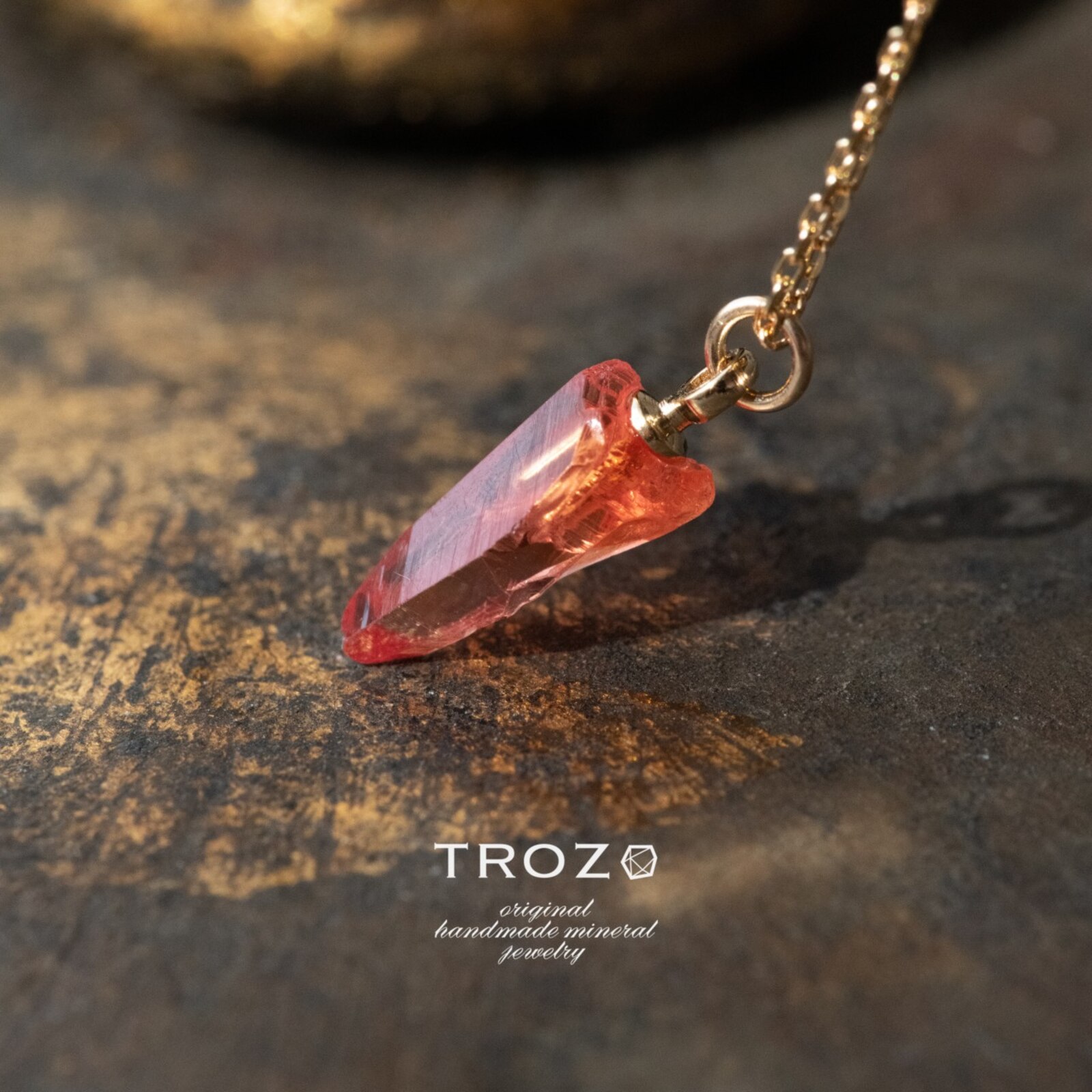
◆ Mineral Data
- English name
- Rhodochrosite (from the Greek *rhodon*, rose, + *chrōs*, color) / Inca Rose
- Chemical formula
- MnCO₃ (manganese carbonate)
- Mineral class
- Carbonate mineral (calcite group) — a continuous solid solution with calcite CaCO₃; a carbonate kin of malachite and azurite (though those are copper carbonates)
- Crystal system
- Trigonal (space group R3̄c) — rhombohedral and scalenohedral single crystals; botryoidal, stalactitic and massive aggregates; perfect cleavage
- Mohs hardness
- 3.5 – 4
- Specific gravity
- 3.45 – 3.7
- Main sources
- Argentina (Capillitas mine, Catamarca — source of “Inca Rose”, the famed banded source, 2002 national stone), USA (Sweet Home Mine, Alma, Colorado — clear red rhombohedra, the Alma King, 2002 state mineral), South Africa (N’Chwaning, Hotazel, Kuruman — large scalenohedral crystals), Peru, Japan (Inakuraishi mine, Furubira, Hokkaido — “cherry-blossom manganese”, closed 1984)
- Color range
- Vivid rose to raspberry-red to crimson (from Mn²⁺), browner or grayer with Fe/Ca/Mg, with white-to-pale-pink banding (concentric, serpentine)
- Notable trait
- The byname “Inca Rose” — Capillitas was once Inca land, with the legend of “the emperors’ blood hardened into stone”. Its concentric banding forms, like malachite, from periodic low-temperature hydrothermal deposition. The Sweet Home Mine’s “Alma King” (a 14 cm clear red crystal) is in the Denver Museum. Named Argentina’s national stone and Colorado’s state mineral, both in 2002. As a carbonate, sensitive to acid and ammonia; brittle with perfect cleavage; browns in air and humidity
- Birthstone
- Not an official Japanese (Zenhokyo) or wedding-anniversary stone. Cherished by mineral collectors and the healing-stone community as a symbol of “true love” and “self-love”
◆ Rose-colored banding — concentric rings drawn by manganese carbonate
The green of malachite, the blue of azurite, and the rose of rhodochrosite.
Rhodochrosite’s greatest appeal is the concentric banding of vivid rose and white-to-pale-pink, seen in cross-sections of the stalactitic material from the Capillitas mine in Argentina — making it, with the green of malachite and the blue of azurite, one of the “three banded carbonate siblings”. The mechanism is shared: manganese ions Mn²⁺ and carbonate ions CO₃²⁻ precipitate periodically from low-temperature hydrothermal solution, building needle-to-tabular crystals in layers. The compositions differ — MnCO₃ versus the copper carbonates of malachite and azurite — but the concentric-band geometry that carbonate minerals share is the common face of periodic natural precipitation under diffusion control. Whether the host is a manganese deposit (rhodochrosite) or a copper deposit (malachite, azurite), only the color changes — green, blue, rose — one of the minerals that most beautifully tells the mechanism of color in geochemistry.
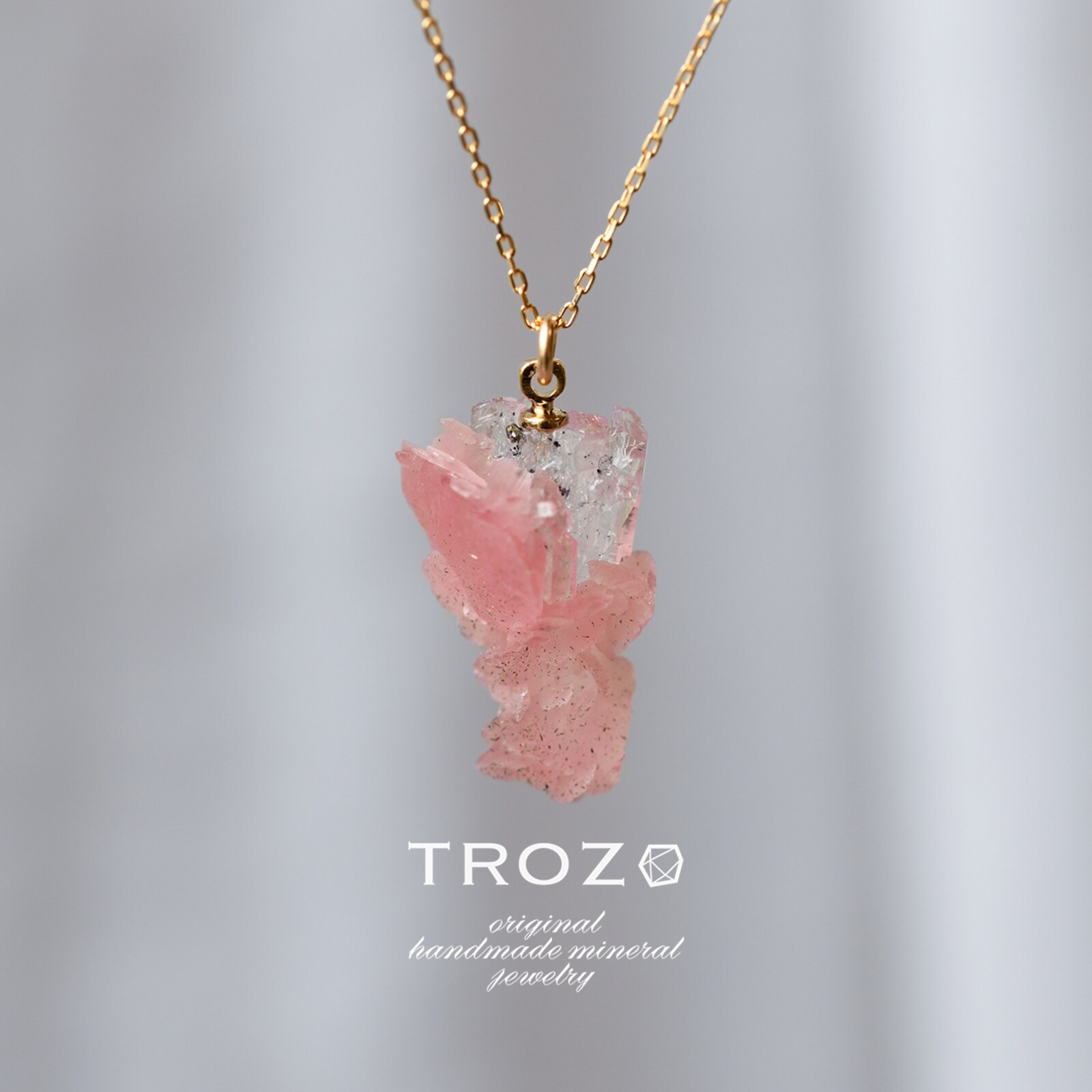
◆ The Inca Rose legend — from Capillitas to Argentina’s national stone
A rose said to be the hardened blood of Inca emperors.
The Capillitas mine in Catamarca, Argentina, was once within the Inca Empire, and the Inca held rhodochrosite sacred around the 13th century. The legend tells that “when the emperors and queens of old passed away, their blood seeped into the earth and became this stone” — the origin of the byname Inca Rose. At Capillitas, manganese-bearing hydrothermal solution precipitated slowly over long ages at low temperature, forming great stalactitic cavities whose cross-sections reveal vivid concentric bands of rose and white. With Jesuit mining in the 17th–18th centuries and 1.5-meter stalactites mined in quantity in the 1930s and carried to Buenos Aires, it was named the national stone of Argentina in 2002. That same year, Colorado named rhodochrosite its state mineral, with the Sweet Home Mine’s clear red rhombohedron “Alma King” (a 14 cm, finest North American specimen) — two “sanctuaries of rhodochrosite”, in South and North America, standing together as national and state stones in the same 2002.
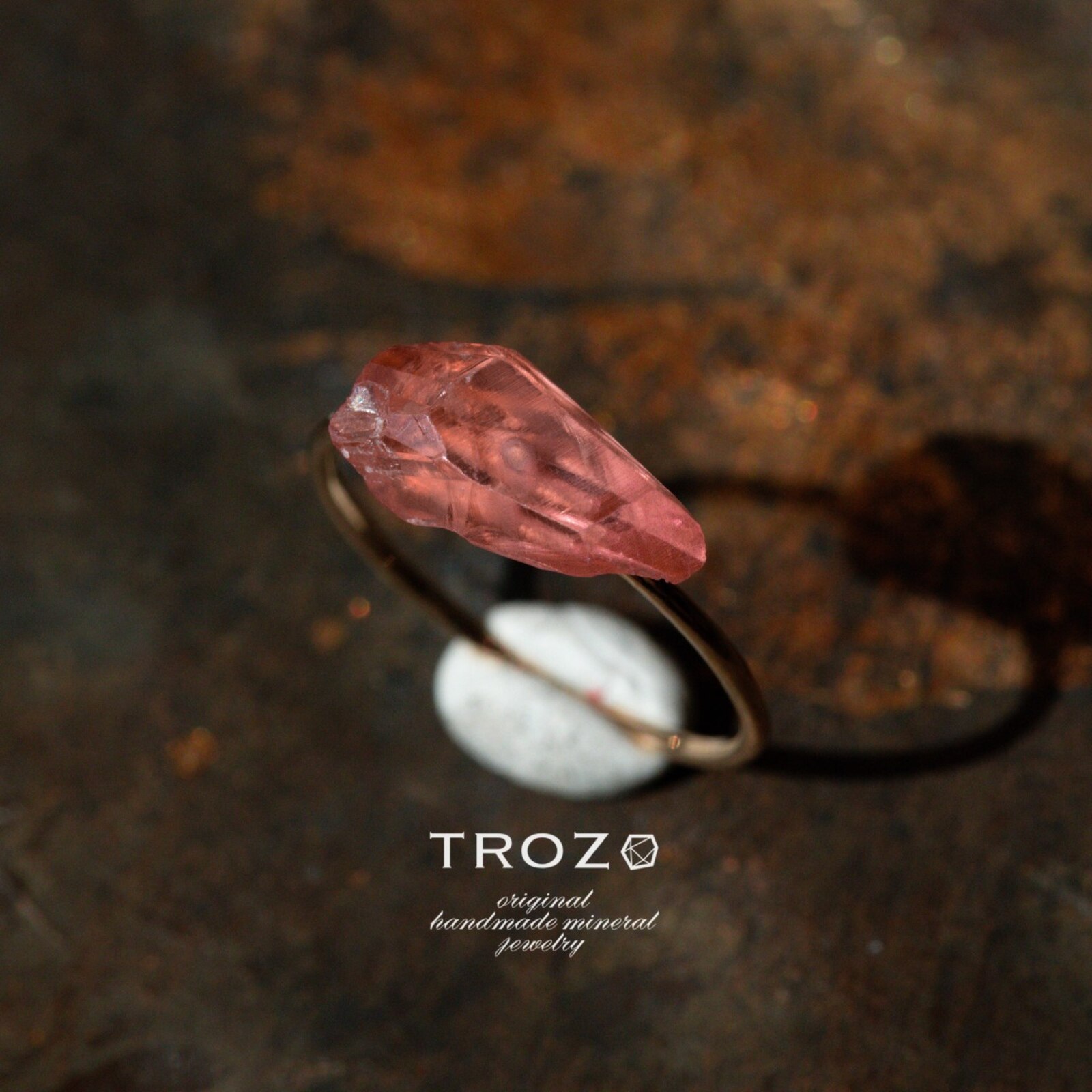
◆ Choosing raw rhodochrosite jewelry
Banding or clear red crystal — choose knowing each source and the care it needs.
The pleasure of choosing raw rhodochrosite jewelry is the crystal expression that differs greatly by source. Argentine (Capillitas) material gives the vivid rose-and-white concentric bands of stalactite cross-sections; American (Sweet Home) material gem-quality clear red rhombohedra; South African (N’Chwaning) material large scalenohedral crystals; and Japanese (Inakuraishi) material — now closed — the botryoidal, crystalline “cherry-blossom manganese” and “Shakotan ruby”. Banding or clear red crystal, the way to enjoy it parts by source. A carbonate kin of malachite and azurite, yet the rose woven by Mn²⁺ has a warmth opposite to the green and blue of copper minerals.
TROZO sets rhodochrosite with its natural crystal faces and banding intact. As a carbonate it is sensitive to acid, ammonia, prolonged water and heat, so please avoid contact with sweat, vinegar, ammonia-based cleaners, steam cleaners and ultrasonic cleaners. It can also develop a brown oxidized film in air and humidity, so avoid long outdoor exposure or storage in the bath. At Mohs 3.5–4 it is brittle, with perfect cleavage along the rhombohedron, so it can break under impact — take it off where it might be knocked, and store it in its own case so it does not touch other stones. Wear the rose-colored banding wrapped in Inca legend, in the raw-mineral jewelry TROZO makes.
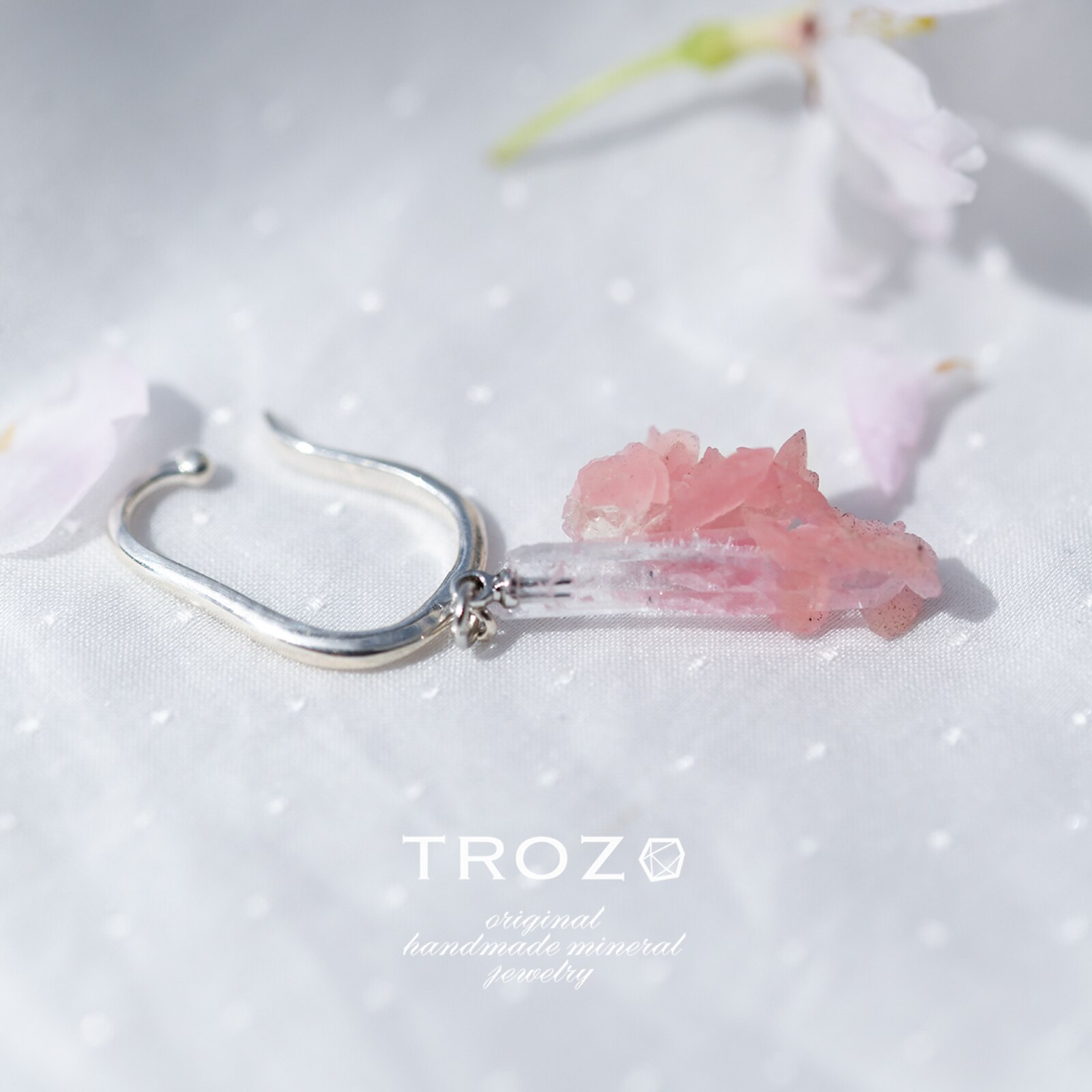
◆ Rhodochrosite Raw-Stone Jewelry
Handmade raw stone & mineral pieces — TROZO
◆ Frequently Asked Questions about Rhodochrosite
Q What does rhodochrosite symbolize?
Rhodochrosite (Inca Rose) is traditionally associated with true love, self-love, passion, healing of the heart, the release of trauma, a rose-colored life, the soulmate and gentleness. From its vivid rose color and the Inca legend of “the emperors’ blood hardened into stone”, it is cherished today as a “stone of love and healing”.
Q Are rhodochrosite and Inca Rose different things?
They are two names for the same mineral. The formal mineralogical and gemological name is rhodochrosite, while Inca Rose is the byname used in the crystal trade. The latter comes from the Capillitas mine in Argentina being once within the Inca Empire and from the legend of “the emperors’ and queens’ blood hardened into stone”. The crystal market tends to say “Inca Rose”, the mineral trade “rhodochrosite”, but they are one and the same.
Q Is rhodochrosite a birthstone?
Rhodochrosite is not a designated birthstone in Japan, nor a designated anniversary stone. It does, however, hold official mineral status as both Argentina’s national stone and Colorado’s state mineral, named in the same year, 2002. In Japan it is chosen as non-birthstone mineral jewelry by those drawn to its rose color and the Inca legend.
Q How do rhodochrosite, malachite and azurite differ and relate?
All three share the appeal of concentric banding in carbonate minerals. Their compositions are rhodochrosite MnCO₃ (manganese), malachite Cu₂(CO₃)(OH)₂ (copper) and azurite Cu₃(CO₃)₂(OH)₂ (copper), and the host — a manganese or a copper deposit — sets the color: Mn²⁺ rose, Cu²⁺ green (malachite) and blue (azurite). The mechanism is shared — banding from periodic precipitation from low-temperature hydrothermal solution. Their care is shared too: as carbonates they are sensitive to acid and ammonia and are brittle at Mohs 3.5–4, so all are used for earrings, necklaces and brooches rather than rings.
Q What are the Japanese “cherry-blossom manganese” and “Shakotan ruby”?
In Japan, the Inakuraishi mine in Furubira, Hokkaido was a famous rhodochrosite source — the largest modern Japanese manganese mine, first in domestic output in 1936. It yielded fine botryoidal and crystalline material, called “cherry-blossom manganese” for its vivid rose and “Shakotan ruby” for the Shakotan Peninsula where it lies. The mine closed in 1984 and specimens are now scarce — an important source told alongside rhodochrosite in the history of Japanese minerals.
Q What care does rhodochrosite need?
As a carbonate, rhodochrosite MnCO₃ is sensitive to acid, ammonia, prolonged water and heat. Avoid sweat (acidic), vinegar, lemon juice, ammonia-based cleaners, steam cleaners and ultrasonic cleaners. It can also develop a brown oxidized film in air and humidity, so avoid long outdoor exposure or storage in the bath. At Mohs 3.5–4 it is brittle, with perfect cleavage along the rhombohedron, so it can break under impact — take it off where it might be knocked and keep it from touching other stones. Store it dry and separately and wipe it with a soft cloth after wear.
Q What kinds of jewelry can rhodochrosite become?
As natural-stone jewelry, rhodochrosite is used for raw-stone earrings, necklaces and brooches. As a relatively brittle mineral with perfect cleavage at Mohs 3.5–4, it can break under impact, so take it off where it might be knocked and store it in its own case. TROZO makes rhodochrosite jewelry that keeps the raw stone unpolished so its crystal faces, banding and rose color lead the design — both pieces you can choose by banding and color from stock, and pieces where the meeting with the stone is left to chance.
Q Where does rhodochrosite come from?
Argentina (the Capillitas mine, Catamarca) is the famed source of stalactitic banded material and the origin of the name Inca Rose (Argentina’s 2002 national stone). Colorado, USA (the Sweet Home Mine, Alma) is the finest source of clear red rhombohedra — the “Alma King” is in the Denver Museum of Nature & Science (Colorado’s 2002 state mineral). South Africa (N’Chwaning, Hotazel, Kuruman) yields large scalenohedral crystals, and Peru (Pasco) Capillitas-like banding. In Japan the Inakuraishi mine in Furubira, Hokkaido (“cherry-blossom manganese”, “Shakotan ruby”) was famous but closed in 1984.
EXPLORE THE SHOP
Explore the world of Rhodochrosite
Discover more pieces than we can show here at the TROZO shop.
Shop Rhodochrosite