
Dioptase
An emerald green colored by copper — sharing the Si₆O₁₈ ring with beryl.
Dioptase is a hydrated copper cyclosilicate, Cu₆Si₆O₁₈·6H₂O, trigonal (R3̄), Mohs 5. Its color comes from the d–d transition of divalent copper (Cu²⁺), a deep emerald-to-teal green that rivals emerald itself. Found in the Altyn-Tyube mine of Kazakhstan in the 1780s, it was first mistaken for emerald until René-Just Haüy named it in 1797 (from the Greek *dia*, “through”, + *optos*, “seen”). It shares the very Si₆O₁₈ six-membered ring of emerald (Be₃Al₂Si₆O₁₈) — but with copper rather than beryllium linking the rings.
◆ Dioptase — Stone Meanings
- Growth in life
- Intuition
- Activation of the heart chakra
- Release of trauma
- Release of karma
- Abundance
- Spiritual awakening
- Healing
◆ About Dioptase
Dioptase is a secondary mineral, Cu₆Si₆O₁₈·6H₂O (a hydrated copper cyclosilicate). It is trigonal (space group R3̄), Mohs 5, SG 3.28–3.35, with a cyclosilicate structure in which Si₆O₁₈ six-membered rings stack and copper Cu²⁺ ions link the rings. The deep emerald-to-teal green comes from the d–d transition of divalent copper (Cu²⁺), which takes a distorted octahedral coordination (a square plane plus two axial H₂O) through the Jahn–Teller effect, giving its characteristic deep green. The name “Dioptase” is from the Greek dia (“through”) + optos (“seen”) — for the way the internal cleavage planes show through when the crystal is tilted.
Dioptase’s history begins with confusion for emerald. In the 1780s, at the Altyn-Tyube (“golden hill”) mine in what is now Karaganda, Kazakhstan, copper miners found clear emerald-green crystals in a quartz vein and, believing they had an emerald deposit, sent them to Moscow. But in 1797 the French mineralogist René-Just Haüy confirmed, from its hardness, specific gravity and copper-based color, that it was a new mineral, distinct from emerald, and named it. The two stones in fact share a structural “kinship”: both emerald, Be₃Al₂Si₆O₁₈, and dioptase, Cu₆Si₆O₁₈·6H₂O, are built on exactly the same Si₆O₁₈ six-membered ring — the difference is whether beryllium-and-aluminium or copper links those rings. “An emerald green colored by copper rather than beryllium” — dioptase is spoken of alongside emerald at the very closest point in mineralogy.
Dioptase is also a kin of the secondary copper minerals, with malachite and azurite. All form in the oxidized zone of copper deposits and take their color from the Cu²⁺ d–d transition, yet their structures part entirely: malachite and azurite are copper carbonates (copper bound to CO₃), while dioptase is a copper cyclosilicate (copper bound to Si₆O₁₈ rings). It is a fascinating geochemistry that makes, from the same copper deposit, the carbonate green (malachite) and blue (azurite) and the silicate deep green (dioptase). Its use is ancient: at the Pre-Pottery Neolithic B site of Ain Ghazal in Jordan (around 7200 BC), the green pigment around the eyes of lime-plaster statues has been identified as dioptase — the earliest known use, recorded in the history of minerals.
Dioptase’s main sources are Kazakhstan (the Altyn-Tyube mine — the 1780s discovery site, the historic type locality), the Republic of the Congo (Mindouli, Renéville, Kimbedi — the modern gem-quality source, Pool region), Namibia (the Tsumeb mine — the world’s finest specimen quality, with malachite and azurite), Arizona in the USA (the Mammoth-St Anthony and Christmas mines), Chile, Peru, Iran, Mexico and Argentina. At Mohs 5 it is brittle, with perfect cleavage in three directions, so it breaks readily under impact or in ultrasonic cleaning; holding water molecules (·6H₂O) in its structure, it is broken down by heat and is sensitive to acid. It is among the most delicate of minerals to handle, so avoiding hard knocks, drops and ultrasonic cleaners is essential.
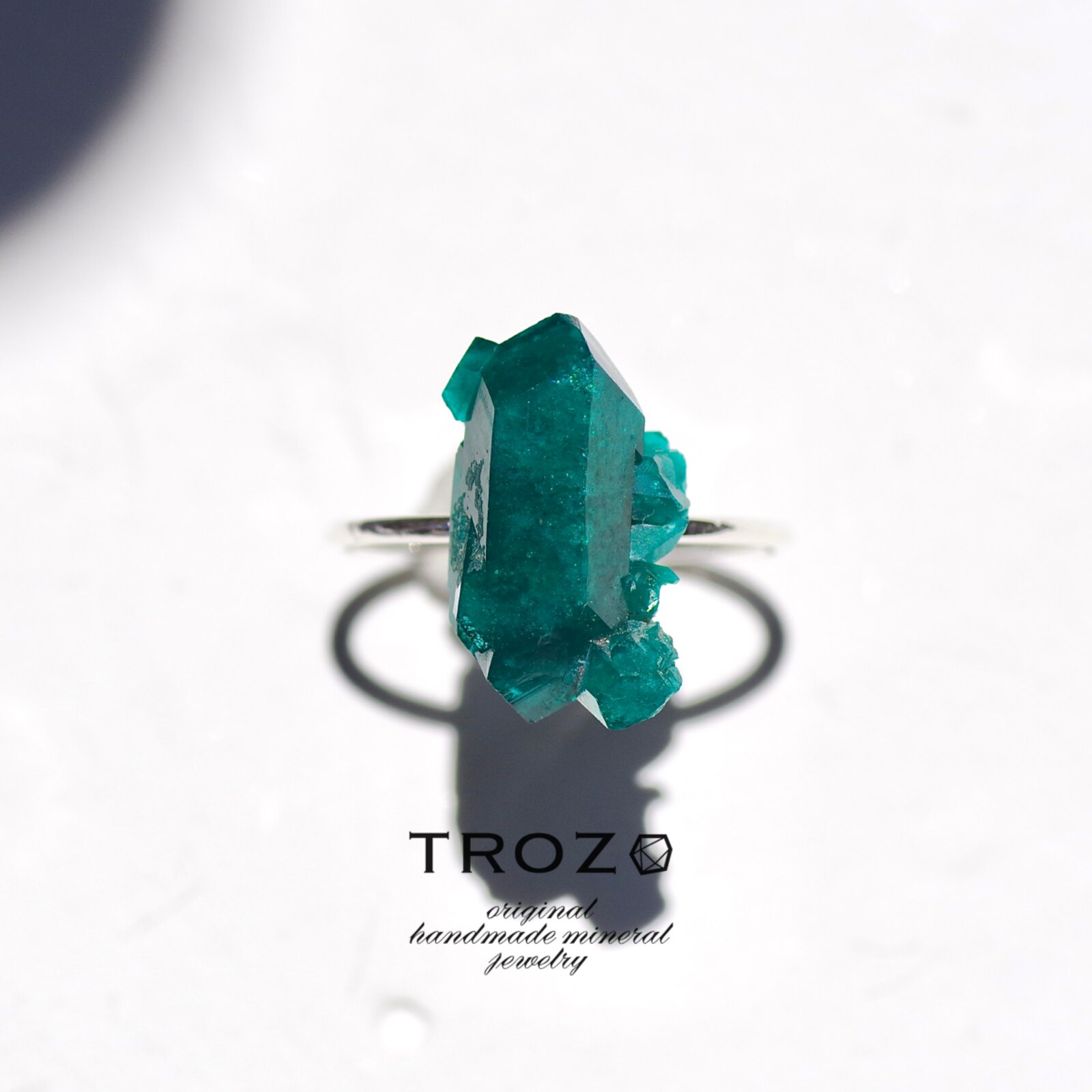
◆ The Many Faces of Dioptase
Every piece differs in hue and inclusion — the unrepeatable character of raw stone.
![Dioptase Dioptase Raw Stone Necklace - One of a Kind | Handmade Natural Stone Jewelry [Fairy Tale Collection]](https://cdn.shopify.com/s/files/1/0713/5585/9244/files/20240423081947_1.jpg?v=1716197536)
![Dioptase Dioptase Raw Stone Earrings - One of a Kind | Handmade Natural Stone Jewelry [Fairy Tale Collection]](https://cdn.shopify.com/s/files/1/0713/5585/9244/files/20240423053056_1.jpg?v=1715684265)
![Dioptase Dioptase Raw Stone Ear Cuff - One of a Kind | Handmade Natural Stone Jewelry [Fairy Tale Collection]](https://cdn.shopify.com/s/files/1/0713/5585/9244/files/20240422210515_1.jpg?v=1715312302)
![Dioptase Dioptase Raw Stone Ear Cuff - One of a Kind | Handmade Natural Stone Jewelry [Fairy Tale Collection]](https://cdn.shopify.com/s/files/1/0713/5585/9244/files/20240422203905_1.jpg?v=1715238100)
◆ Mineral Data
- English name
- Dioptase (from the Greek *dia*, “through”, + *optos*, “seen”; named by René-Just Haüy in 1797, for the internal cleavage planes seen through a tilted crystal)
- Chemical formula
- Cu₆Si₆O₁₈·6H₂O (hydrated copper cyclosilicate; commonly written CuSiO₃·H₂O)
- Mineral class
- Cyclosilicate — the Si₆O₁₈ six-ring is shared with emerald Be₃Al₂Si₆O₁₈ (a different mineral by whether copper or beryllium-aluminium links the rings). A secondary copper mineral with malachite, azurite and chrysocolla
- Crystal system
- Trigonal (space group R3̄) — short hexagonal prisms with rhombohedral terminations, and massive aggregates; perfect cleavage in three directions
- Mohs hardness
- 5
- Specific gravity
- 3.28 – 3.35
- Main sources
- Kazakhstan (Altyn-Tyube, Karaganda — the 1780s discovery, historic type locality), Republic of the Congo (Mindouli, Renéville, Kimbedi, Pool — the modern gem-quality source), Namibia (Tsumeb — the world’s finest specimens, with malachite and azurite), USA (Arizona: Mammoth-St Anthony, Christmas), Chile, Peru, Iran, Mexico, Argentina
- Color range
- Vivid emerald green to teal to deep teal-green (from the Cu²⁺ d–d transition with Jahn–Teller distortion); green streak
- Notable trait
- Shares the Si₆O₁₈ six-ring of emerald (Be₃Al₂Si₆O₁₈) — a different mineral by its linking metal; spoken of as “an emerald green colored by copper rather than beryllium”. First mistaken for emerald in 1780s Kazakhstan, named a new mineral by Haüy in 1797. A secondary copper mineral with malachite and azurite. Earliest known use: eye-rim pigment on the statues of Ain Ghazal (~7200 BC). Delicate — Mohs 5, brittle, perfect cleavage; broken down by heat, sensitive to acid; no ultrasonic
- Birthstone
- Not an official Japanese (Zenhokyo) or wedding-anniversary stone. Popular with mineral collectors and in healing circles as a symbol of heart-chakra activation and life’s growth
◆ The same ring as emerald, a different metal — the mineralogy of the Si₆O₁₈ frame
An emerald green colored by copper rather than beryllium — a rare relationship.
The most fascinating thing about dioptase is its structural “kinship” with emerald. Emerald, Be₃Al₂Si₆O₁₈, and dioptase, Cu₆Si₆O₁₈·6H₂O — the formulas look entirely different, yet both are cyclosilicates built on exactly the same Si₆O₁₈ six-membered ring. The only difference is whether beryllium-and-aluminium or copper links those rings. When Russian traders found clear green crystals at the Altyn-Tyube mine in Kazakhstan in the 1780s and sent them to Moscow as emerald, it was no accident but a structural inevitability — until Haüy analyzed them in 1797, no one could tell the two apart by eye. The color arises from the Cu²⁺ d–d transition: surrounded by the Si₆O₁₈ ring, Cu²⁺ takes a distorted octahedral coordination (a square plane plus two axial H₂O) through the Jahn–Teller effect, yielding a deep emerald green by a different route from emerald’s (from Cr/V). “An emerald green colored by copper rather than beryllium” — dioptase is one of the natural stones that, beside emerald, tells the mineralogy of the Si₆O₁₈ ring most deeply.
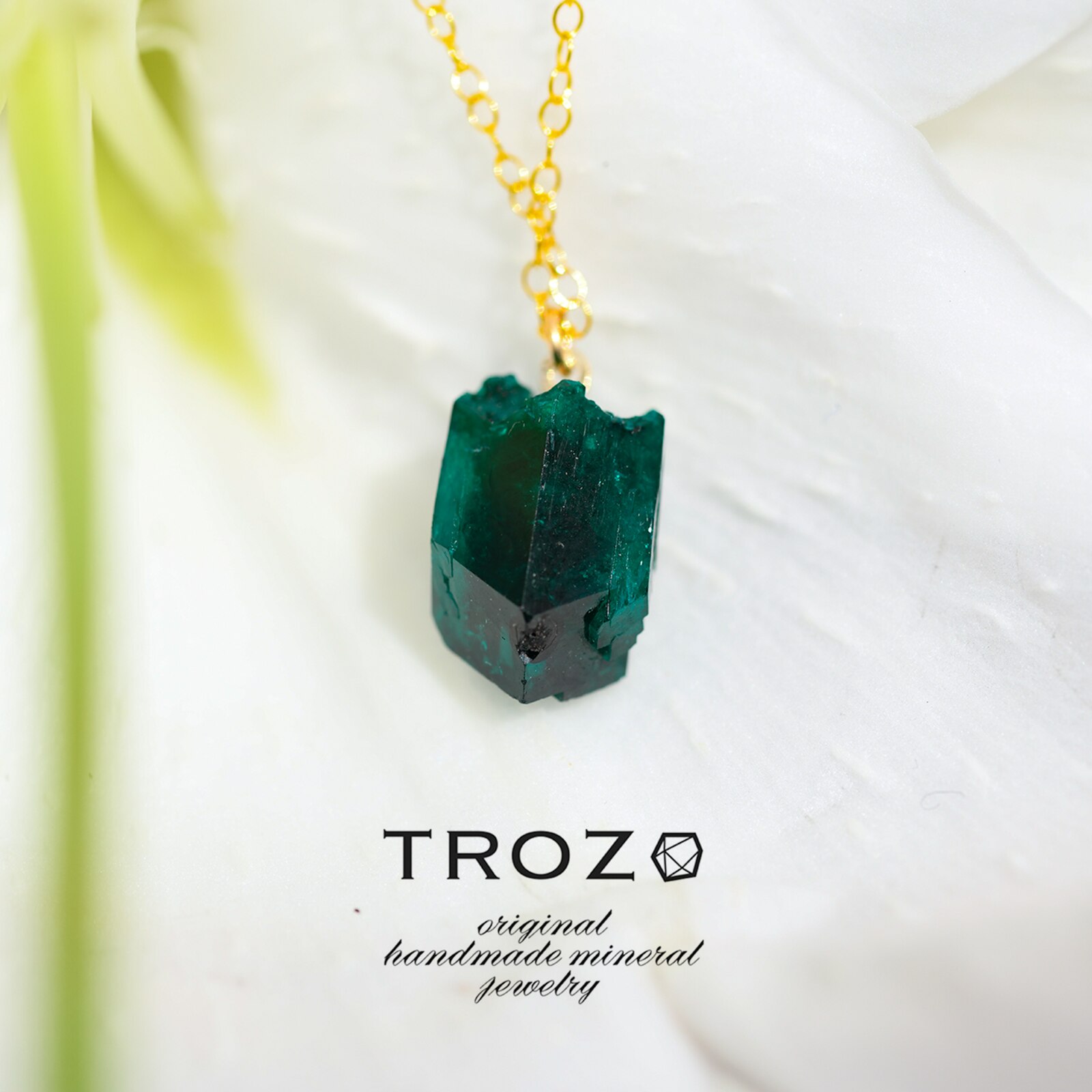
◆ A member of the secondary copper minerals — a green that runs from 7200 BC
The green of malachite, the blue of azurite, and the deep green of dioptase.
Dioptase is also a kin of the secondary copper minerals, with malachite and azurite. All form in the oxidized zone of copper deposits and take their color from the Cu²⁺ d–d transition, yet their structures part entirely — malachite and azurite are copper carbonates (copper bound to CO₃), while dioptase and chrysocolla are copper silicates (copper bound to SiO₄). It is a fascinating geochemistry that makes, from the same copper deposit, the carbonate green (malachite) and blue (azurite) and the silicate deep green (dioptase). Its use is ancient: at the Pre-Pottery Neolithic B site of Ain Ghazal in Jordan (around 7200 BC), the green pigment painted around the eyes of lime-plaster statues has been identified as dioptase — the earliest known use, recorded in the history of minerals. Since prehistoric Jordan, the deep green that copper weaves has been handled with care by human hands.
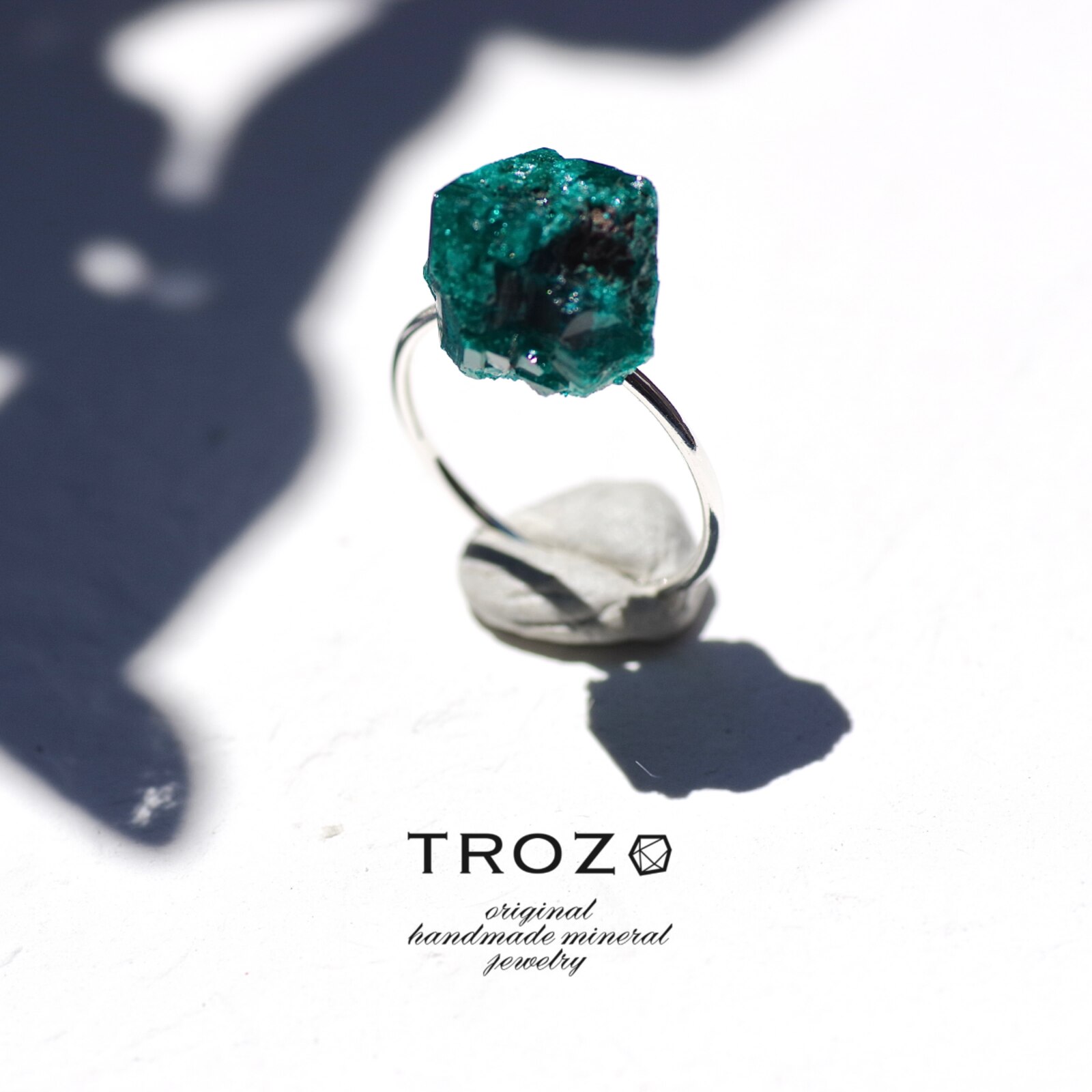
◆ Choosing raw dioptase jewelry
Choose knowing the crystal by source, and its delicate care.
The pleasure of choosing raw dioptase jewelry is the crystal expression that differs greatly by source. Namibian (Tsumeb) material gives small, vivid-green crystals intergrown with malachite and azurite, of the world’s finest specimen quality; Congo (Mindouli, Renéville) material gem-quality, clear single crystals; Kazakh (Altyn-Tyube) material historic type-locality specimens set in quartz veins; and Arizona material a distinctive secondary stone — the expression varies greatly by source, from clear gem-quality crystals to matrix specimens.
TROZO sets dioptase with its natural crystal faces and a deep green that rivals emerald intact. Dioptase is among the most delicate of minerals to handle: at Mohs 5 it is brittle, with perfect cleavage in three directions, so it breaks readily under impact; holding water molecules (·6H₂O) in its structure it is broken down by heat, is sensitive to acid, and must never see an ultrasonic cleaner. Take care, too, not to inhale the dust (it is copper-bearing), though a finished piece does not release significant copper through skin contact. Because it breaks readily under impact or a drop, it asks for careful handling — taking it off where it might be knocked, and storing it in its own case so it does not touch other stones. Wear the rare emerald green colored by copper, in the raw-mineral jewelry TROZO makes.
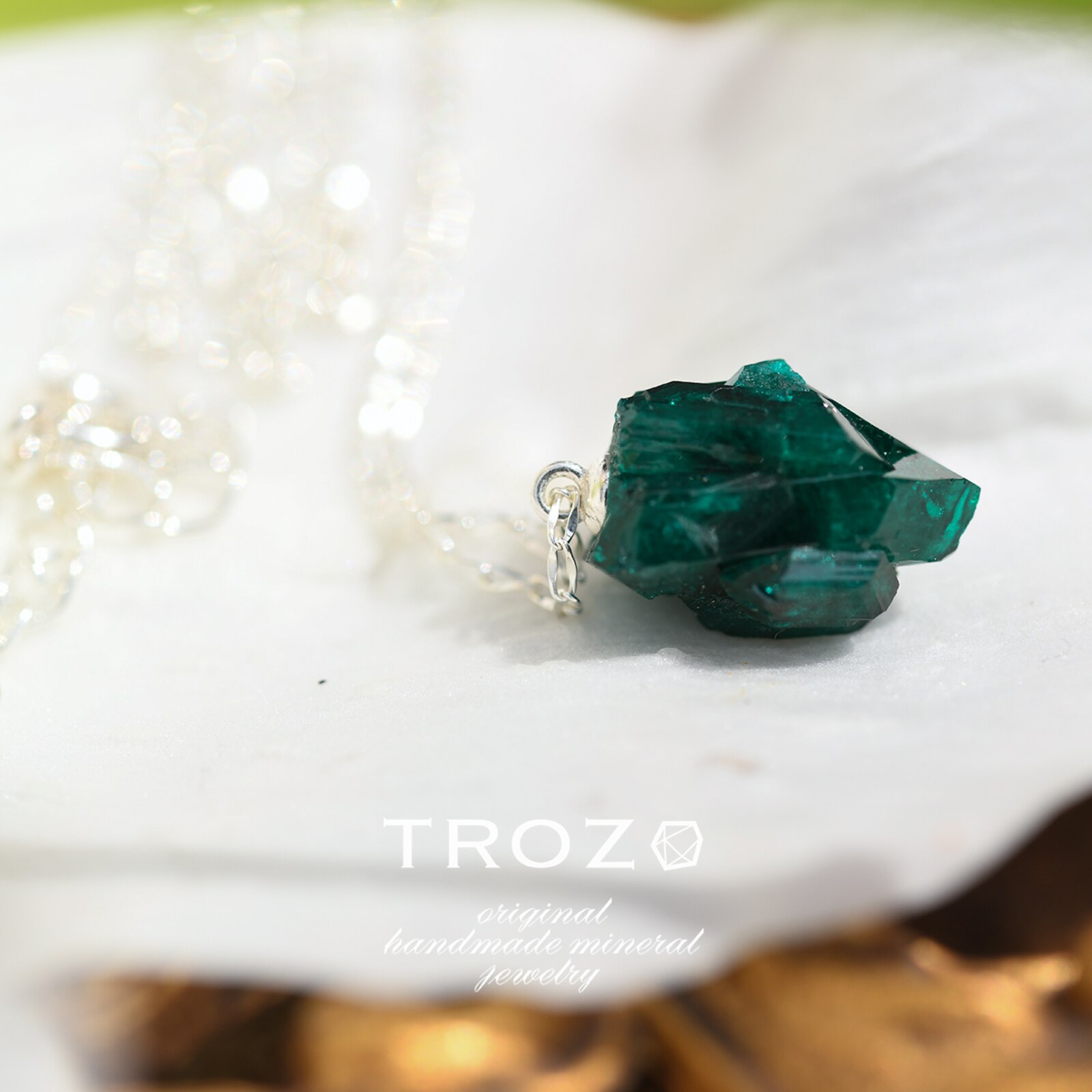
◆ Dioptase Raw-Stone Jewelry
Handmade raw stone & mineral pieces — TROZO
Dioptase Raw Stone Necklace - One of a Kind | Handmade Natural Stone Jewelry [Fairy Tale Collection]
$176.00
Dioptase Raw Stone Earrings - One of a Kind | Handmade Natural Stone Jewelry [Fairy Tale Collection]
$210.00
Dioptase Raw Stone Ear Cuff - One of a Kind | Handmade Natural Stone Jewelry [Fairy Tale Collection]
$158.00
Dioptase Raw Stone Ear Cuff - One of a Kind | Handmade Natural Stone Jewelry [Fairy Tale Collection]
$194.00
![Dioptase Dioptase Raw Stone Ear Cuff - One of a Kind | Handmade Natural Stone Jewelry [Fairy Tale Collection]](https://cdn.shopify.com/s/files/1/0713/5585/9244/files/20240422202854_1.jpg?v=1715167832)
Dioptase Raw Stone Ear Cuff - One of a Kind | Handmade Natural Stone Jewelry [Fairy Tale Collection]
$113.00
◆ Frequently Asked Questions about Dioptase
Q What does dioptase symbolize?
Dioptase is traditionally associated with growth in life, intuition, activation of the heart chakra, the release of trauma and karma, abundance, spiritual awakening and healing. From a vivid green that rivals emerald and the rarity of its copper-deposit origin, it is cherished today as a “stone that heals the heart and grows one’s life”.
Q Is dioptase a birthstone?
Dioptase is not a designated birthstone in Japan, nor a designated anniversary stone. In Japan it is chosen as non-birthstone mineral jewelry by those drawn to the rarity of a stone that shares emerald’s Si₆O₁₈ ring yet is colored by copper, and to its beauty as a secondary copper mineral.
Q How does dioptase differ from emerald?
Dioptase Cu₆Si₆O₁₈·6H₂O and emerald Be₃Al₂Si₆O₁₈ are kindred cyclosilicates built on exactly the same Si₆O₁₈ six-membered ring, but they are different minerals with different linking metals. Emerald’s rings are linked by Be²⁺ and Al³⁺, colored by Cr/V; dioptase’s by Cu²⁺, colored by the copper d–d transition. First mistaken for emerald in 1780s Kazakhstan, dioptase was confirmed a new mineral by Haüy in 1797 from differences in hardness (emerald 8 vs dioptase 5), specific gravity (2.7 vs 3.3) and coloring metal (Cr/V vs Cu). “An emerald green colored by copper rather than beryllium” is dioptase’s mineralogical identity.
Q How do dioptase, malachite and azurite differ and relate?
All three contain copper (Cu²⁺) as secondary minerals, forming in the oxidized zone of copper deposits and colored by the Cu²⁺ d–d transition. The difference is structure — malachite Cu₂(CO₃)(OH)₂ and azurite Cu₃(CO₃)₂(OH)₂ are copper carbonates (copper bound to CO₃), while dioptase Cu₆Si₆O₁₈·6H₂O is a copper cyclosilicate (copper bound to Si₆O₁₈ rings). From the same copper deposit come the carbonate green (malachite) and blue (azurite) and the silicate deep green (dioptase) — a copper-secondary-mineral color series woven by geochemistry. Their care is shared: all are Mohs 5 or below, brittle, sensitive to acid, and ask that impact and acidic cleaners be avoided.
Q What is the origin of “dia + optos”?
The name Dioptase comes from the Greek dia (“through”) + optos (“seen”). It was named in 1797 by the French mineralogist René-Just Haüy, for the way dioptase’s internal cleavage planes show through when the crystal is tilted. Because emerald shows no such internal cleavage planes, the name marked dioptase as a mineral distinct from emerald. It shares its root with the modern optical term “diopter”.
Q What care does dioptase need?
Dioptase is among the most delicate of minerals to handle. At Mohs 5 it is brittle, with perfect cleavage in three directions, so it breaks readily under a fall; holding water molecules (·6H₂O) in its structure it is broken down by heat, is sensitive to acid, and must never see an ultrasonic cleaner. Take care, too, not to inhale the dust (it is copper-bearing), though a finished piece does not release significant copper through skin contact. Because it breaks readily under impact, take it off where it might be knocked and store it in its own case so it does not touch other stones; store it somewhere dry and wipe it gently with a soft cloth after wear.
Q What kinds of jewelry can dioptase become?
As natural-stone jewelry, dioptase is used for raw-stone earrings, necklaces and brooches. As a delicate mineral at Mohs 5 with perfect cleavage, it can break under impact, so take it off where it might be knocked and store it in its own case so it does not touch other stones. TROZO makes dioptase jewelry that keeps the raw stone unpolished so its crystal faces and a deep green that rivals emerald lead the design — both pieces you can choose by color and crystal form from stock, and pieces where the meeting with the stone is left to chance.
Q Where does dioptase come from?
The Altyn-Tyube mine in Kazakhstan (Karaganda) is the 1780s discovery and historic type locality, famed for specimens in quartz vein. The Republic of the Congo (Mindouli, Renéville, Kimbedi, Pool) is the main modern source of gem-quality dioptase, the most prized as a gem. Namibia’s Tsumeb mine yields the world’s finest specimen quality, with rare specimens intergrown with malachite and azurite. It is also found in Arizona, USA (the Mammoth-St Anthony and Christmas mines), Chile, Peru, Iran, Mexico and Argentina. Note that the “Republic of the Congo” and the “Democratic Republic of the Congo” are different countries; dioptase’s main source is the former, in the Pool region.
EXPLORE THE SHOP
Explore the world of Dioptase
Discover more pieces than we can show here at the TROZO shop.
Shop Dioptase