
Cavansite
A deep-blue rose drawn by vanadium, blooming in the geodes of Deccan basalt.
Cavansite is a hydrated calcium vanadium silicate, Ca(VO)Si₄O₁₀·4H₂O, orthorhombic (Pcmn), Mohs 3–4. A rare phyllosilicate, it forms deep sky-blue rosettes of radiating needle crystals. Its color comes from vanadium V⁴⁺ entering the structure as a vanadyl group (VO²⁺), whose d¹ electron absorbs red light by a d–d transition — a coloring mechanism found in no other blue mineral. Found at Owyhee Dam in Oregon in 1967 and named by Staples and others in 1973, the market mainstay today is the Wagholi quarry in Maharashtra, India — blue crystal flowers in the cavities of Deccan basalt.
◆ Cavansite — Stone Meanings
- Intuition
- Healing
- Spiritual awakening
- Seeing the truth
- Communication
- Self-expression
- Deep insight
- Creativity
◆ About Cavansite
Cavansite is a rare mineral, Ca(VO)Si₄O₁₀·4H₂O (a hydrated calcium vanadium silicate). It is orthorhombic (space group Pcmn), Mohs 3–4, SG 2.21–2.33. It is a phyllosilicate (sheet silicate), of the same layered group as mica and talc but with a special structure in which VO₅ pyramids bridge the layers. The name “Cavansite” is a blend of the initials of Ca (calcium) + Van (vanadium) + Si (silicate) — coined when Staples and others described the Oregon material as a new mineral in 1973, a name that is the composition itself. The deep sky-blue comes from vanadium V⁴⁺ entering the structure as a vanadyl group (VO²⁺), whose d¹ electron absorbs red light by a d–d transition — a coloring mechanism unique among blue minerals.
Cavansite’s greatest appeal is the deep sky-blue rosette of radiating needle crystals. Prismatic single crystals open like petals into spherical and hemispherical clusters, and the sight of blue crystal flowers blooming on a white matrix of stilbite or apophyllite has captivated mineral collectors the world over. Cavansite is also known for its dimorph twin, pentagonite, which shares the same formula Ca(VO)Si₄O₁₀·4H₂O but with a different crystal structure: cavansite’s silicate net is built of 4- and 8-membered rings, pentagonite’s of 6-membered rings whose prismatic crystals form a fiveling, giving a pentagonal-star cross-section that names it. The two occur together at the same locality and are hard to tell apart by eye — an important pair, a textbook case of “same composition, different structure” like graphite and diamond, or calcite and aragonite.
Cavansite was found at Owyhee Dam in Malheur County, Oregon, USA in 1967 and formally described as a new mineral by Lloyd W. Staples, Howard T. Evans Jr. and James R. Lindsay in *American Mineralogist* Vol. 58 in 1973 — a mineral under 60 years old. Oregon material led at first, but from the late 1980s (around 1988) it was found in quantity at the Wagholi quarry near Pune, Maharashtra, India, and from the 1990s that has been effectively the market mainstay. The host is the cavities (geodes) of Deccan Traps basalt — strata formed by the great flood-basalt eruptions of the latest Cretaceous to earliest Paleogene (about 66 million years ago, the K-Pg boundary), a geological setting tied to the very time of the dinosaur extinction. It crystallized as a secondary mineral from low-temperature hydrothermal solution after the basalt cooled, intergrown with zeolites such as stilbite and apophyllite.
At Mohs 3–4 cavansite is very brittle, and the rosettes of needle crystals collapse readily under a light knock. Being hydrated, it can alter if its crystal water is lost to heat or drying, and it is sensitive to acid, so contact with sweat, vinegar, ammonia-based cleaners, steam cleaners and ultrasonic cleaners should be avoided. Keep it from direct sun and high humidity, store it dry and separately with its matrix (stilbite), and take the greatest care not to knock it. One thing to watch in the market is confusion with pentagonite — the same locality, the same blue, so even sellers sometimes mistake them; a sure distinction needs the star-shaped twin cross-section under the microscope. With recent quarry restrictions and closures, it has grown scarcer.
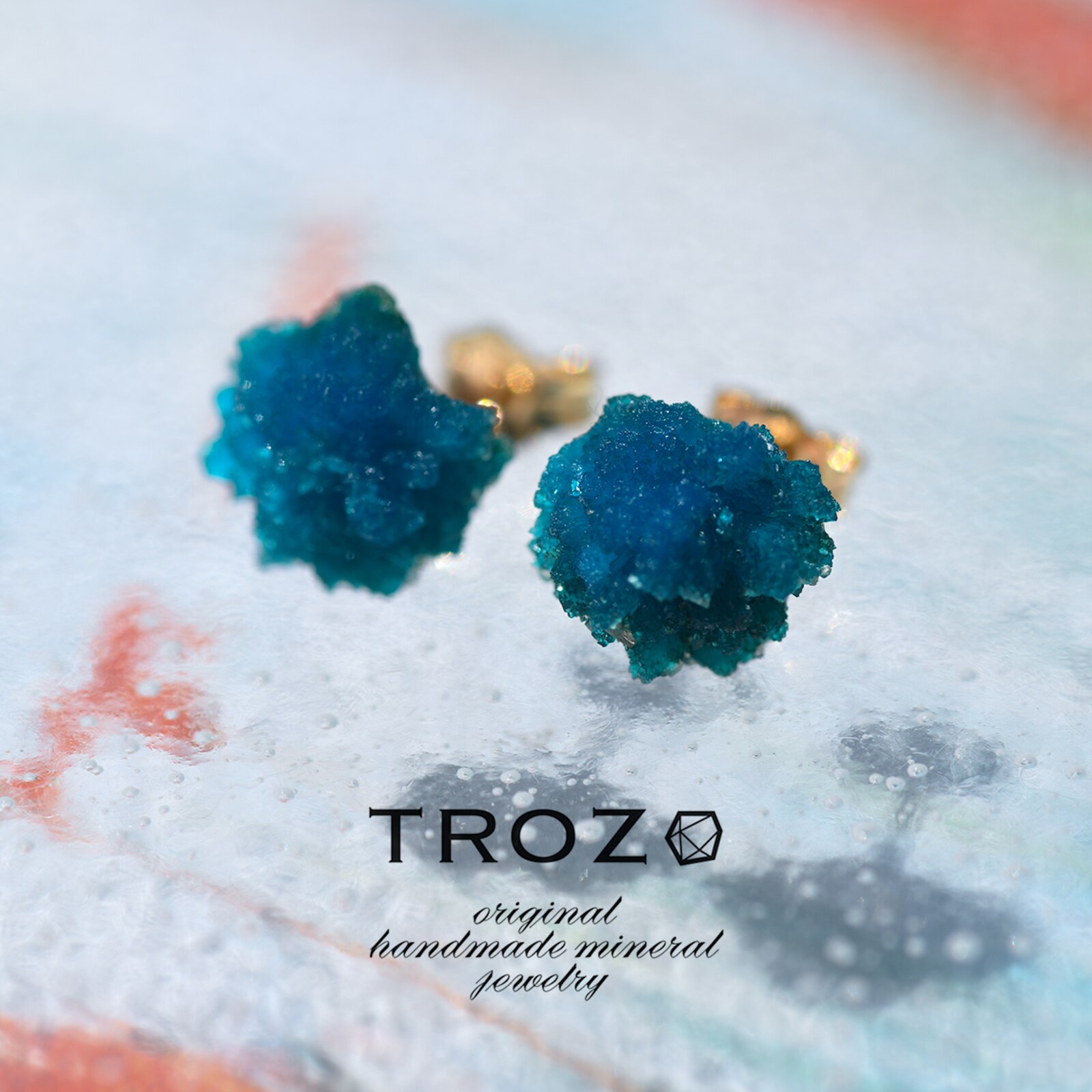
◆ Mineral Data
- English name
- Cavansite (a blend of the initials of Calcium + Vanadium + Silicate; named by Staples and others, 1973)
- Chemical formula
- Ca(VO)Si₄O₁₀·4H₂O (hydrated calcium vanadium silicate; V is tetravalent V⁴⁺, entering as a vanadyl group VO²⁺)
- Mineral class
- Phyllosilicate (sheet silicate) — the class of mica, talc and kaolinite, but with a special structure where VO₅ pyramids bridge the layers. A dimorph of pentagonite — the same composition, a different structure
- Crystal system
- Orthorhombic (space group Pcmn) — prismatic single crystals in radiating rosette, spherical and hemispherical clusters; good cleavage on {010}
- Mohs hardness
- 3 – 4
- Specific gravity
- 2.21 – 2.33
- Main sources
- The Wagholi quarries near Pune, Maharashtra, India — the market mainstay today, from Deccan-basalt cavities. Owyhee Dam, Malheur County, Oregon, USA — the 1967 discovery, the type locality. Minor occurrences: Goble, Columbia County, Oregon; New Zealand; Brazil; Norway; Scotland
- Color range
- Deep sky-blue to blue to blue-green (from the d¹ d–d transition of the vanadyl group VO²⁺); vitreous to pearly luster
- Notable trait
- A rosette of radiating needle crystals (blue flowers on a white stilbite matrix). Colored by vanadium V⁴⁺ — a mechanism distinct from copper Cu²⁺ (azurite, turquoise), iron Fe²⁺ (iolite) or sulfur radical S₃⁻ (lapis lazuli). A dimorph of pentagonite — same composition, different structure (like graphite/diamond, calcite/aragonite). A new mineral, found at Owyhee Dam in 1967, named 1973. Found in quantity at Wagholi, India around 1988, the modern market mainstay. From the cavities of Deccan basalt (K-Pg boundary, 66 million years)
- Birthstone
- Not an official Japanese (Zenhokyo) or wedding-anniversary stone. A relatively recent mineral without traditional lore, rising in popularity among mineral collectors and in the crystal market
◆ A blue drawn by vanadium — the V⁴⁺ d¹ coloring mechanism
Not copper, not iron — a deep sky-blue drawn by a d¹ electron.
Cavansite’s vivid sky-blue comes from vanadium V⁴⁺ entering the structure as a vanadyl group (VO²⁺), whose d¹ electron absorbs red light by a d–d transition. The world has many blue minerals, but the element that drives the color differs greatly from one to the next: azurite and turquoise are colored by copper Cu²⁺ (d⁹), iolite by an Fe²⁺ ↔ Mg²⁺ charge transfer (pleochroism), lapis lazuli by the electronic transition of the sulfur radical S₃⁻, and cavansite by vanadium V⁴⁺ (d¹). Even among “blue minerals”, a different element and electron configuration in the lattice sets the d–d transition energies and the color wavelength by an entirely different route. Cavansite’s vanadyl ion VO²⁺, a curious unit of V double-bonded to O, behaves within the structure to give the d¹ electron its characteristic energy levels and a sky-blue glow — a coloring mechanism found in no other blue mineral.
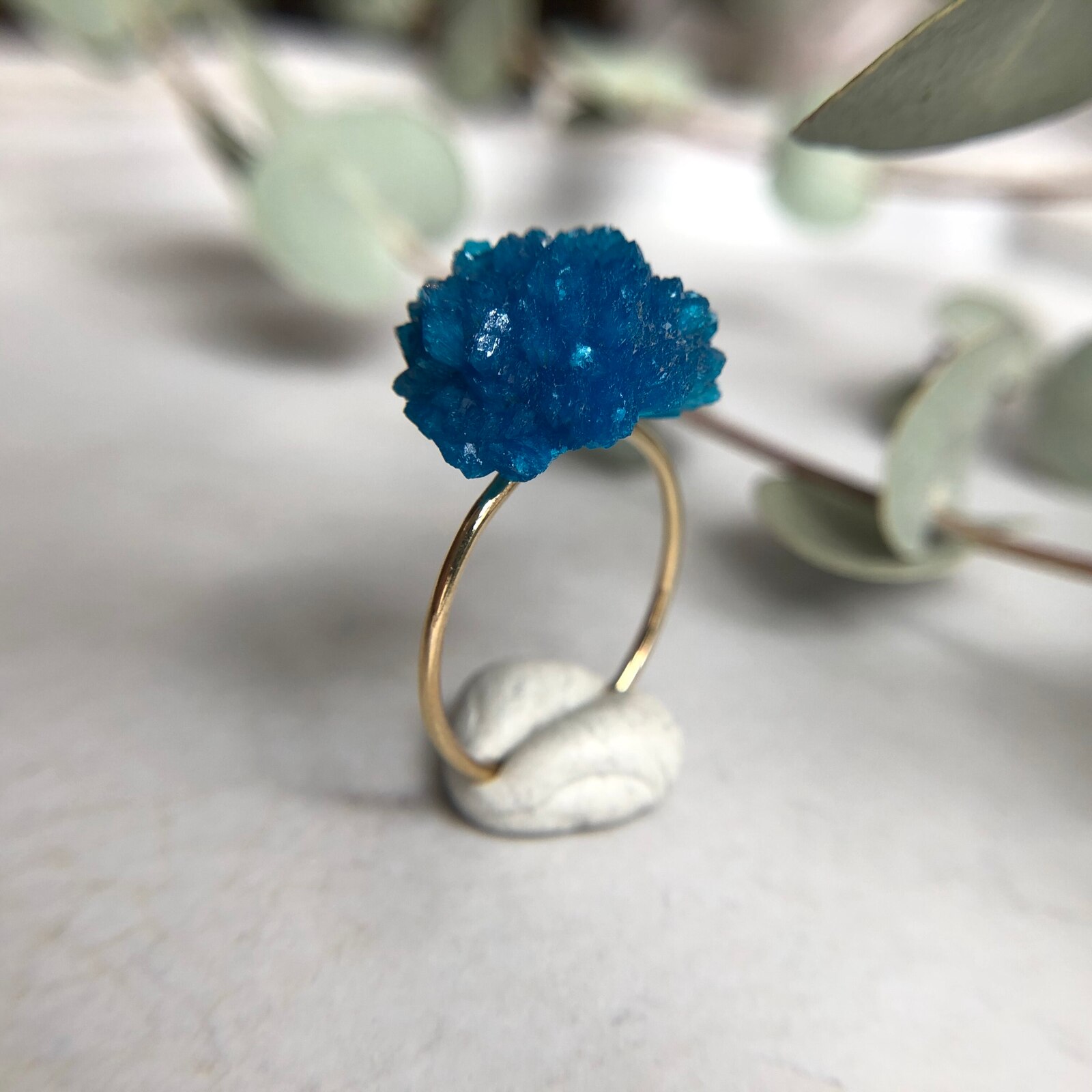
◆ A twin called pentagonite — dimorphism and Deccan basalt
Same formula, different structure; the twin with a star cross-section.
The other thing no account of cavansite can omit is its twin, pentagonite. The two are dimorphs — the same formula Ca(VO)Si₄O₁₀·4H₂O with a different crystal structure — described together as new minerals by Staples, Evans and Lindsay in 1973. The difference is the linkage of the silicate net: cavansite is built of 4- and 8-membered rings, pentagonite of 6-membered rings, whose crystals form a fiveling with a pentagonal-star cross-section that names it. Dimorphs of the same formula and different structure are textbook cases in mineralogy, alongside graphite and diamond (C), calcite and aragonite (CaCO₃), and rutile/anatase/brookite (TiO₂). The two occur together at the Wagholi quarry near Pune, Maharashtra, India, in the cavities of Deccan Traps basalt — strata from the great flood-basalt eruptions of the latest Cretaceous to earliest Paleogene (about 66 million years ago, the K-Pg boundary), a vast igneous body formed at the very time of the dinosaur extinction. Low-temperature hydrothermal solution seeped into the cavities of the cooled basalt, and cavansite bloomed there as a secondary mineral with zeolites such as stilbite and apophyllite — a blue crystal flower on a white matrix, and a memory of the Earth 66 million years ago.
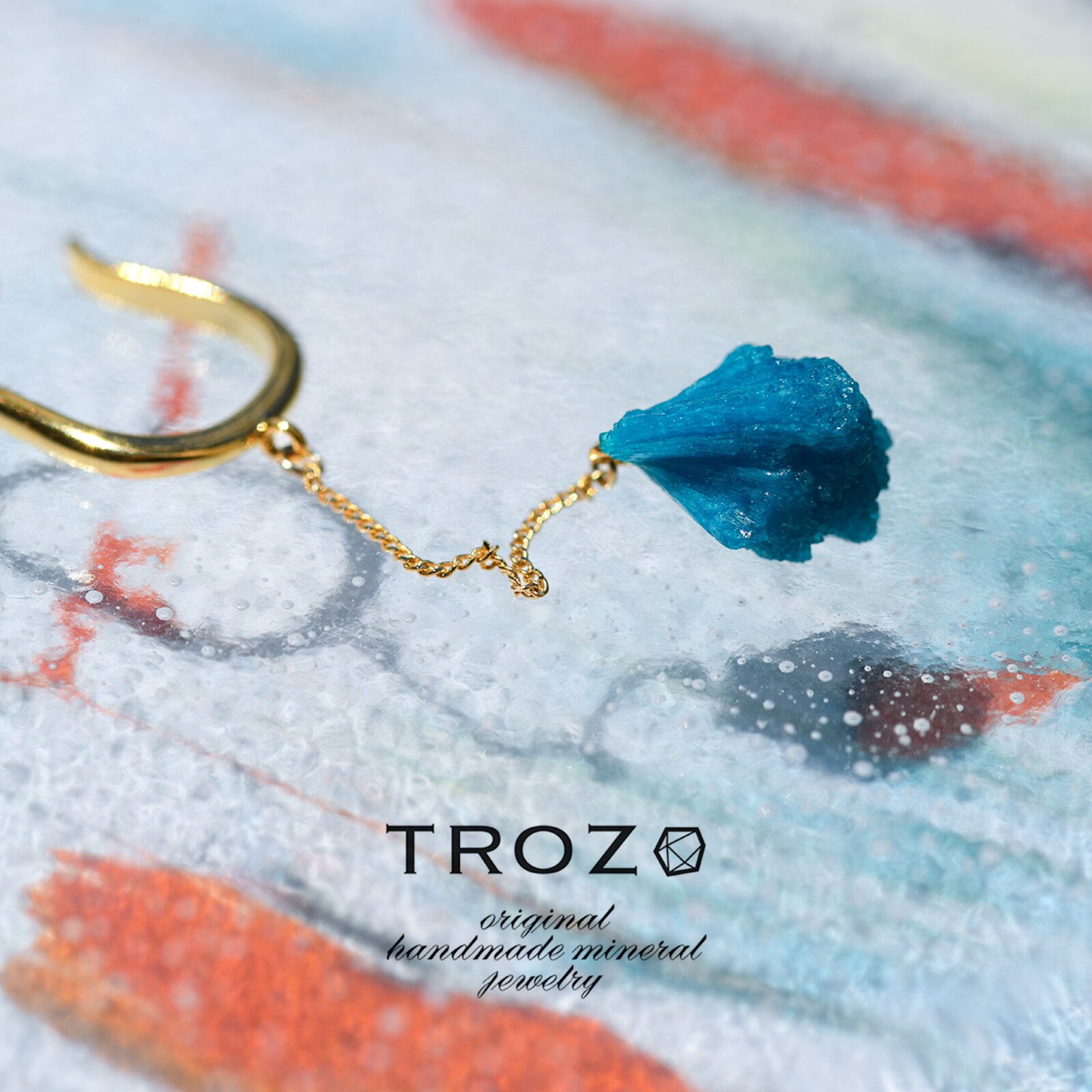
◆ Choosing raw cavansite jewelry
Choose by the density of the rosette, the depth of blue and its delicate care.
The heart of enjoying raw cavansite is the density of the rosette and the depth of blue blooming on a white stilbite matrix. The denser and deeper-blue the rosette of needle crystals, the higher the regard, and fine Wagholi specimens have been prized as something exceptional in the collector market. The contrast with the matrix — a blue rosette on white stilbite — is the heart of its beauty, so handling it carefully together with the matrix is the basis, both as a specimen and as raw-mineral jewelry.
TROZO sets cavansite with its matrix-bearing crystal cluster intact. At Mohs 3–4 it is very brittle, and the rosette of needle crystals collapses readily under a light knock, so avoid hard impacts and never use an ultrasonic or steam cleaner. Being hydrated, it can lose its crystal water to heat or drying, and contact with sweat, vinegar and ammonia-based cleaners should be avoided. Keep it from direct sun and high humidity, store it dry in its own case with the matrix, and take the greatest care not to let it touch other stones. Because it resembles pentagonite, a trusted identification and source documentation help confirm natural origin. Wear the deep-blue rose drawn by vanadium, in the raw-mineral jewelry TROZO makes.
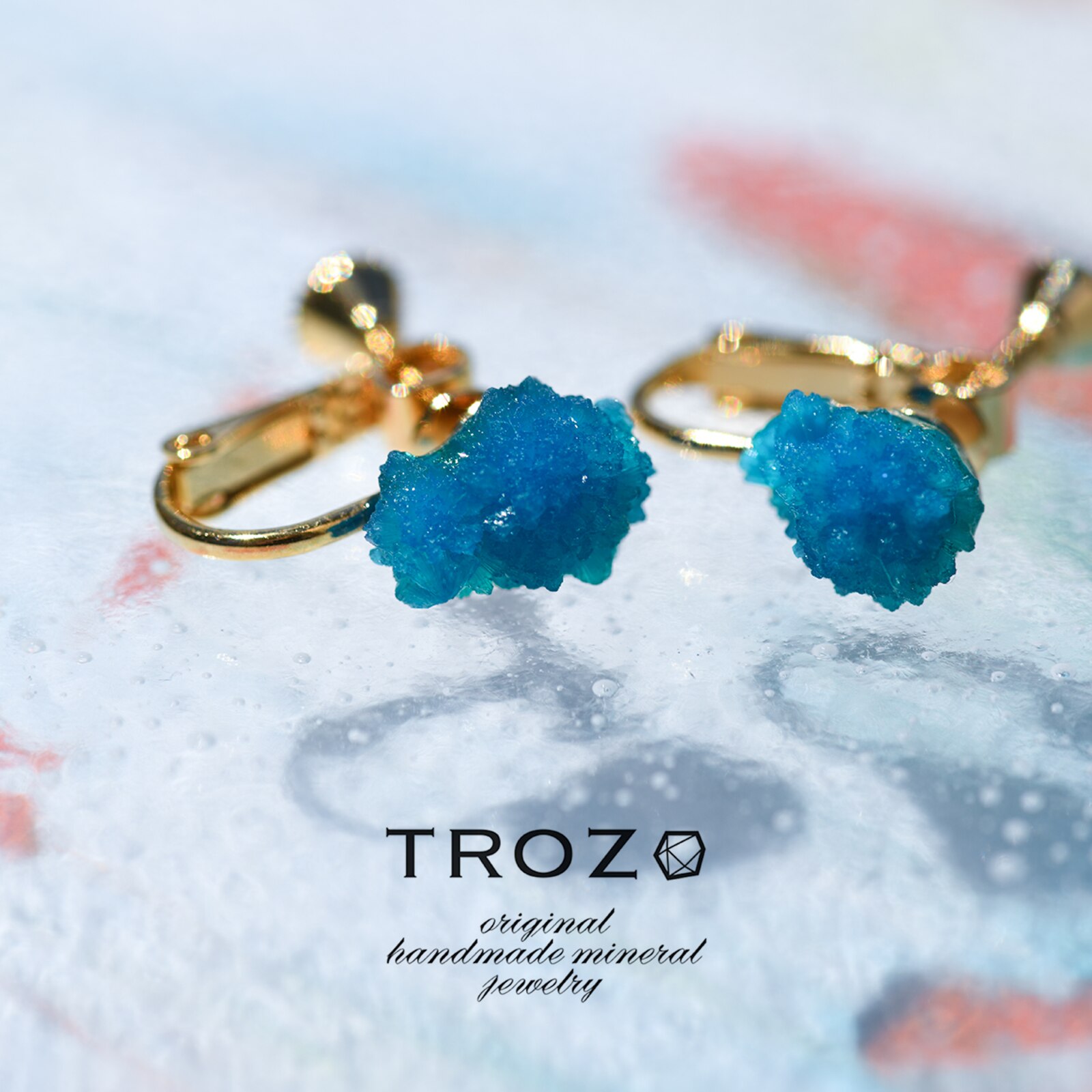
◆ Cavansite Raw-Stone Jewelry
Handmade raw stone & mineral pieces — TROZO
◆ Frequently Asked Questions about Cavansite
Q What does cavansite symbolize?
Cavansite is traditionally associated with intuition, healing, spiritual awakening, seeing the truth, communication, self-expression, deep insight and creativity. As a relatively new mineral (found 1967, named 1973) it has no traditional lore — these meanings spread through the modern crystal market. From its deep-blue rosette crystals, it is cherished as a “stone of inner sight and self-expression”.
Q Is cavansite a birthstone?
Cavansite is not a designated birthstone in Japan, nor a designated anniversary stone. As a very new mineral (found 1967, named 1973), it sits outside the birthstone and anniversary frameworks. In Japan it is chosen as non-birthstone mineral jewelry by those drawn to the deep-blue rosette drawn by vanadium and the rarity of its source.
Q What does the name “Cavansite” stand for?
The name “Cavansite” is a blend of the initials of Ca (calcium) + Van (vanadium) + Si (silicate) — a straightforward naming after the three main elements of the formula Ca(VO)Si₄O₁₀·4H₂O. It was coined when Lloyd W. Staples, Howard T. Evans Jr. and James R. Lindsay described it as a new mineral in *American Mineralogist* in 1973 — a clear case of the composition becoming the name.
Q How do cavansite and pentagonite differ?
Cavansite and pentagonite are dimorphs — twins with the same formula Ca(VO)Si₄O₁₀·4H₂O but a different crystal structure. The difference is the linkage of the silicate net: cavansite is built of 4- and 8-membered rings, pentagonite of 6-membered rings, whose prismatic crystals form a fiveling with a pentagonal-star cross-section (pentagon = five-sided), giving pentagonite its name. Dimorphs of the same formula and different structure are textbook cases like graphite and diamond (C), calcite and aragonite (CaCO₃). The two occur together at Wagholi, India and are hard to tell apart by eye, so a sure distinction needs the star-shaped twin cross-section under the microscope.
Q Why is cavansite found at Wagholi, India?
Cavansite’s modern main source, the Wagholi quarries near Pune, Maharashtra, India, has a host of Deccan Traps basalt — strata formed by the great flood-basalt eruptions of the latest Cretaceous to earliest Paleogene (about 66 million years ago, the K-Pg boundary). This was one of the largest igneous events in Earth’s history, at the very time of the dinosaur extinction; the cooled basalt left many cavities (geodes), into which low-temperature hydrothermal solution seeped and secondary minerals crystallized — stilbite, apophyllite and cavansite among them. The type locality is Owyhee Dam, Oregon (found 1967), but since the quantity discovery at Wagholi around 1988, the market mainstay has been Indian material.
Q How does cavansite’s blue differ from other blue minerals?
Cavansite’s deep sky-blue comes from vanadium V⁴⁺ entering the structure as a vanadyl group (VO²⁺), whose d¹ electron absorbs red light by a d–d transition. Compared with other blue minerals — azurite and turquoise are copper Cu²⁺ (d⁹), iolite an Fe²⁺ ↔ Mg²⁺ charge transfer, lapis lazuli the sulfur radical S₃⁻ — the driving element and electron configuration differ entirely. A mineral in which vanadium is the lead of blue color is itself rare in mineralogy, one of cavansite’s distinctive values.
Q What care does cavansite need?
Cavansite is very brittle at Mohs 3–4, and the rosette of needle crystals collapses readily under a light knock. Avoid hard impacts, and never use an ultrasonic or steam cleaner. Being hydrated, it can lose its crystal water to heat or drying, and contact with sweat, vinegar, ammonia-based and acidic cleaners should be avoided. Keep it from direct sun and high humidity, store it dry in its own case with the matrix (stilbite), and take the greatest care not to let it touch other stones.
Q What kinds of jewelry can cavansite become?
As natural-stone jewelry, cavansite is used for raw-stone earrings, necklaces and brooches. The cavansite rosette is very fragile and demands the greatest care as jewelry, so most circulates as mineral specimens. TROZO offers raw-mineral jewelry that keeps the cavansite rosette on its white stilbite matrix — both pieces you can choose by the density of the rosette and the depth of blue from stock, and pieces where the meeting with the stone is left to chance. It is a natural stone that lets you wear the deep-blue rose drawn by vanadium, a coloring and crystal form distinctive even among blue minerals.
EXPLORE THE SHOP
Explore the world of Cavansite
Discover more pieces than we can show here at the TROZO shop.
Shop Cavansite