
Opal
Light and water woven into living color — October’s birthstone, the gem that holds a rainbow.
Opal (SiO₂·nH₂O, hydrated silica) is a rare gem whose orderly, stacked microspheres of silica diffract light into a shifting rainbow known as play-of-color. It is amorphous — a “mineraloid” with no crystal lattice — with a Mohs hardness of 5.5–6.5. As October’s birthstone, its traditional associations include hope, innocence and creativity. Opal divides into precious opal, which shows play-of-color (black, white, fire, water, boulder), and common opal, which does not — each with a character entirely its own.
Opal is the October birthstone. See all October birthstones →
◆ Opal — Stone Meanings
- Hope
- Innocence
- Purity
- Creativity
- Artistic inspiration
- Happiness
- Embracing change
- A talisman of rainbows
◆ About Opal
Opal has the chemical formula SiO₂·nH₂O — hydrated silica. Its defining trait is that it is amorphous: it has no crystal structure, which places it among the “mineraloids” rather than true minerals. Its Mohs hardness is 5.5–6.5 and its specific gravity 1.9–2.3. Because it carries water within (the n × H₂O), opal is a delicate stone, sensitive to dryness, heat and sudden change.
Its great beauty is the flashing rainbow called play-of-color. This is an optical effect unique to a non-crystalline stone: inside opal, silica spheres roughly 0.1 µm across are stacked in an orderly array, and light passing between them is diffracted and split into separate colors. The size of the spheres governs which wavelengths interfere, so reds, greens and blues each appear in turn.
Precious opal — opal that shows play-of-color — comes in several main types defined by body color and origin. Black opal, with a dark blue-to-black body that makes the colors leap out, is the most prized (Lightning Ridge in Australia is the famed source). White opal, with a pale body, is the most widely seen (chiefly from Coober Pedy). Fire opal from Mexico has an orange-to-red body color. Water opal is near-transparent so the color seems to float, and boulder opal is cut together with its host rock. Opal with little or no play-of-color is called common opal.
October’s birthstone and a gift for the 14th and 34th wedding anniversaries, opal carries the associations of hope, innocence, purity and creativity. Tilt it and the rainbow dances — opal is the classic example of a raw stone that seems to move with the light.
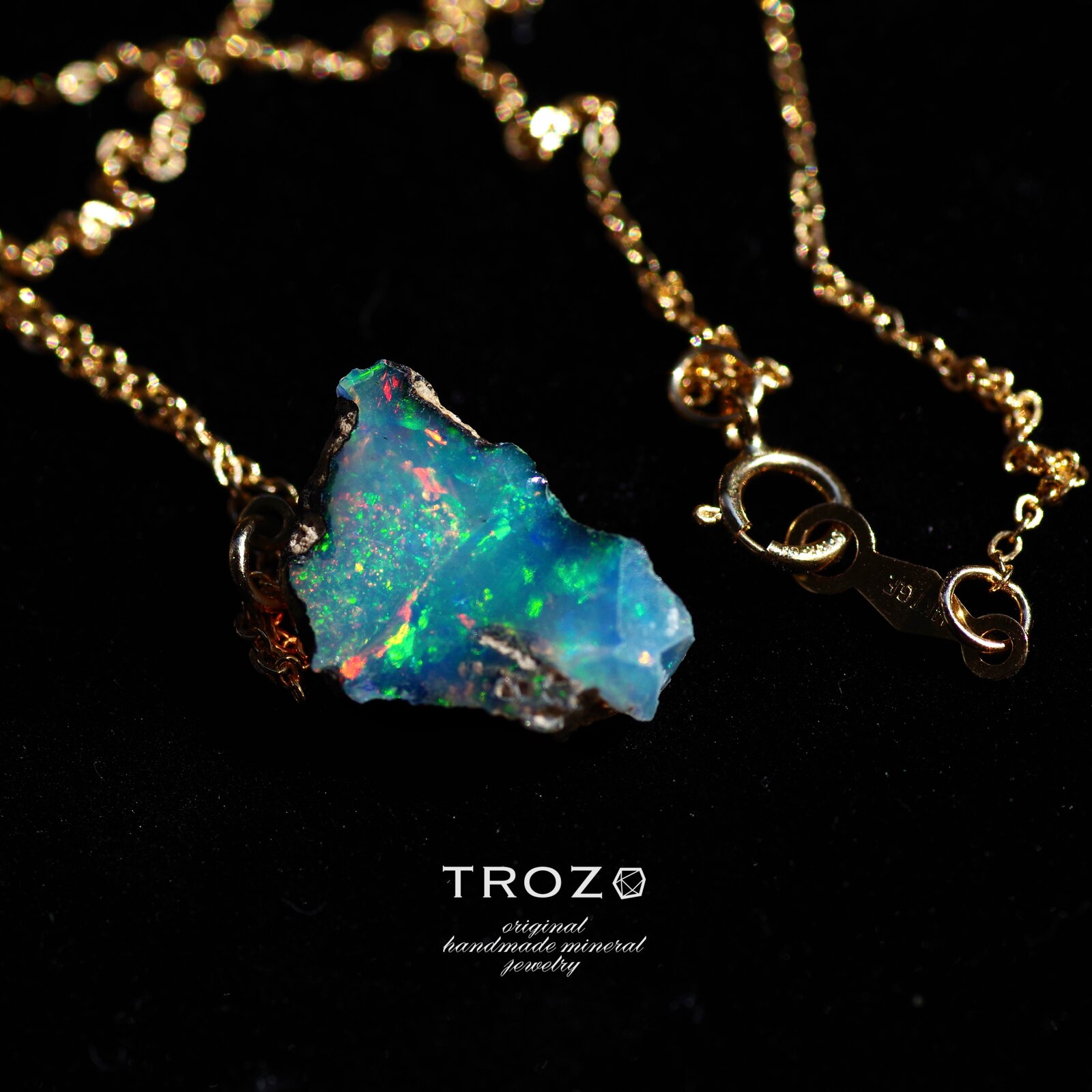
◆ Mineral Data
- English name
- Opal
- Chemical formula
- SiO₂·nH₂O (hydrated silica — contains water)
- Mineral class
- Mineraloid — amorphous, so strictly outside the formal mineral classification
- Crystal system
- Amorphous (no crystal structure)
- Mohs hardness
- 5.5 – 6.5
- Specific gravity
- 1.9 – 2.3
- Main sources
- Australia (Coober Pedy, Lightning Ridge — roughly 95% of world supply), Mexico (fire opal), Ethiopia, Brazil, USA (Nevada)
- Color range
- Precious opal with play-of-color (black / white / fire / water / boulder), and common opal without it (white to pale to orange body color)
- Notable trait
- Stacked ~0.1 µm silica spheres diffract light into rainbow play-of-color; being hydrated, it is sensitive to dryness, heat and shock
- Birthstone
- October
◆ How play-of-color works — 0.1 µm spheres that hold a rainbow
Not a crystal, but color born from the interference of light.
Opal’s flashing rainbow — its play-of-color — is an optical effect unique to this non-crystalline stone. Inside opal, tiny silica spheres about 0.1 micrometers (µm) across are stacked in a regular array, and light diffracts and disperses in the gaps between them so that colors separate and appear. Because the wavelength that interferes depends on the size of the spheres, hues from red (larger spheres) to blue (smaller spheres) emerge. A stone that is not a crystal, yet sets light dancing through a regular microscopic structure — this is why opal is called a “mineraloid”, a gem in a category of its own.
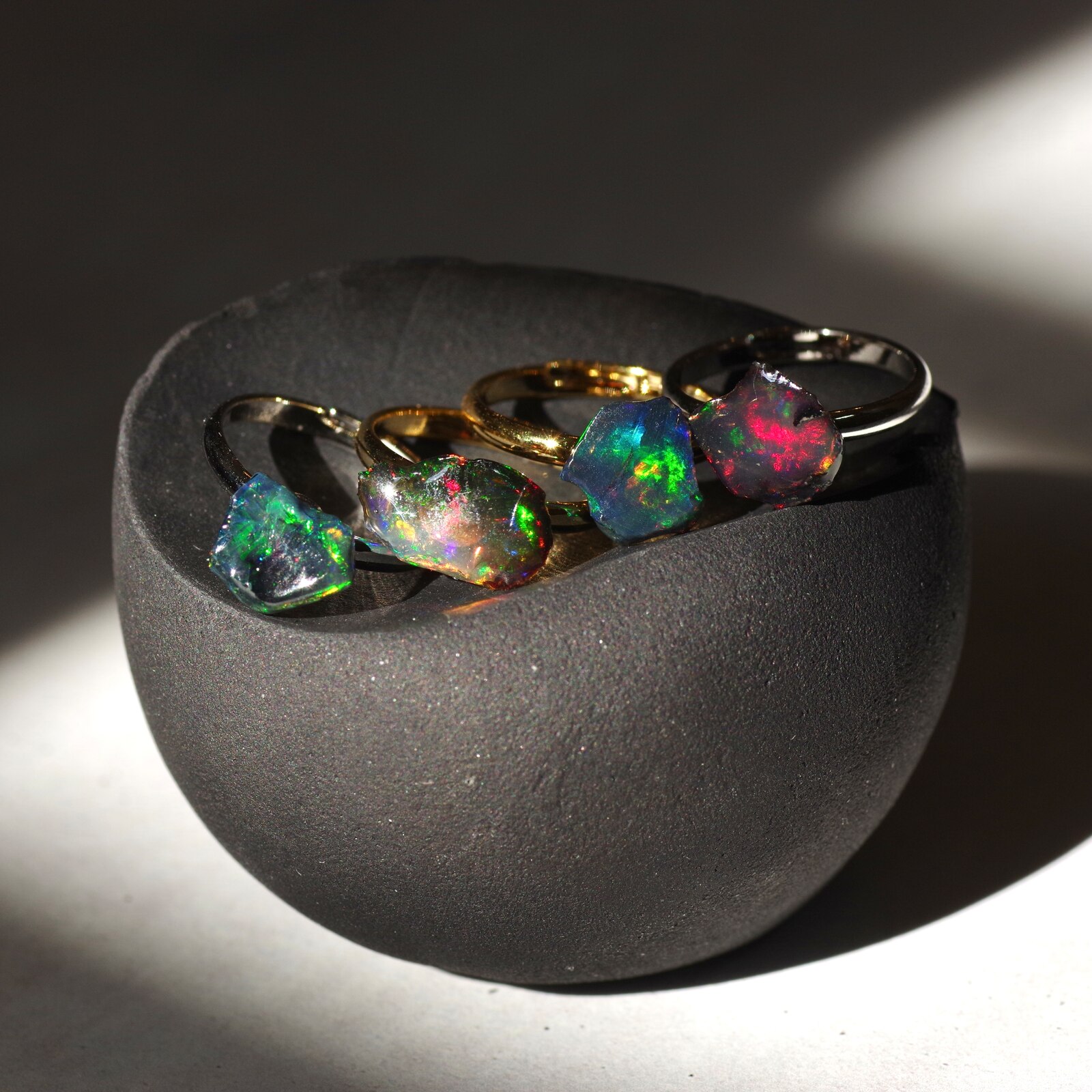
◆ Types of precious opal — from black to fire
Five distinct characters, set by body color and origin.
Precious opal (opal that shows play-of-color) falls into five main types according to body color and source. Black opal, with a dark blue-to-black body that makes the play-of-color blaze, is the most highly valued, and Lightning Ridge in Australia is its celebrated home. White opal, with a pale body, is the most familiar and widely available type, typified by Coober Pedy. Fire opal from Mexico has an orange-to-red body color — some stones show play-of-color, others are prized for the body color alone. Water opal has a transparent body so the colors seem to lift off the stone, while boulder opal is cut together with its Australian host rock. Opal with little or no play-of-color is called common opal.
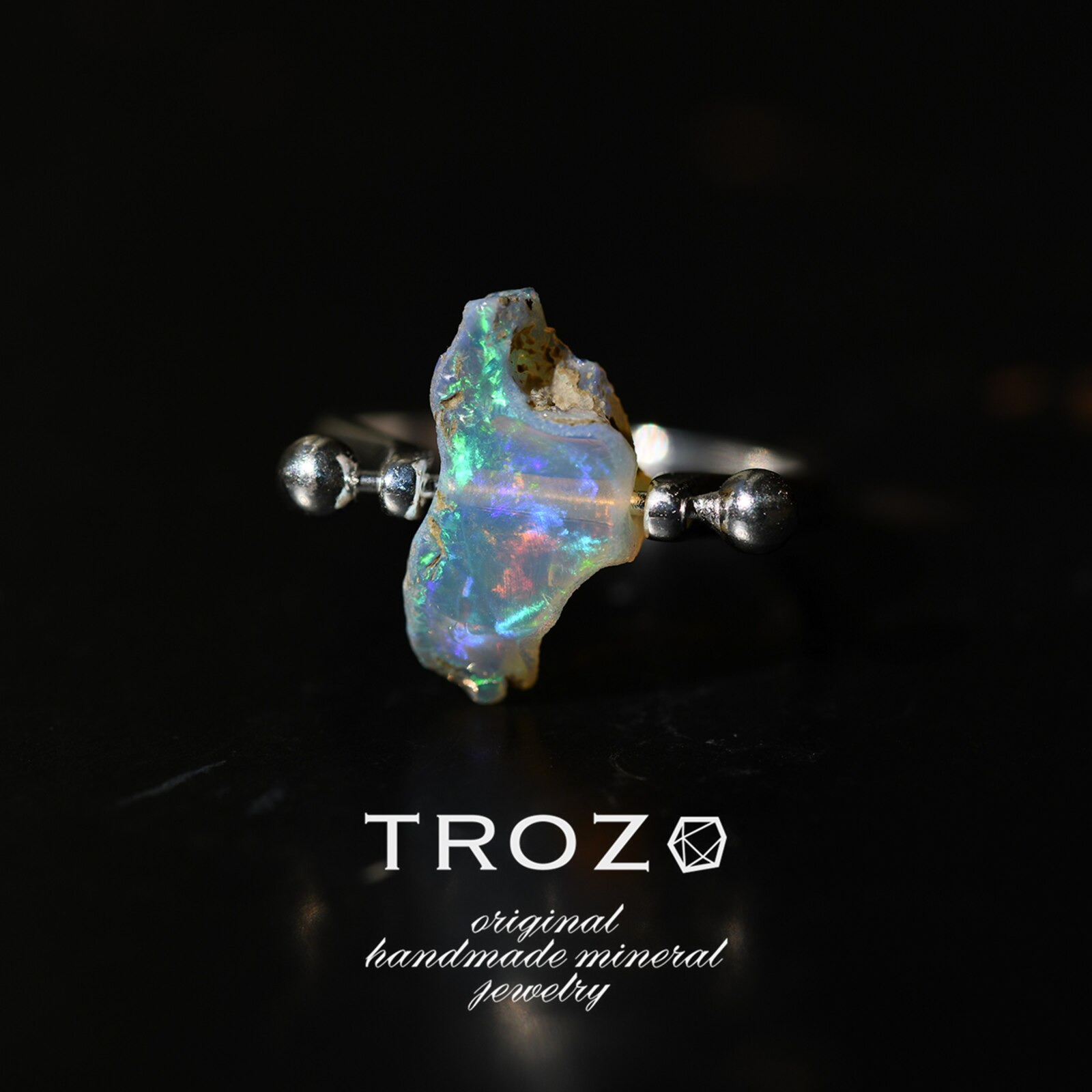
◆ Choosing raw opal jewelry
Choose by play-of-color, body color and size — and treat it with care.
At Mohs 5.5–6.5 opal is softer than many gemstones, and because it is a hydrated stone it is genuinely delicate with dryness, heat, shock and sudden temperature change. Keep it away from long spells of direct sun, the direct draught of an air-conditioner and very dry air, and store it in a soft pouch or box that holds a little humidity. Take it off for bathing, sport and housework, and never use an ultrasonic cleaner. The character of a raw opal lives in its play-of-color pattern (pinfire, flame, broad-flash and so on), the contrast of its body color, and the drama the stacked silica spheres create.
TROZO works opal without polishing away its character, setting each stone so that its natural play-of-color and body-color contrast lead the design. We offer pieces for those who would like to choose the type of play-of-color, body color and size from stock, as well as pieces where we entrust the meeting to chance. Because opal is a delicate material, we are always happy to talk through storage and care so it stays beautiful for years.
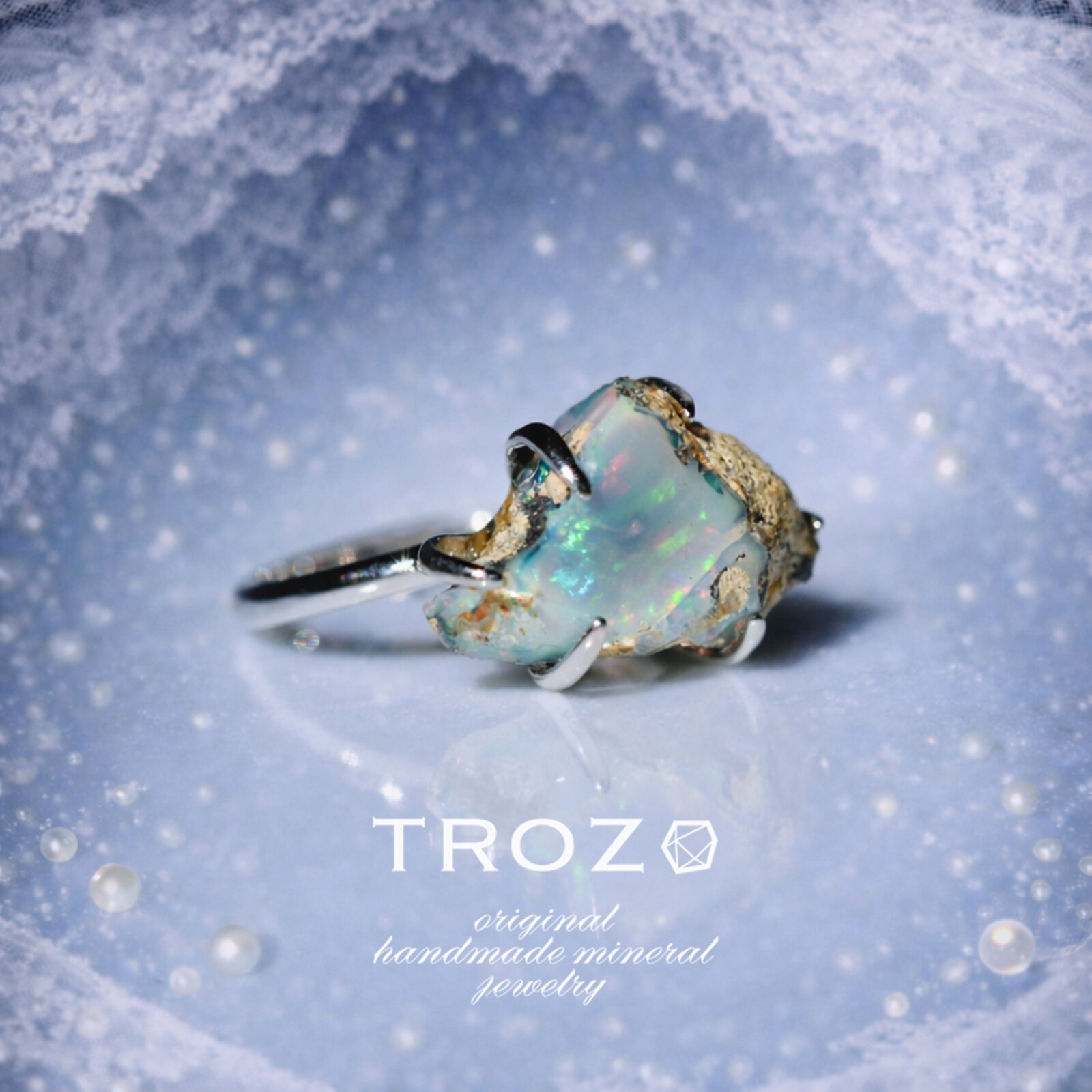
◆ Opal Raw-Stone Jewelry
Handmade raw stone & mineral pieces — TROZO
◆ Frequently Asked Questions about Opal
Q What does opal symbolize?
Opal is traditionally associated with hope, innocence, purity, creativity, artistic inspiration, happiness and change. It is October’s birthstone and a customary gift for the 14th and 34th wedding anniversaries.
Q What exactly is play-of-color?
It is the rainbow flash created when light meets the orderly stack of roughly 0.1 µm silica spheres inside opal and is diffracted and dispersed in the gaps between them. Because the interfering wavelength depends on the size of the spheres, different colors — red, green, blue and more — appear as you move the stone. It is an optical effect unique to opal, which has no crystal structure.
Q What is the difference between black opal and white opal?
It is the body color. Black opal has a dark blue-to-black body that makes the play-of-color stand out vividly; it is the most prized precious opal, and Lightning Ridge in Australia is world-famous for it. White opal has a pale body, is more readily produced and so is the more commonly seen type, typified by Coober Pedy.
Q How hard is opal, and how should I look after it?
Its Mohs hardness is 5.5–6.5, on the softer side for a gem, and because it is a hydrated stone it is sensitive to dryness, heat, shock and sudden temperature change. Store it away from prolonged direct sunlight, the direct draught of an air-conditioner and very dry air. Take it off for bathing, sport and housework, and do not use an ultrasonic cleaner.
Q Does fire opal have play-of-color?
Fire opal has an orange-to-red body color, and it exists both with and without play-of-color. Its main source is Mexico, and the vividness of the body color is its great appeal. Stones that do show play-of-color are sometimes called “fire precious opal”.
Q What kinds of jewelry can opal become?
As natural-stone jewelry, opal is used for raw-stone earrings, necklaces, rings, brooches and ear cuffs. TROZO makes opal jewelry that keeps the stone unpolished so its play-of-color and body-color contrast lead the design — both pieces where you can choose the type of play-of-color, body color and size from stock, and pieces where the meeting with the stone is left to chance.
Q What are doublets and triplets?
These are assembled opal products in which a thin slice of opal is glued to a backing and, sometimes, a protective cap. A doublet is a two-layer construction (dark backing plus a thin opal layer); a triplet is three layers (a protective crystal cap, a thin opal layer, and a dark backing). They create a black-opal look inexpensively, but they are not the same as a natural solid opal. TROZO works only with natural solid opal.
EXPLORE THE SHOP
Explore the world of Opal
Discover more pieces than we can show here at the TROZO shop.
Shop Opal