
Sunstone
A solar flash thrown by flakes of copper — the counterpart to moonstone.
Sunstone (also heliolite) is the name for plagioclase feldspars that hold flakes of metal or oxide minerals and throw a metallic flash with the angle of light. Triclinic, Mohs 6–6.5. Its flash, “aventurescence (schiller)”, comes from aligned platelets — native copper (Cu) or hematite — reflecting incoming light specularly. Oregon sunstone, named Oregon’s state gemstone in 1987, holds native copper plates in labradorite formed in basalt. It is the feldspar-group counterpart to moonstone — “sun” to its “moon”.
◆ Sunstone — Stone Meanings
- The energy of the sun
- Confidence
- Leadership
- Vitality
- Optimism
- Drive
- Positivity
- Creativity
◆ About Sunstone
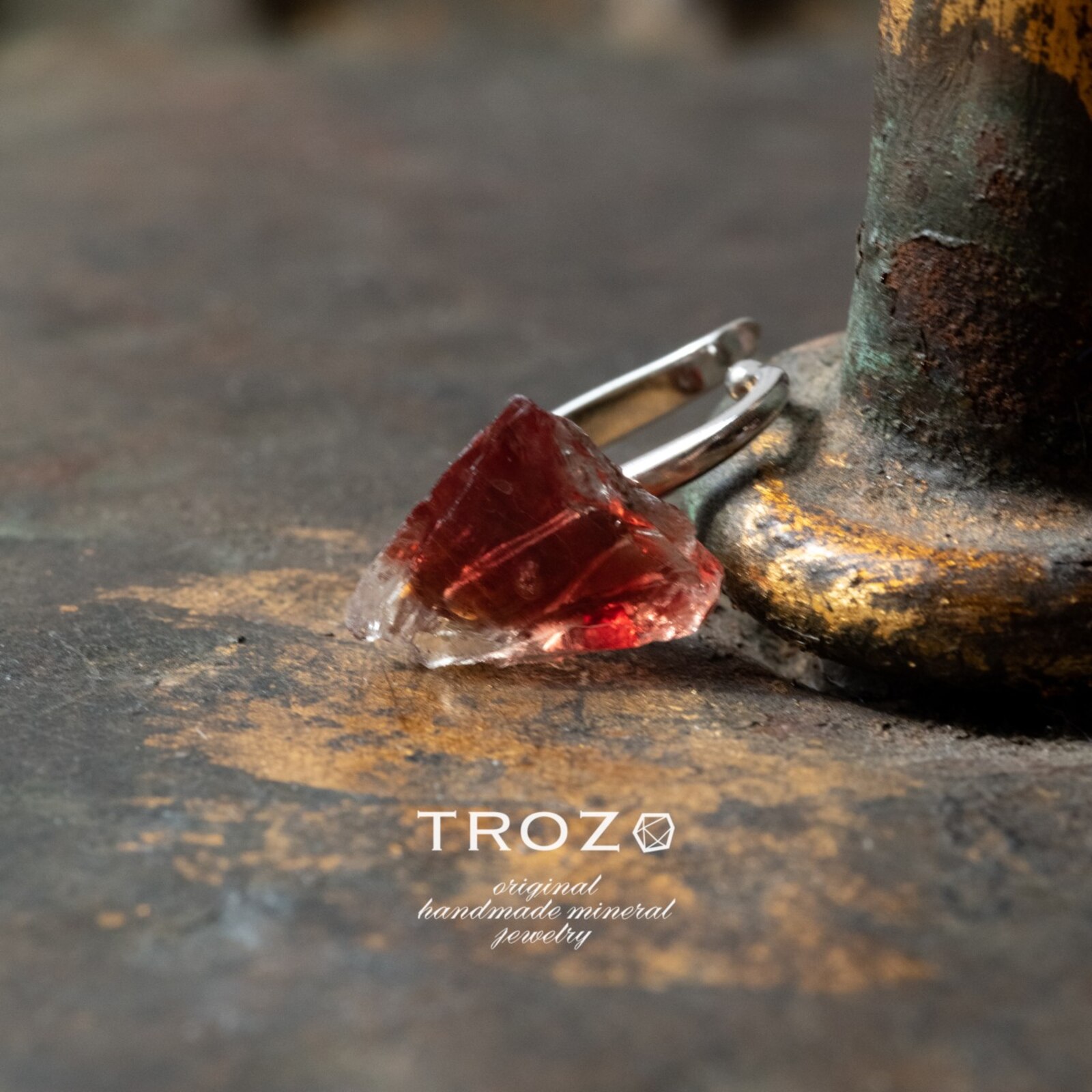
Sunstone (also called heliolite) is a plagioclase feldspar — a silicate of the feldspar group within the albite NaAlSi₃O₈ ↔ anorthite CaAl₂Si₂O₈ solid-solution series, formula (Ca,Na)Al(Si,Al)Si₂O₈. It is triclinic, Mohs 6–6.5, SG 2.62–2.66, with perfect cleavage along (001). “Sunstone” is, strictly, not a mineral species but a trade name for an optical effect — the host spans oligoclase, labradorite and bytownite, the common thread being “holds flakes of metal or oxide minerals and throws a metallic flash with the angle of light”. Its Japanese name, “sun feldspar”, was coined for symmetry with moonstone, the feldspar that throws a soft blue-white light.
Sunstone’s greatest appeal is aventurescence (schiller) — the metallic flash that arises when aligned platelet inclusions reflect incoming light specularly. The inclusions are metal flakes well larger than the wavelength of light (tens to hundreds of µm), aligned parallel to the (001) cleavage of the feldspar, so at a certain angle many small plates reflect together in the same direction and reach the eye as a strong flash. Part of sunstone’s interest is that the inclusion type differs by source: Oregon material holds native copper (platelets of elemental Cu), while Indian, Norwegian and Tanzanian material holds mainly hematite or goethite flakes. Copper gives a red-orange-green schiller, and hematite can give a rainbow with thin-film interference — the host and inclusion together set the range of character.
Best known of all is Oregon sunstone, mined in Harney County (the Plush district) and eastern Lake County (the Ponderosa and Dust Devil mines) of Oregon, USA — a gem-quality sunstone of labradorite-to-bytownite plagioclase crystallized in basalt lava, holding plates of native copper. It was named Oregon’s state gemstone on 4 August 1987. The clearest material is faceted and treated as a gemstone. As a member of the feldspar group, the contrast with moonstone is fascinating: moonstone is an adularia/orthoclase (potassium feldspar) and albite lamellar structure giving adularescence (a Rayleigh-scattered blue-white glow), while sunstone is a plagioclase with metal plates giving aventurescence (a specular metallic flash) — “the moon’s soft light” and “the sun’s flash”, told as a pair on different physical foundations.
Sunstone’s main sources are Oregon, USA (Plush, Ponderosa, Dust Devil — native-copper sunstone, the state gemstone), India (Tamil Nadu — hematite plus oligoclase), Norway (Tvedestrand — a classic source, hematite/goethite), Tanzania (near Arusha, found 2000), Russia (around Lake Baikal) and Canada (Ontario, Quebec). Norway has the “Viking sunstone” legend of the medieval sagas, of navigators reading the sun’s position by polarization — though modern scholarship holds that the legendary stone was more likely calcite (Iceland spar) or cordierite (iolite), probably distinct from feldspar sunstone. At Mohs 6–6.5 it is of standard feldspar hardness, but with its perfect (001) cleavage it can break under a hard blow, so ultrasonic and steam cleaners are best avoided as a precaution.
◆ Mineral Data
- English name
- Sunstone (also heliolite, from the Greek *helios*, sun, + *lithos*, stone; aventurine feldspar)
- Chemical formula
- (Ca,Na)Al(Si,Al)Si₂O₈ — a plagioclase feldspar solid solution (albite NaAlSi₃O₈ ↔ anorthite CaAl₂Si₂O₈)
- Mineral class
- Tectosilicate — feldspar group — plagioclase series. Not a mineral species but a trade name for an optical effect; the host spans oligoclase, labradorite and bytownite. Moonstone is an adularia/orthoclase (potassium feldspar), a different subseries
- Crystal system
- Triclinic — perfect cleavage along (001), good cleavage along (010)
- Mohs hardness
- 6 – 6.5
- Specific gravity
- 2.62 – 2.66
- Refractive index
- 1.525 – 1.58
- Main sources
- USA (Oregon: Plush, Ponderosa, Dust Devil — native-copper sunstone, 1987 state gemstone), India (Tamil Nadu — hematite + oligoclase), Norway (Tvedestrand — classic source), Tanzania (near Arusha, found 2000), Russia (Lake Baikal), Canada (Ontario, Quebec), Madagascar, Mexico, South Australia
- Color range
- Transparent to opaque, pale yellow to orange to red-brown to red; green or blue schiller (Oregon copper-bearing type); rainbow (hematite thin-film interference)
- Notable trait
- Aventurescence (schiller) — platelet inclusions of metal or oxide minerals aligned to the (001) cleavage (varying by source: Oregon = native copper, India/Norway = hematite/goethite) throw a metallic flash by specular reflection. Oregon’s state gemstone (1987). The feldspar-group counterpart to moonstone — “sun” and “moon”. The Viking-sunstone legend exists, though scholarship favors calcite/cordierite as the legendary mineral, distinct from feldspar sunstone. Perfect cleavage — can break under impact
- Birthstone
- Not an official Japanese (Zenhokyo) or wedding-anniversary stone. Oregon’s official state gemstone (designated 1987)
◆ A flash thrown by flakes of copper — the physics of aventurescence
Aligned metal plates within the crystal return the light together.
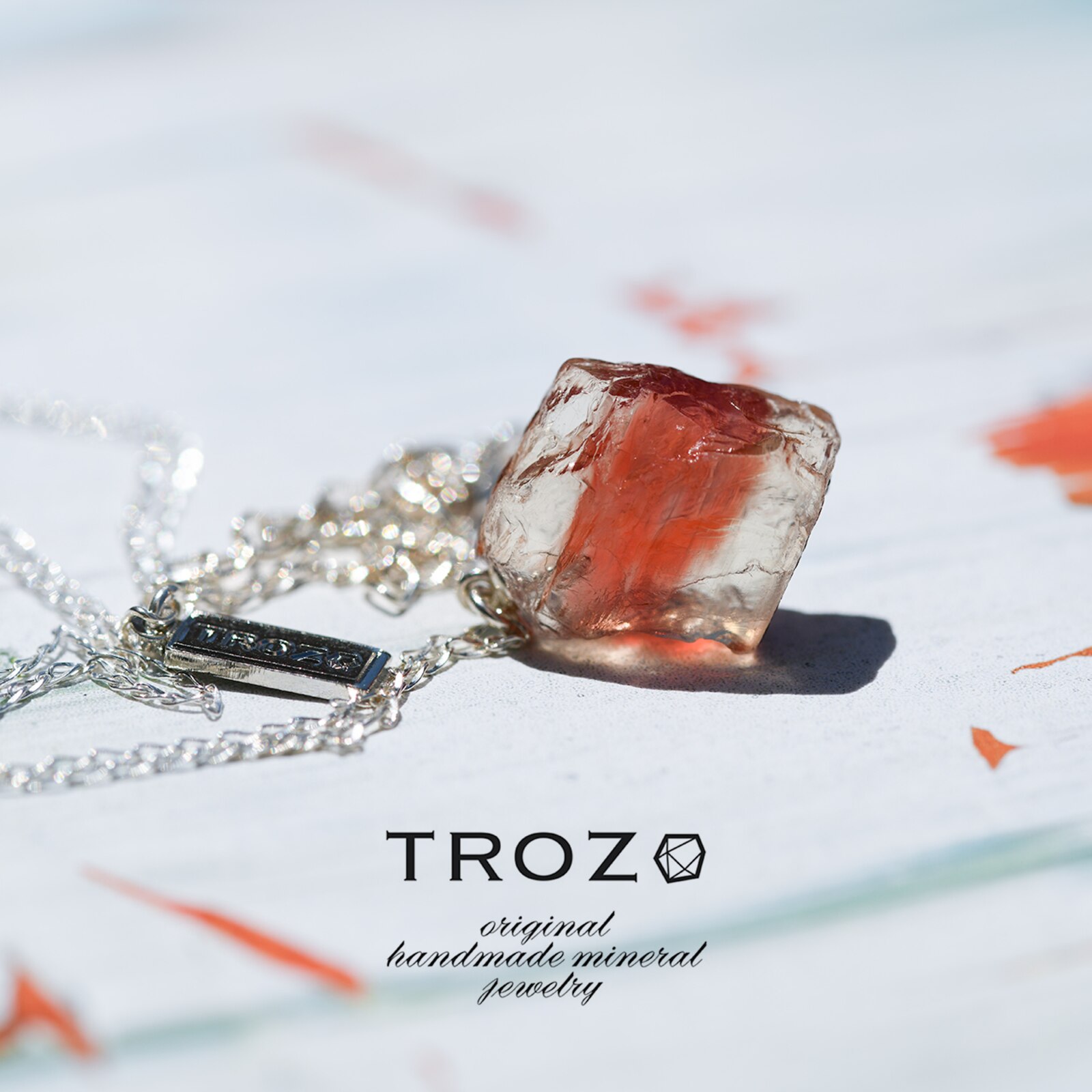
The star of any account of sunstone is the optical effect of aventurescence (schiller). The platelet inclusions of metal or oxide minerals within the crystal are dispersed parallel to the (001) cleavage — and when light strikes, these countless small plates reflect specularly in the same direction, reaching the eye as a strong metallic flash. Because the inclusions are well larger than the wavelength of light (tens to hundreds of µm), this is not the diffuse (Rayleigh) scattering of moonstone but, quite literally, “tiny mirrors arrayed within the crystal”. The inclusion type differs by source: Oregon material holds native copper (platelets of elemental Cu), while Indian, Norwegian and Tanzanian material holds mainly hematite (Fe₂O₃) or goethite (FeO(OH)). Copper plates give a red-orange-green schiller, and hematite films can give a rainbow with thin-film interference. “Flakes of copper throwing a solar flash” — for Oregon sunstone, no tagline is more physically exact.
◆ The counterpart to moonstone — Oregon’s state gemstone and the Viking legend
The moon’s soft light and the sun’s flash, twins of the feldspar group.
Sunstone is the natural stone paired with moonstone in the feldspar group. Moonstone is an adularia/orthoclase (potassium feldspar) and albite lamellar structure giving adularescence (a Rayleigh-scattered blue-white glow), while sunstone is a plagioclase with metal plates giving aventurescence (a specular metallic flash) — different subseries on different physical foundations, “the moon’s soft light” and “the sun’s flash”, the names coined for the symmetry of their optics. Best known is Oregon sunstone, mined in the Plush district of Harney County and eastern Lake County (the Ponderosa and Dust Devil mines) of Oregon — a rare gem-quality sunstone of labradorite-to-bytownite plagioclase crystallized in basalt lava, holding native copper plates, named Oregon’s state gemstone on 4 August 1987. Norway’s Tvedestrand is a classic source, and the medieval sagas (such as the *Saga of King Olaf*) tell of the “Viking sunstone” as a navigation tool — that a sailor read the sun’s position by the stone’s polarization on a cloudy day. But modern scholarship holds the legendary mineral was more likely calcite (Iceland spar) or cordierite (iolite), probably distinct from feldspar sunstone.
◆ Choosing raw sunstone jewelry
Choose knowing the inclusion by source, the strength of flash and the care it needs.
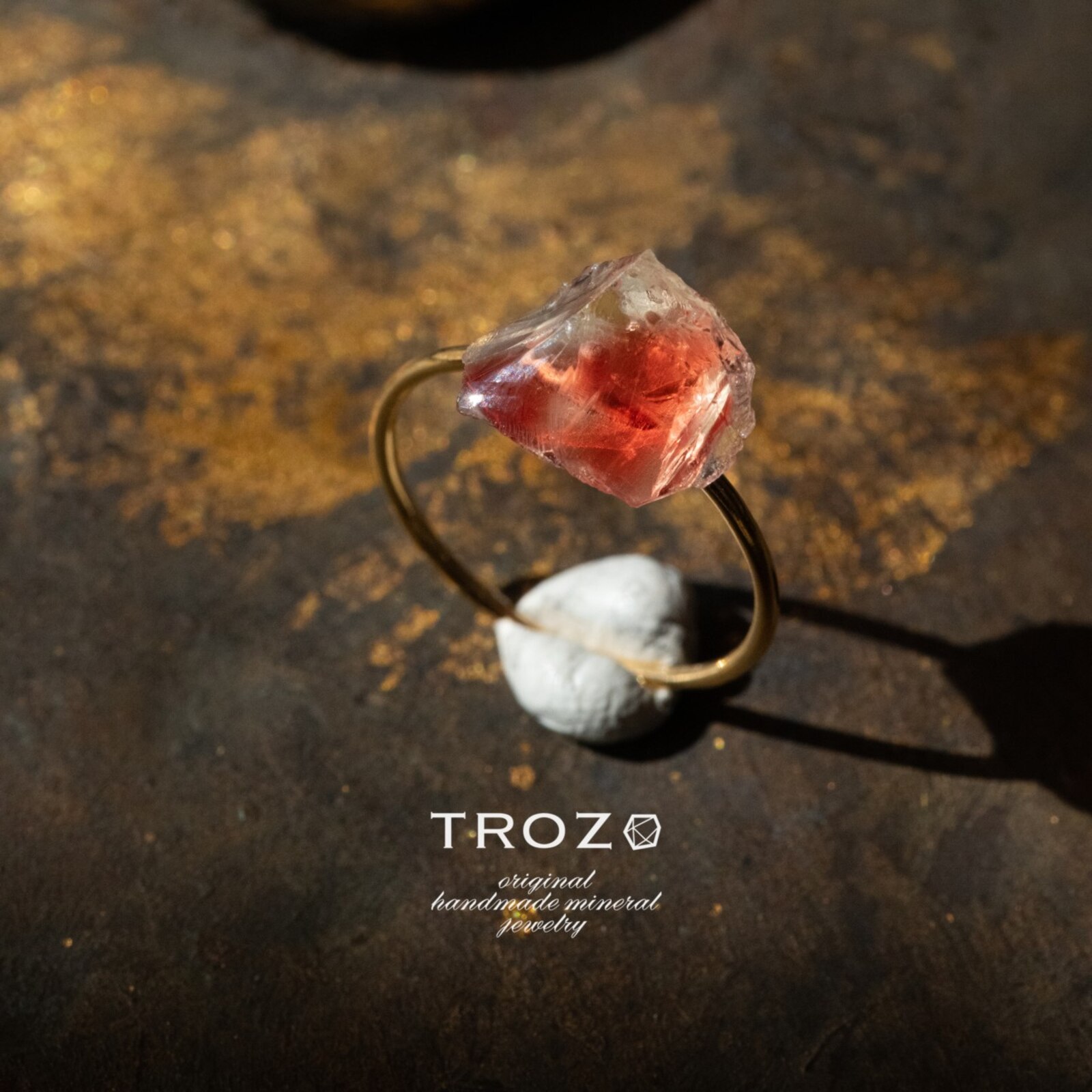
The pleasure of choosing raw sunstone jewelry is that the kind of flash changes greatly by source. Oregon material has the red-orange-green schiller of native-copper plates and high gem-quality clarity; Indian material a red-brown-to-orange sparkle in an oligoclase host; Norwegian material a classic source with the rainbow interference of hematite films; and Tanzanian material (found 2000) a vivid recent newcomer — the character parts widely by source, from clear gem quality to a raw-stone schiller luster.
TROZO sets sunstone with its natural crystal faces and the flash of its inclusions intact. At Mohs 6–6.5 it is of standard feldspar hardness, but with perfect cleavage along (001) it can break under a hard blow, so it is safest to take it off where it might be knocked. Avoid ultrasonic and steam cleaners as a precaution, store it in its own case so it does not touch other stones, and do not leave it long with sweat unwiped — these keep it beautiful longer. Wear the “sun’s flash”, the counterpart to moonstone, in the raw-mineral jewelry TROZO makes.
◆ Sunstone Raw-Stone Jewelry
Handmade raw stone & mineral pieces — TROZO
◆ Frequently Asked Questions about Sunstone
Q What does sunstone symbolize?
Sunstone is traditionally associated with the energy of the sun, confidence, leadership, vitality, optimism, drive, positivity and creativity. Because the flash thrown by the metal flakes within recalls sunlight, it is cherished today as a “stone that holds the power of the sun”.
Q Is sunstone a birthstone?
Sunstone is not a designated birthstone in Japan, nor a designated anniversary stone. It was, however, named Oregon’s state gemstone in 1987, and is known internationally as a rare source-gemstone that symbolizes the state of Oregon.
Q How does sunstone’s “schiller” flash work?
Sunstone’s metallic flash is an optical effect called aventurescence (schiller). The platelet inclusions of metal or oxide minerals within (native copper, hematite, goethite and so on, by source) are aligned parallel to the feldspar’s (001) cleavage, and when light strikes, countless small plates reflect specularly in the same direction for a strong flash. Because the reflectors are well larger than the wavelength of light, it is on a different physical footing from moonstone’s Rayleigh-scattered “adularescence (blue-white glow)”.
Q What is the difference between sunstone and moonstone?
Both are feldspar-group natural stones, but they differ in subseries and optics. Moonstone is an adularia/orthoclase (potassium feldspar, KAlSi₃O₈) and albite lamellar structure giving adularescence (a Rayleigh-scattered blue-white glow); sunstone is a plagioclase (Na-Ca feldspar) with metal/oxide plates giving aventurescence (a specular metallic flash). Their Japanese names, “moon feldspar” and “sun feldspar”, were coined for the symmetry of these two optical effects as the feldspar group’s “moon and sun”.
Q What makes Oregon sunstone special?
It is the world-famous sunstone mined in the Plush district of Harney County and eastern Lake County (the Ponderosa and Dust Devil mines) of Oregon, USA. A rare gem-quality sunstone of labradorite-to-bytownite plagioclase crystallized in basalt lava, it holds native copper (platelets of elemental Cu), is highly clear and can be faceted, and was named Oregon’s state gemstone on 4 August 1987. It shows a wide schiller of red, orange, green and blue, and is very highly regarded as a gemstone source.
Q What is the “Viking sunstone”?
It is a navigation tool from the medieval Scandinavian sagas (such as the *Saga of King Olaf*), the legendary mineral by which Vikings are said to have read the sun’s position on a cloudy day using its polarization. It is sometimes linked to Norwegian (Tvedestrand) sunstone, but modern scholarship holds the legendary mineral was more likely calcite (Iceland spar) or cordierite (iolite) (Ramskou 1967; reconstruction experiments by Ropars and others, 2011–2013). The prevailing view is that mineralogical sunstone (feldspar) and the legendary sunstone are probably different things.
Q What care does sunstone need?
At Mohs 6–6.5 sunstone is of standard feldspar hardness, but with perfect cleavage along (001) a hard blow can cause a directional break. It is safest to take it off where it might be knocked. Avoid ultrasonic and steam cleaners, as they can aggravate microcracks in feldspar. Wipe off sweat with a soft cloth, store it in its own case so it does not touch other stones, and avoid salt water and prolonged strong direct sun (a risk of color change).
Q What kinds of jewelry can sunstone become?
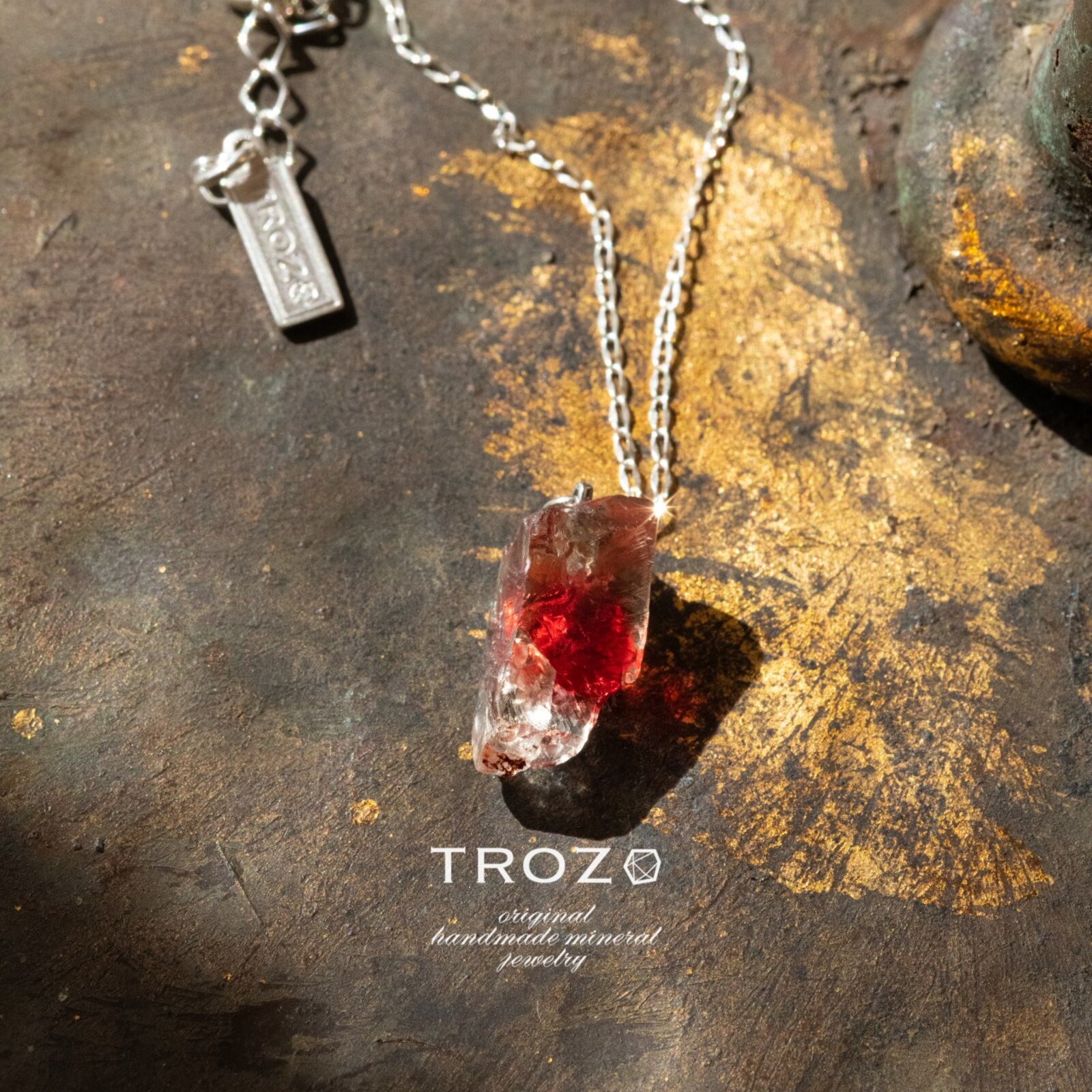
As natural-stone jewelry, sunstone is used for raw-stone earrings, necklaces, rings, brooches and ear cuffs. TROZO makes sunstone jewelry that keeps the raw stone unpolished so its crystal faces and the flash of its metal inclusions (aventurescence) lead the design — both pieces you can choose by color and strength of flash from stock, and pieces where the meeting with the stone is left to chance.
EXPLORE THE SHOP
Explore the world of Sunstone
Discover more pieces than we can show here at the TROZO shop.
Shop Sunstone