
Moonstone
A blue-white sheen that holds moonlight. June’s birthstone — a stone of mystery.
Moonstone is a feldspar — sanidine or anorthoclase, (K,Na)AlSi₃O₈ — that shows a beautiful optical effect. Thin alternating layers of orthoclase and albite scatter and interfere with light to create adularescence, a moonlit blue-white shimmer. A sacred stone in ancient India and the stone of the moon goddess Diana in ancient Rome, it is cherished today as June’s birthstone.
Moonstone is the June birthstone. See all June birthstones →
◆ Moonstone — Stone Meanings
- Good fortune
- Health
- A premonition of love
- Pure love
- Intuition
- Healing
- The feminine
- Waxing and waning
◆ About Moonstone
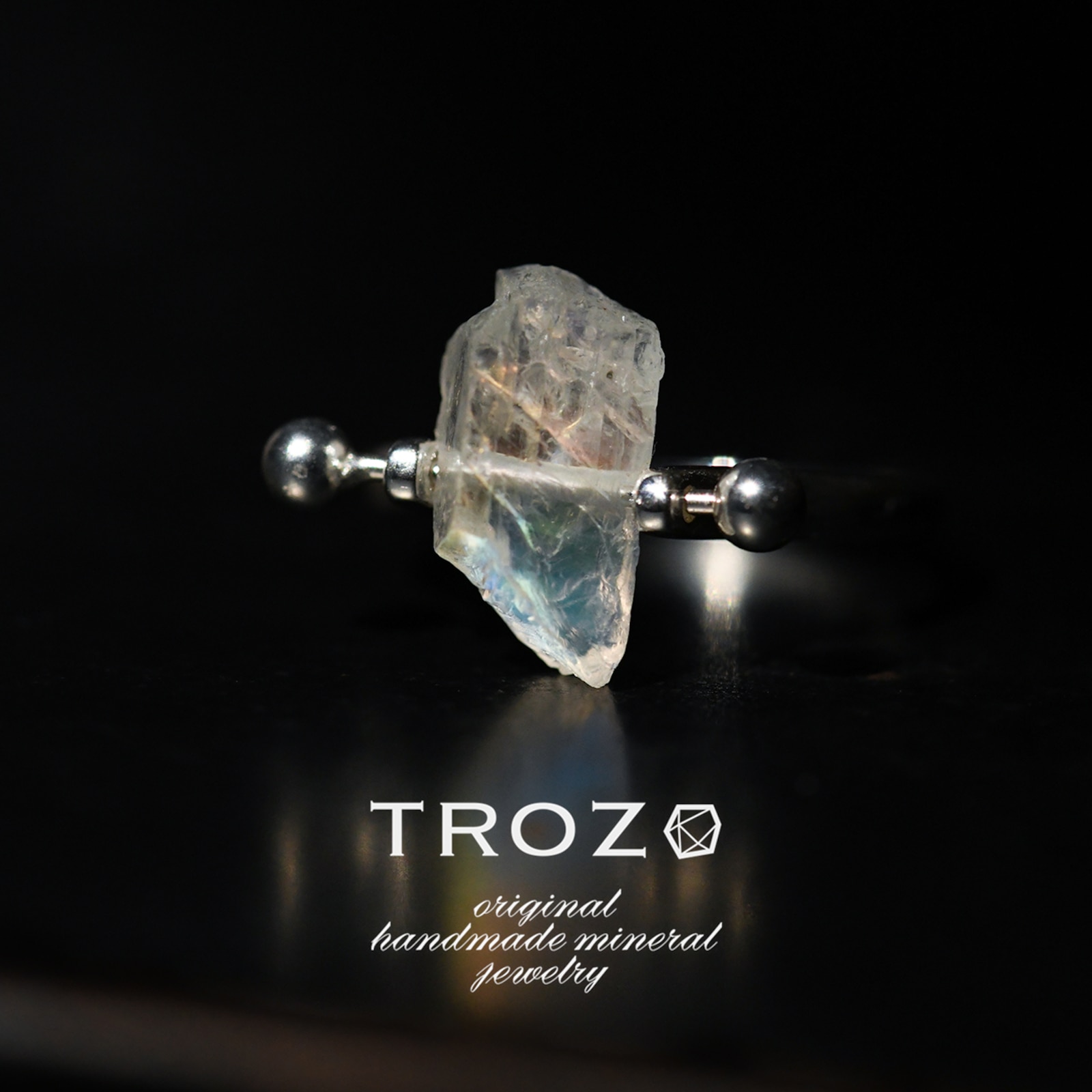
Moonstone is the name for feldspars that show a beautiful blue-white shimmer. Mineralogically the host is sanidine ((K,Na)AlSi₃O₈) or anorthoclase ((Na,K)AlSi₃O₈), crystallizing in the monoclinic or triclinic system, a natural stone of Mohs hardness 6.
Its great appeal is the blue-white sheen called adularescence. Within the crystal, thin alternating layers of orthoclase and albite refract and interfere with incoming light to produce the effect — and as light and angle change, the glow streams across the stone like rippling moonlight, a raw stone full of movement.
The people of ancient India wore moonstone as a “sacred stone” and amulet; in ancient Rome it was believed to change with the phases of the moon and to hold the image of the moon goddess Diana (Artemis, or Selene, in Greek myth). Cherished today as June’s birthstone, it is loved around the world alongside the moon.
Stones with an especially strong blue sheen are called “blue moonstone” and prized as something exceptional. The contrast of body color and sheen, the clarity of the crystal, the spread of the shimmer — even among moonstone, no two raw stones share the same scene.
◆ Mineral Data
- English name
- Moonstone
- Chemical formula
- (K,Na)AlSi₃O₈ (sanidine) / (Na,K)AlSi₃O₈ (anorthoclase)
- Mineral class
- Feldspar group (alkali feldspar)
- Crystal system
- Monoclinic (sanidine) / triclinic (anorthoclase)
- Mohs hardness
- 6
- Specific gravity
- 2.6
- Main sources
- India, Sri Lanka, Myanmar, Brazil, Madagascar, USA, Japan (Lake Kizaki in Nagano and others)
- Color range
- Colorless to milky; strong blue sheen is “blue moonstone”, orange body is “peach moonstone”, rainbow sheen is “rainbow moonstone”
- Notable trait
- Adularescence — a moonlit blue-white sheen from thin alternating layers of orthoclase and albite interfering with light
- Birthstone
- June
◆ Adularescence — how moonlight comes to dwell in stone
Thin layers inside the crystal turn light into the glow of the moon.
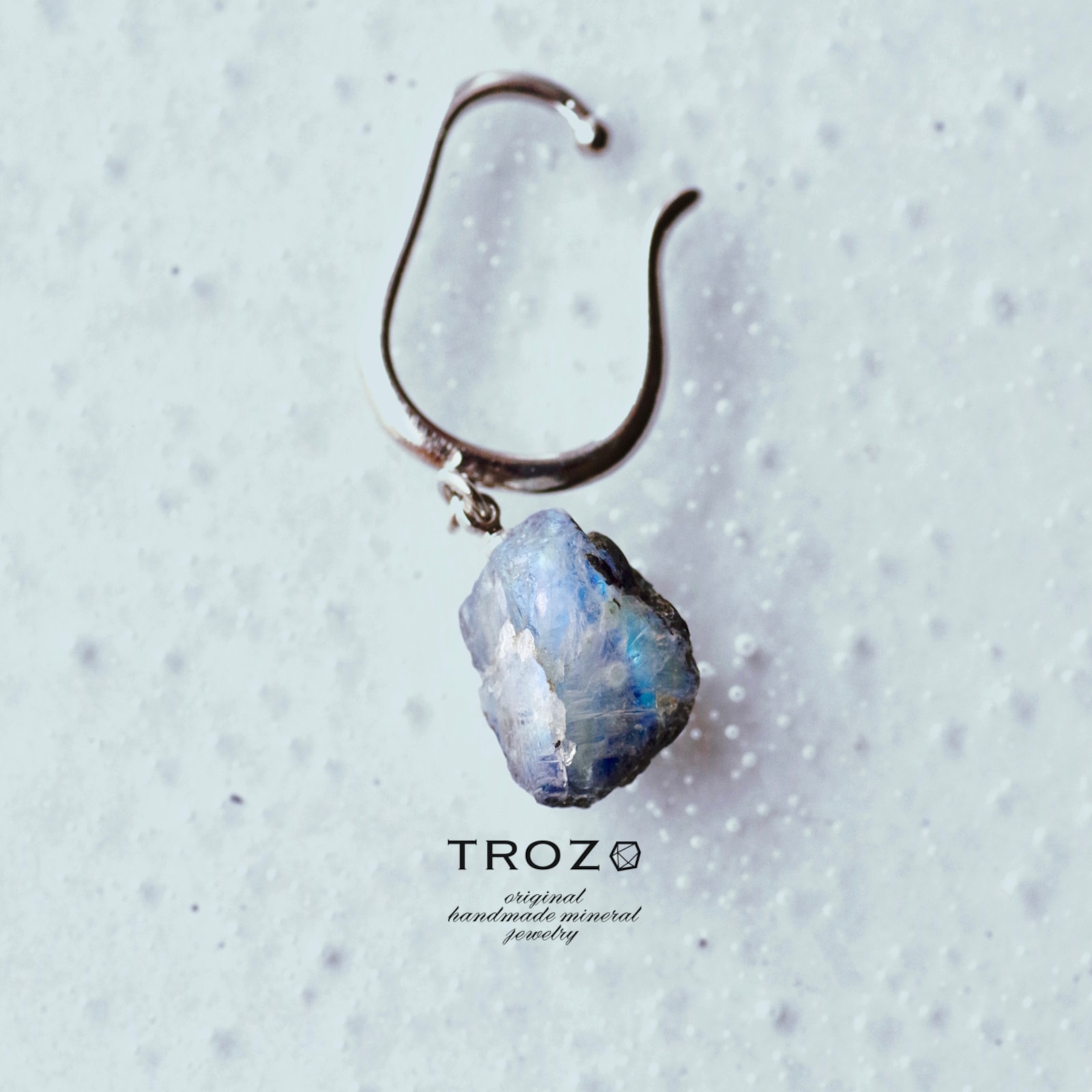
Moonstone’s blue-white shimmer arises when thin layers of orthoclase and albite — feldspars of differing refractive index — alternate within the crystal, so that incoming light is reflected and interferes. The effect is called adularescence, named for material gathered in the Adula mountains of 19th-century Switzerland. Alongside the labradorescence of labradorite and the aventurescence of sunstone, it is one of the signature plays of light in the feldspar family. As light and angle shift, the glow streams across the stone like rippling moonlight — moonstone’s greatest appeal.
◆ A sacred stone, dedicated to the goddess of the moon
From ancient India to Rome, a symbol of the moon.
Moonstone was revered as a “sacred stone” in ancient India and worn as an amulet and in prayer. In ancient Rome it was believed to change with the waxing and waning of the moon, and the image of the moon goddess Diana (Artemis, or Selene, in Greek myth) was thought to dwell within each stone. From the Middle Ages in Europe it was carried as a charm to deepen the bond between lovers, and today, as June’s birthstone, it remains beloved alongside the moon — a stone of long and storied lineage.
◆ Choosing raw moonstone jewelry
Choose by the spread of the sheen, the clarity of the body and size.
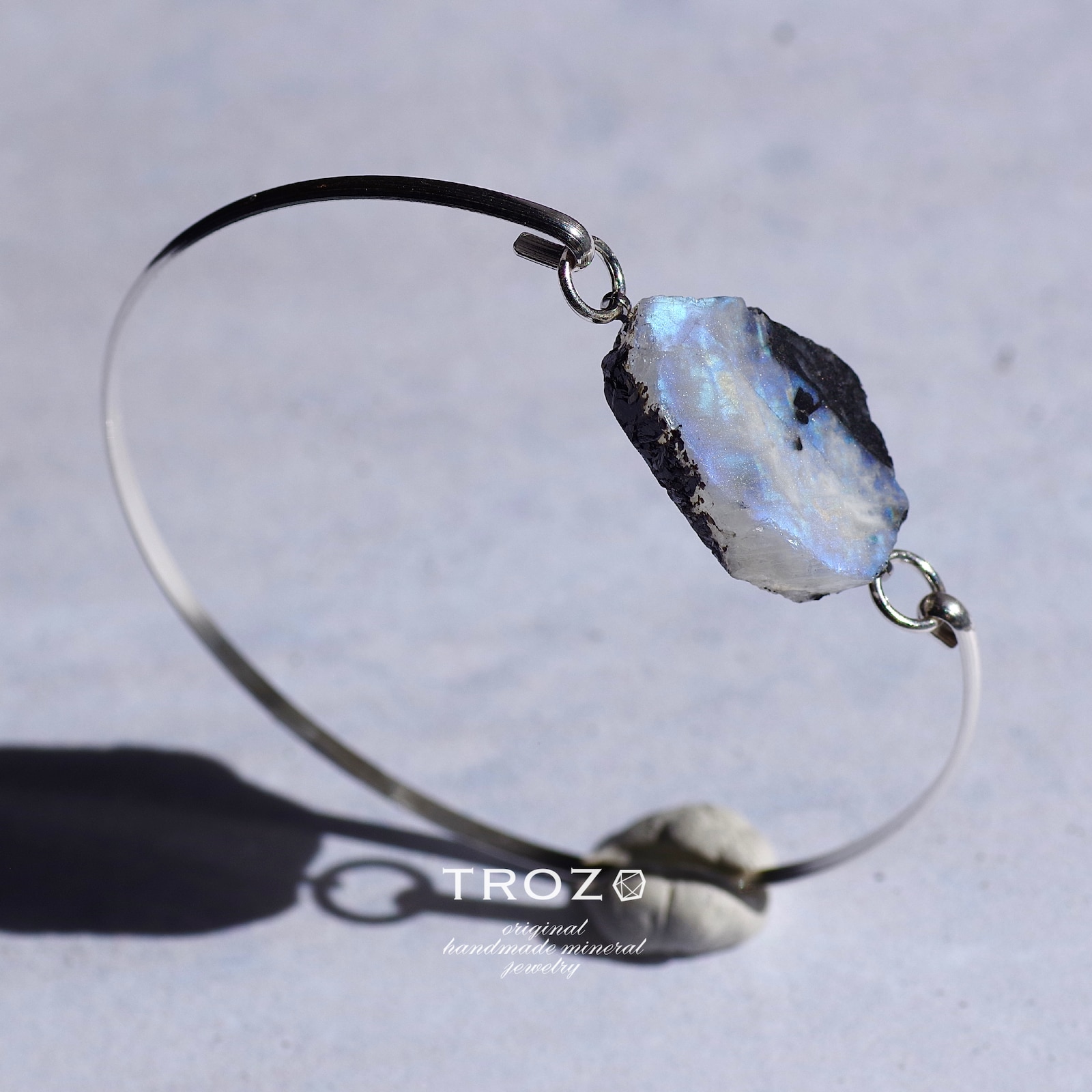
At Mohs 6 moonstone is harder than fluorite (4) and softer than quartz (7) — a middle ground. It has the strength to stand up to everyday wear, though it prefers to be kept from knocks and abrasion. The character of a raw stone turns on the color of the sheen (blue, rainbow, silver) and how it spreads, the clarity of the body (clear or milky), and the clarity of the crystal. “Blue moonstone” is the rare quality whose blue flash spreads across the whole face, while “rainbow moonstone” offers a sheen of many colors — it is best to see the play of light for yourself.
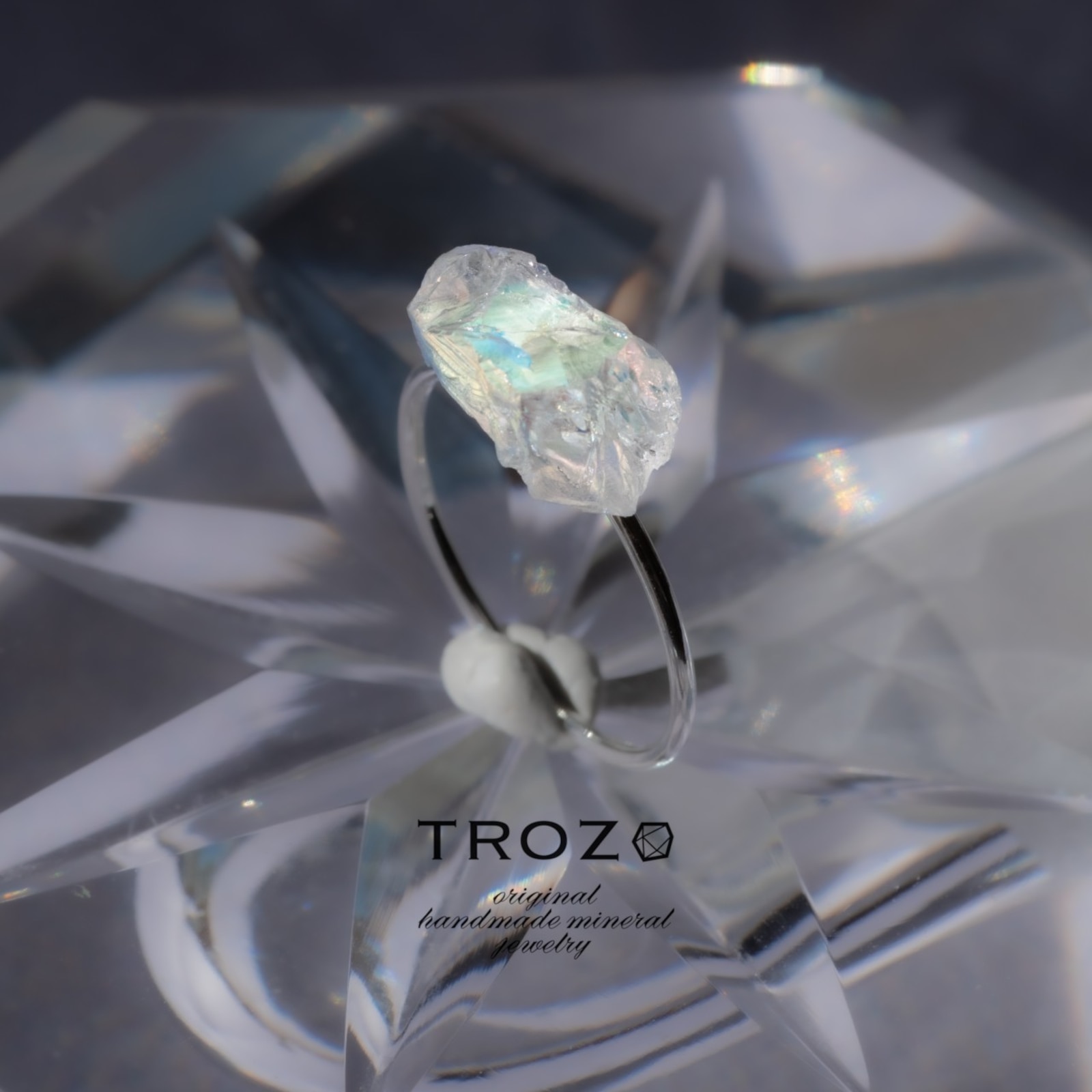
TROZO sets moonstone without polishing away its character, letting the natural sheen and the contrast of the body color lead the design. We offer pieces for those who would like to choose strength of sheen, color and size from stock, as well as pieces where the meeting with the stone is left to chance. Worn where light can reach it, it offers those moments when moonlight suddenly surfaces.
◆ Moonstone Raw-Stone Jewelry
Handmade raw stone & mineral pieces — TROZO
◆ Frequently Asked Questions about Moonstone
Q What does moonstone symbolize?
Moonstone is traditionally associated with good fortune, health, a premonition of love and pure love. Long a symbol of the moon, it has been cherished as a protective stone for women and a charm of love, and is the classic birthstone for June.
Q What is adularescence (the sheen)?
It is the effect in which thin layers of orthoclase and albite, of differing refractive index, alternate within moonstone and reflect and interfere with incoming light to produce a moonlit blue-white glow. It is named “adularescence” after moonstone gathered in the Adula mountains of Switzerland, and is a play of light characteristic of the feldspar family, alongside the labradorescence of labradorite.
Q How hard is moonstone?
Its Mohs hardness is 6 — softer than quartz (7) and harder than fluorite (4). It has the strength for everyday wear, but keeping it from knocks and strong abrasion, and from rubbing against harder stones in storage, preserves its beauty longer.
Q What is the difference between blue and rainbow moonstone?
“Blue moonstone” has a blue sheen over a clear-to-white body — the traditional moonstone; pieces whose sheen spreads across the whole face are rare and prized. “Rainbow moonstone” has a multi-colored sheen; mineralogically it is sometimes classed not as moonstone but as white labradorite, though the market trades it under the name rainbow moonstone.
Q What kinds of jewelry can moonstone become?
As natural-stone jewelry, moonstone is used for raw-stone earrings, necklaces, rings, brooches and ear cuffs. TROZO makes moonstone jewelry that keeps the raw stone unpolished so its sheen and the contrast of body color lead the design — both pieces you can choose by strength of sheen, color and size from stock, and pieces where the meeting with the stone is left to chance.
Q Where does moonstone come from?
India, Sri Lanka and Myanmar are the traditional sources — Sri Lankan material is especially known as “blue moonstone” with a strong blue flash. It is also found in Brazil, Madagascar, the USA and Japan (such as Lake Kizaki in Nagano).
Q How should I look after moonstone?
At a middle hardness of Mohs 6, it is best handled away from knocks and abrasion. Feldspars cleave readily along planes, so take care with drops and hard impacts. It can be rinsed with water, but avoid sudden temperature changes and wipe gently with a soft cloth.
EXPLORE THE SHOP
Explore the world of Moonstone
Discover more pieces than we can show here at the TROZO shop.
Shop Moonstone