Zircon
The oldest mineral on Earth — a December birthstone.
Zircon (ZrSiO₄) is a zirconium silicate, tetragonal, Mohs 7.5. It comes in many colors — colorless, blue, yellow, red, brown, green — and blue zircon is the most popular, making up about 80% of the market. Zircon is special because it is the oldest mineral found on Earth: grains from Jack Hills in Western Australia are about 4.4 billion years old. It is entirely different from synthetic cubic zirconia (ZrO₂), and a modern December birthstone.
Zircon is the December birthstone. See all December birthstones →
◆ Zircon — Stone Meanings
- Eternity
- Purity
- Serenity
- Wisdom
- Allure
- Hope
- Prosperity
- Victory
◆ About Zircon
Zircon (ZrSiO₄) is a zirconium silicate. It is tetragonal, Mohs 7.5, with a specific gravity of 3.9–4.7 (varying with metamictization). It comes in many colors — colorless, blue, yellow, red, brown, green — with a vitreous-to-adamantine luster and a high refractive index of 1.92–2.01; colorless stones have a strong, diamond-like brilliance. The name traces to the Arabic *zarqun* (“vermilion”) or the Persian *zargun* (“golden”), and it has been prized for centuries.
The greatest reason zircon is special in both earth science and gemology is that it is the oldest mineral found on Earth. Tiny zircon grains from Jack Hills in Western Australia were confirmed by research at the University of Wisconsin to have formed about 4.4 billion years ago — only some 150 million years after the Earth itself. Zircon can preserve such ancient ages because its structure takes in radioactive uranium (U) and thorium (Th), which decay over time into lead (Pb); the ratio allows precise U-Pb dating. This “time-capsule” quality makes zircon a treasure of science, telling the story of the Earth’s origin and the formation of its crust.
Zircon comes in many colors, but the favorite in fine jewelry is blue zircon — a vivid starlite-blue to teal made by heating brown zircon from Ratanakiri, Cambodia to around 1,000 °C, which makes up about 80% of the market. There are also hyacinth (orange-red), cinnamon (brown) and colorless (long used as a diamond substitute) varieties. Zircon also has a distinctive phenomenon called metamictization, in which the alpha decay of uranium and thorium gradually breaks down the crystal structure; the metamict type (“malacon”) has a lower SG of 3.9–4.2 and higher radioactivity.
Zircon is loved today as a modern December birthstone. (In Japan’s 2021 gemstone revision it was formally added as a December birthstone, making four December stones — turquoise, lapis lazuli, tanzanite and zircon — a month of wide choice.) One important note: the synthetic diamond imitation cubic zirconia (CZ) = ZrO₂ is entirely different from zircon (ZrSiO₄) — the names merely sound alike; zircon is a natural mineral and CZ is man-made.
◆ Mineral Data
- English name
- Zircon (from the Arabic *zarqun*, “vermilion” / the Persian *zargun*, “golden”)
- Chemical formula
- ZrSiO₄ (zirconium silicate)
- Mineral class
- Nesosilicate mineral, zircon group
- Crystal system
- Tetragonal
- Mohs hardness
- 7.5
- Specific gravity
- 3.9 – 4.7 (varies with metamictization; ~4.6–4.7 fully crystalline, 3.9–4.2 metamict)
- Main sources
- Cambodia (Ratanakiri, the main source of blue zircon), Thailand, Myanmar, Sri Lanka, Australia (Jack Hills, source of the oldest mineral), Vietnam, Madagascar, Tanzania, Nigeria
- Color range
- Colorless, blue (blue zircon, ~80% of the market), yellow, orange-red (hyacinth), brown (cinnamon), green, red
- Notable trait
- The oldest mineral found on Earth (Jack Hills, Australia, ~4.4 billion years); a “time capsule” used for U-Pb dating; shows metamictization (structure broken down by alpha decay). Entirely different from synthetic cubic zirconia (ZrO₂)
- Birthstone
- December (modern addition; alongside turquoise, lapis lazuli and tanzanite)
◆ Zircon — the oldest mineral on Earth
A 4.4-billion-year-old crystal that tells of the Earth’s origin.
Zircon’s character as a gem lies in its color and brilliance, but its value to science runs deeper still — because zircon (ZrSiO₄) is the oldest mineral found on Earth. Tiny zircon grains gathered at Jack Hills in Western Australia were confirmed by U-Pb dating (by W. Peck and others at the University of Wisconsin) to have formed about 4.4 billion years ago — a world only some 150 million years after the Earth’s birth (about 4.54 billion years ago), with the zircon crystals recording the water and crust that were there. Zircon can play this “time-capsule” role because its structure holds trace uranium (U) and thorium (Th), which decay to lead (Pb) at a ratio that allows precise dating — for geology and planetary science, one of the most important minerals for understanding the Earth’s origin.
◆ Blue zircon — a December birthstone
Starlite blue, the appeal of Cambodian blue.
Zircon comes in colorless, blue, yellow, red, brown and green, but the star of fine jewelry is blue zircon. Making up about 80% of the market, this blue is created by heating brown zircon from Ratanakiri, Cambodia to around 1,000 °C, giving a vivid starlite-blue to teal. With a high refractive index of 1.92–2.01, faceted blue zircon throws a brilliance approaching diamond. In Japan’s 2021 gemstone revision, zircon was formally added as a December birthstone, making four December stones — turquoise, lapis lazuli, tanzanite and zircon, a month of wide choice. As a stone that wears the blue of winter, it has grown in popularity in recent years.
◆ Choosing raw zircon jewelry
Choose knowing the color, the type, and the difference from cubic zirconia.
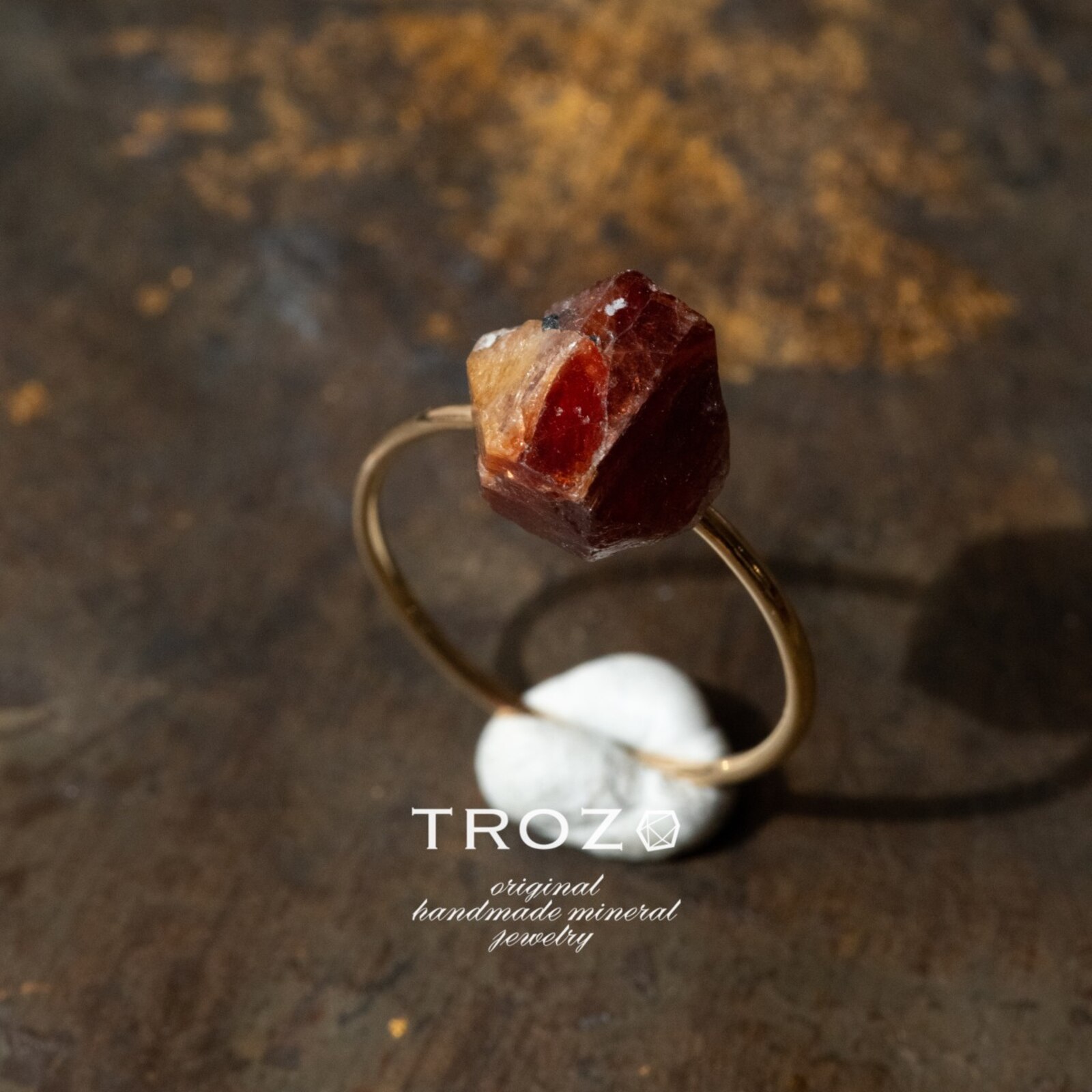
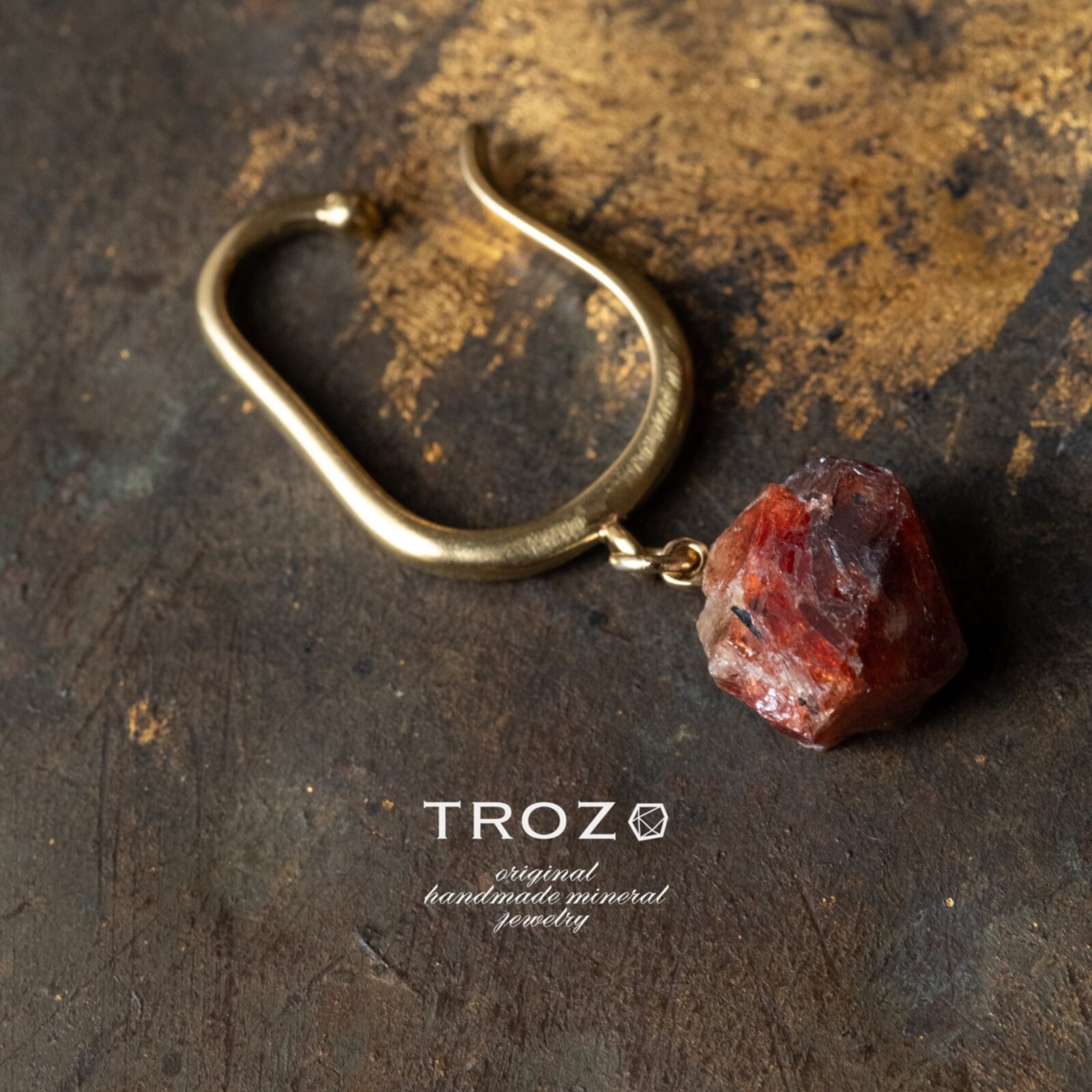
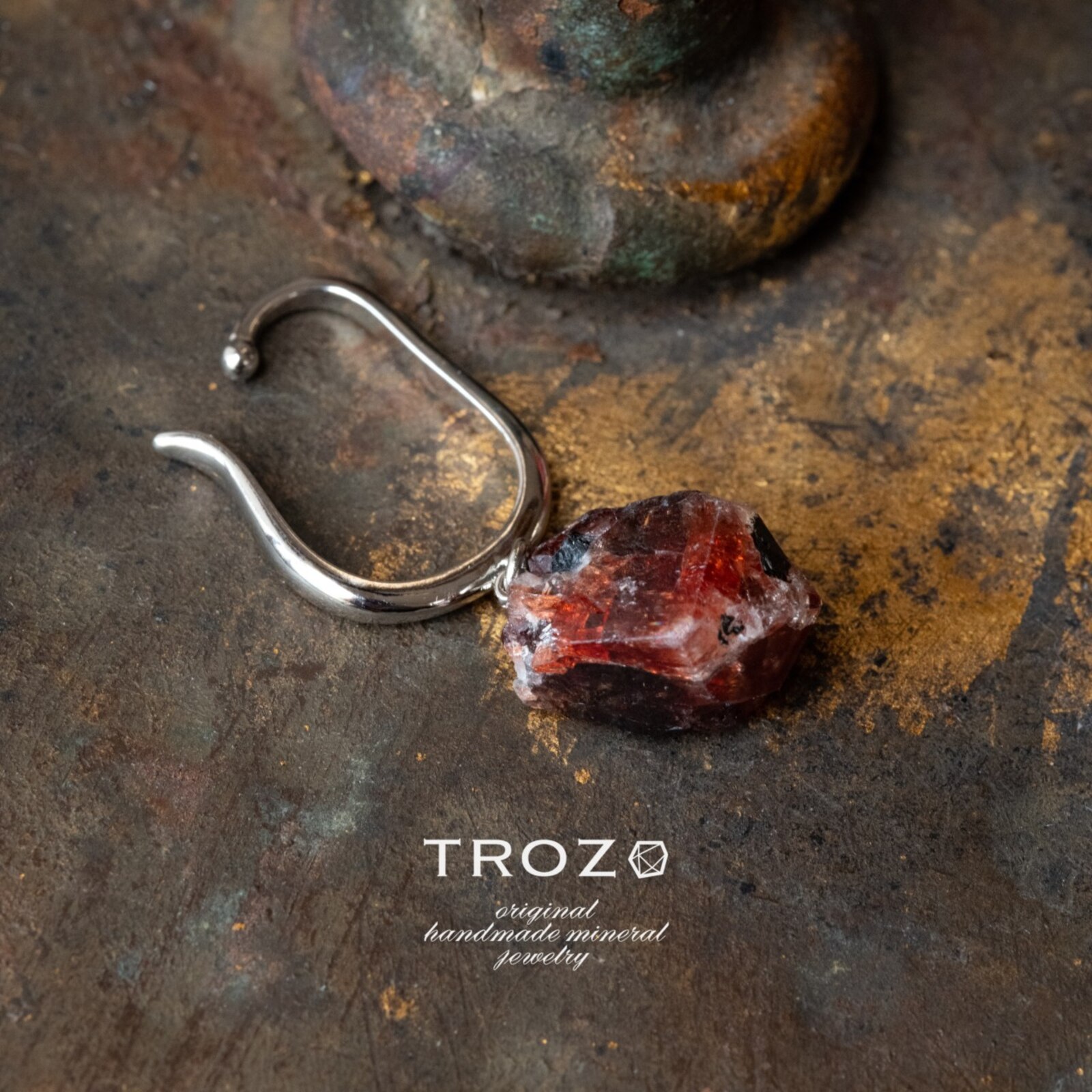
The first thing to grasp when choosing raw zircon jewelry is that zircon and cubic zirconia (CZ) are entirely different. Because the names sound alike they are often confused, but zircon is the natural mineral ZrSiO₄ (zirconium silicate) while cubic zirconia is the man-made ZrO₂ (zirconium dioxide) — different in both composition and crystal structure. Zircon is rich in color, and you can choose by taste — blue (notably from Ratanakiri, Cambodia), hyacinth (orange-red), cinnamon (brown) and colorless (long prized as a diamond substitute).
TROZO sets zircon without polishing away its character, letting the natural color and the tetragonal crystal form lead the design. Because zircon shows metamictization — its structure altered by the alpha decay of trace uranium and thorium — there is a charm in the per-stone variation of crystal expression. As a gift for those born in December, or as everyday jewelry for anyone who would like to feel the Earth’s history on their skin, we offer raw zircon rich in expression.
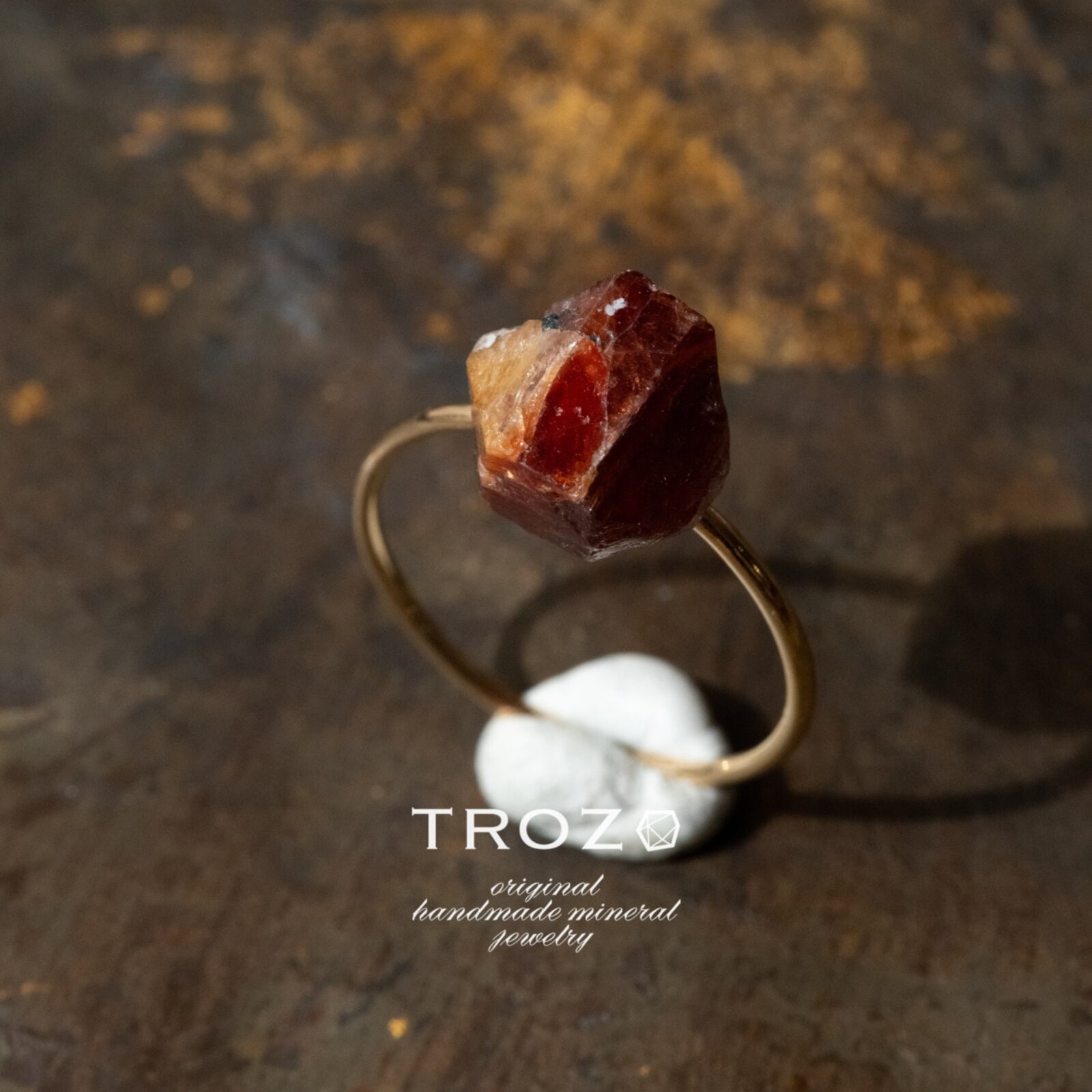
◆ Zircon Raw-Stone Jewelry
Handmade raw stone & mineral pieces — TROZO
◆ Frequently Asked Questions about Zircon
Q What does zircon symbolize?
Zircon is traditionally associated with eternity, purity, serenity, wisdom, allure, hope, prosperity and victory — words tied to its natural history and gemology, such as “eternity” for the oldest mineral on Earth and “allure” and “hope” for the strong brilliance of blue zircon.
Q What month’s birthstone is zircon?
It is a modern December birthstone. In Japan’s 2021 gemstone revision it was formally added as a December birthstone, making four December stones — turquoise, lapis lazuli, tanzanite and zircon — a month of wide choice.
Q Are zircon and cubic zirconia different?
Yes — entirely different. Zircon is the natural mineral ZrSiO₄, with tetragonal crystals. Cubic zirconia (CZ) is the man-made ZrO₂, mass-produced since the 1970s as a diamond imitation. The names are alike only because they share the element zirconium; the composition and crystal structure are completely different.
Q Is zircon really the oldest mineral on Earth?
Yes. Tiny zircon grains found at Jack Hills in Western Australia were confirmed by U-Pb dating (University of Wisconsin and others) to have formed about 4.4 billion years ago — evidence of a world only some 150 million years after the Earth’s birth (about 4.54 billion years ago), and one of the most important minerals in earth and planetary science. Zircon can play this “time-capsule” role because its structure takes in uranium and thorium, which decay to lead at a ratio that allows dating.
Q Is blue zircon a natural color?
Blue zircon’s vivid blue is achieved by heating brown zircon from Ratanakiri, Cambodia to around 1,000 °C. Zircon that is brown or yellow-brown when mined turns starlite-blue to teal as the heat changes the color centers within the crystal. Heat treatment is a standard, long-used practice in the gem trade, giving stable color, and this is the main type of zircon, about 80% of the market.
Q How hard is zircon, and what care does it need?
Its Mohs hardness is 7.5, hard among natural stones, but zircon has low toughness and its edges chip readily. An edge can chip under a hard blow, so it is safest to take it off where it might be knocked. The metamict type (“malacon”), in which the alpha decay of uranium and thorium has progressed, has a lower SG of 3.9–4.2 and is more brittle. Avoid contact with hard objects, and avoid ultrasonic and steam cleaners.
Q Where does zircon come from?
Cambodia (Ratanakiri) is famed as the main source of blue zircon, with further material from Thailand, Myanmar and Sri Lanka (hyacinth and cinnamon types), Australia (Jack Hills, the source of the oldest mineral), Vietnam, Madagascar, Tanzania and Nigeria.
EXPLORE THE SHOP
Explore the world of Zircon
Discover more pieces than we can show here at the TROZO shop.
Shop Zircon