
Ruby
King of gems, the red of pigeon’s blood. July’s birthstone, a corundum-family stone.
Ruby is the variety of corundum colored deep red by chromium — one of the world’s four precious gemstones. Its formula is Al₂O₃, trigonal, Mohs 9 — second in hardness only to diamond. Called *ratnaraja*, “king of gems”, in ancient India, it has a history of over 2,500 years. The finest red is called “pigeon’s blood”, and it is loved as July’s birthstone and the gift for a 40th wedding anniversary.
Ruby is the July birthstone. See all July birthstones →
◆ Ruby — Stone Meanings
- Passion
- Love
- Victory
- Courage
- Vitality
- Benevolence
- Beauty
- Allure
◆ About Ruby
Ruby is the deep-red variety of corundum. Its formula is Al₂O₃ (aluminium oxide), it is trigonal, and at Mohs 9 it is among the hardest of natural minerals, second only to diamond (10). The red comes from trace chromium within the crystal (around 1%); the more chromium, the deeper the red, and the finest stones carry a strong fluorescence.
Counted with diamond, sapphire and emerald among the world’s four precious gemstones, ruby has stood apart in jewelry since antiquity. In ancient India it was called *ratnaraja* — “king of gems” — a symbol of the sun and an offering to the gods, loved by royalty for over 2,500 years.
The name for ruby’s finest quality is “pigeon’s blood” — said to come from a 1348 description by an Arabian gem merchant of the color of fresh pigeon’s blood dropped on a silver plate, it refers to a pure, vivid red with strong fluorescence. The Mogok valley of Myanmar has been prized as the source of the world’s finest quality for centuries.
Its associations include passion, love, victory, courage and vitality. Most ruby on the market is heat-treated to improve clarity (around 1,000 °C, melting the inclusion “silk” and brightening the color); untreated “no-heat” stones are rare. It is July’s birthstone and the gift for a 40th “ruby” wedding anniversary.
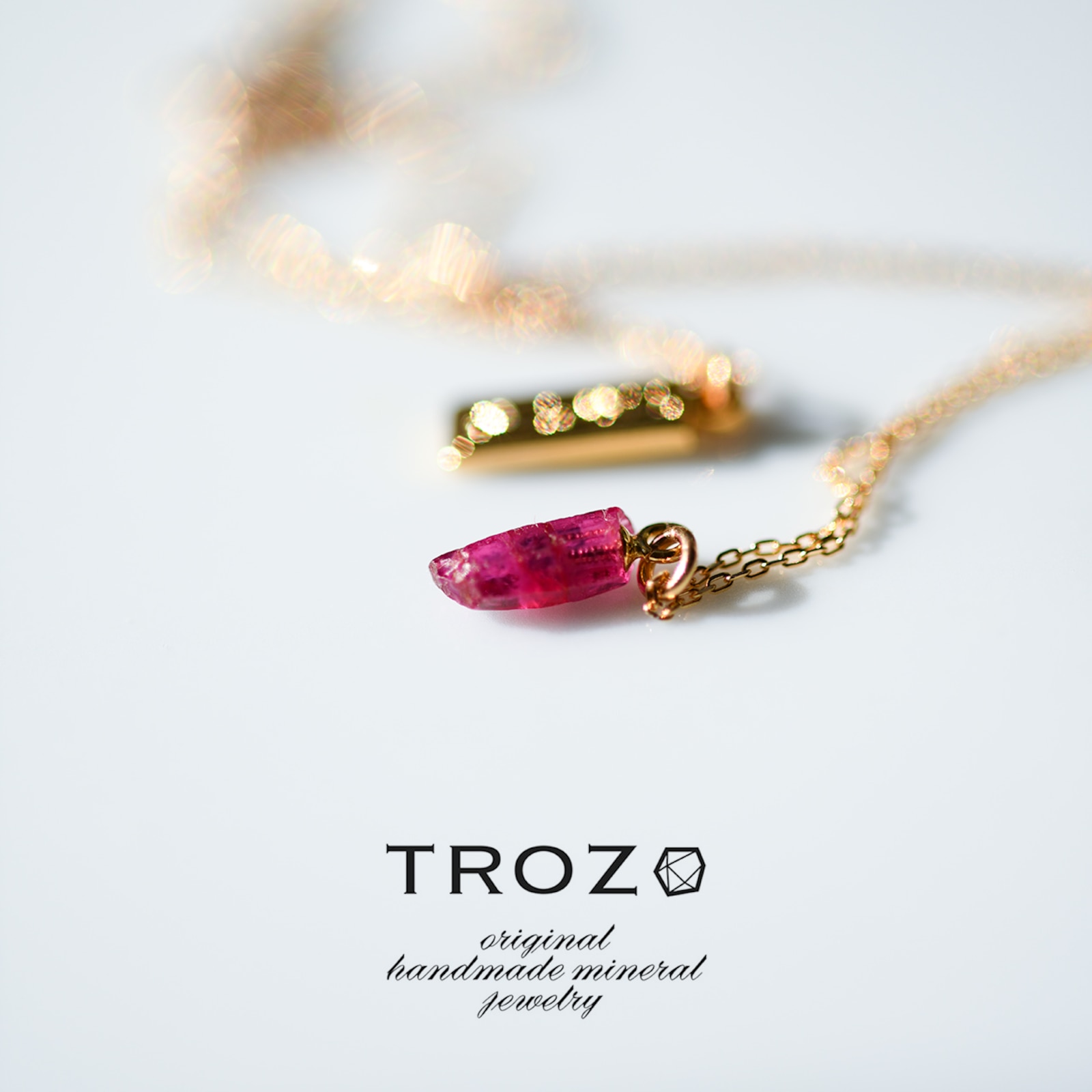
◆ Mineral Data
- English name
- Ruby
- Chemical formula
- Al₂O₃ + trace Cr (chromium, ~1%) — the red variety of corundum
- Mineral class
- Corundum family
- Crystal system
- Trigonal
- Mohs hardness
- 9 (second only to diamond)
- Specific gravity
- 4.0
- Main sources
- Myanmar (Mogok valley — finest quality), Sri Lanka, Thailand, Cambodia, Tanzania, Madagascar, Mozambique, Greenland, Afghanistan
- Color range
- Vivid to deep red; the finest is “pigeon’s blood”, a pure red with strong fluorescence
- Notable trait
- Corundum colored red; every other color of corundum is “sapphire”. Most market material is heat-treated. One of the world’s four precious gemstones; called the “king of gems” in ancient India
- Birthstone
- July (40th “ruby” wedding anniversary)
◆ Ruby and sapphire — the same corundum, siblings of color
Red is ruby; everything else is sapphire.
Ruby and sapphire are color variants of one mineral, corundum (Al₂O₃). About 1% chromium (Cr) makes the deep-red “ruby”; iron (Fe) and titanium (Ti) make blue “sapphire”. Sapphire is in fact not only blue but every color except red — yellow, green, purple, pink, orange — so it means “all corundum that is not red” (the boundary between pink stones called “pink sapphire” and “ruby” is sometimes debated by source and market). The formula, the trigonal system and the Mohs 9 hardness are all identical — a curious family treated as entirely different gems by the trace element alone.
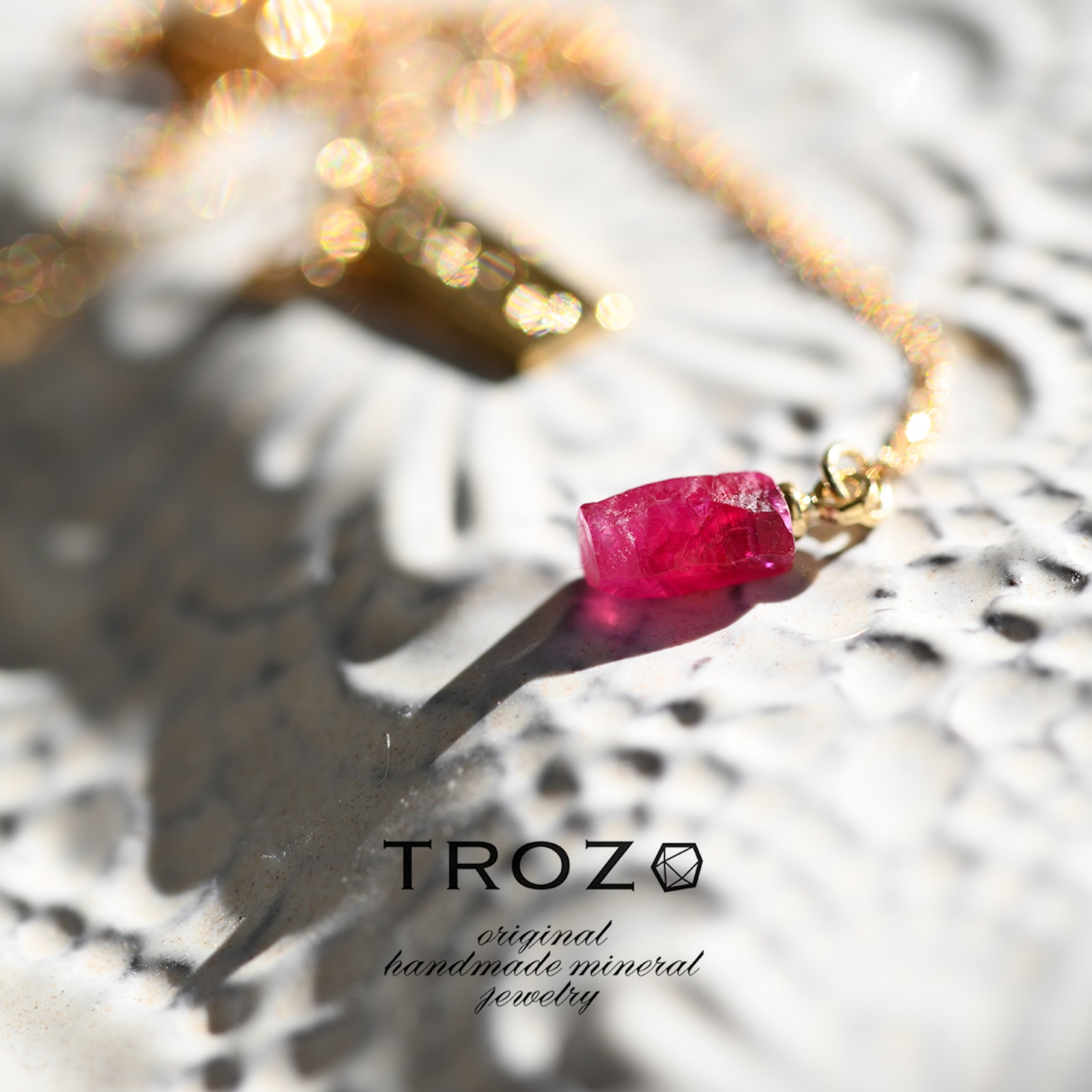
◆ King of gems — 2,500 years of history from ancient India
Ratnaraja, a symbol of the sun and an offering to the gods.
The earliest records of ruby reach back over 2,500 years in the texts of ancient India. In Sanskrit it was *ratnaraja* — “king of gems” — and its burning red was held a symbol of the sun, the most sacred and valuable of offerings to the gods. From the Middle Ages, the Mogok valley of Burma (now Myanmar) became known as the source of the world’s finest quality, and a 1348 record survives of an Arabian gem merchant describing the finest red as “pigeon’s blood”.
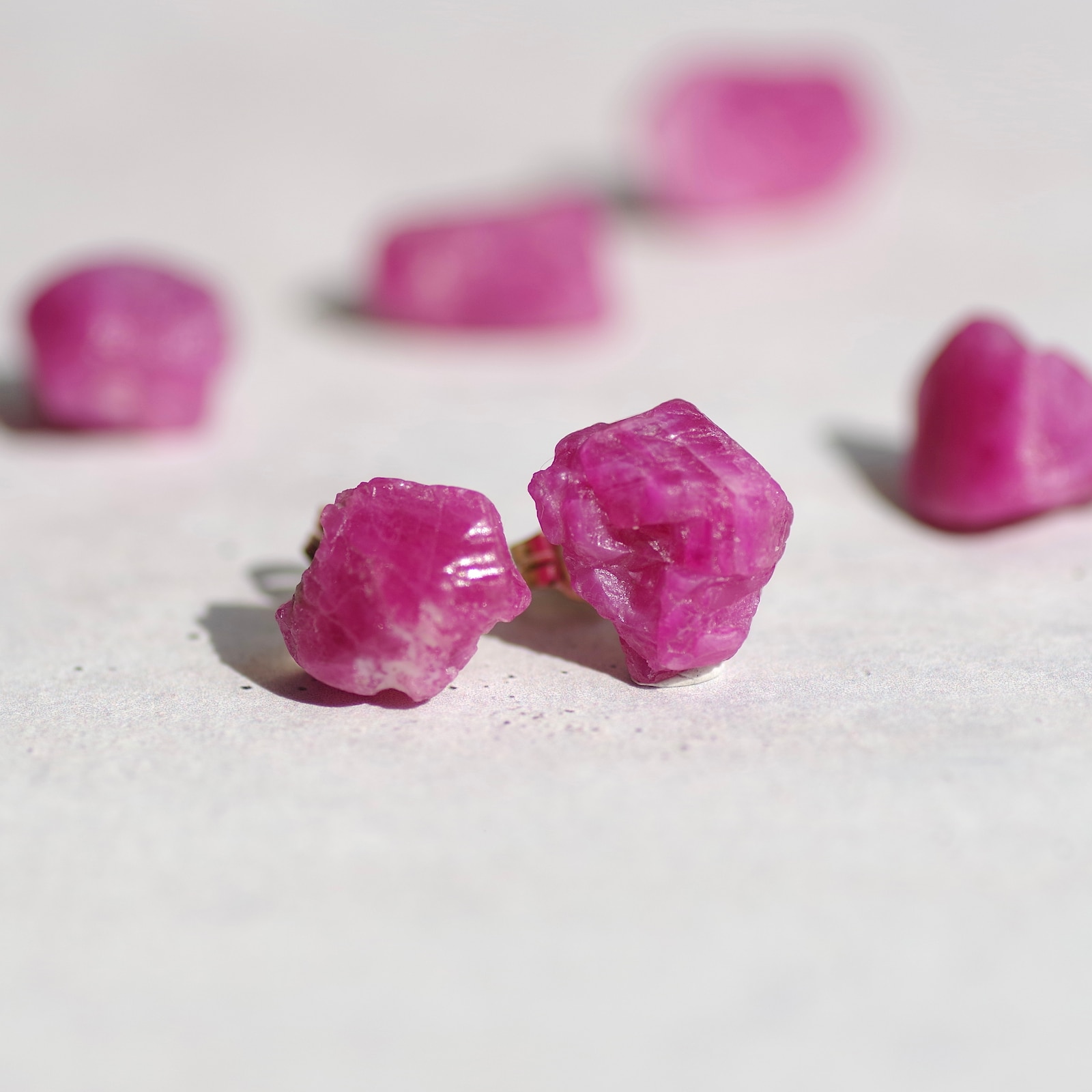
◆ Choosing raw ruby jewelry — the longing for pigeon’s blood
Choose by vividness of red, clarity and size.
At Mohs 9 ruby is second in hardness only to diamond — an exceptionally durable material for everyday wear. The character of a raw stone turns on the vividness of the red (chromium content), the clarity, the landscape of the inclusions (silk), the natural form (trigonal, tabular hexagons) and the size. The finest “pigeon’s blood” is a pure red with strong fluorescence and a presence all its own, but paler reds and stones that keep their silk each have their own raw-stone character.
TROZO sets ruby without polishing away its character, letting the natural red and the inclusions lead the design. Most ruby on the market is heat-treated to improve clarity (a custom of long standing that does not diminish its value). We offer pieces for those who would like to choose the depth of red and size from stock, as well as pieces where the meeting with the stone is left to chance — a stone for a lifetime, a symbol of passion and love.
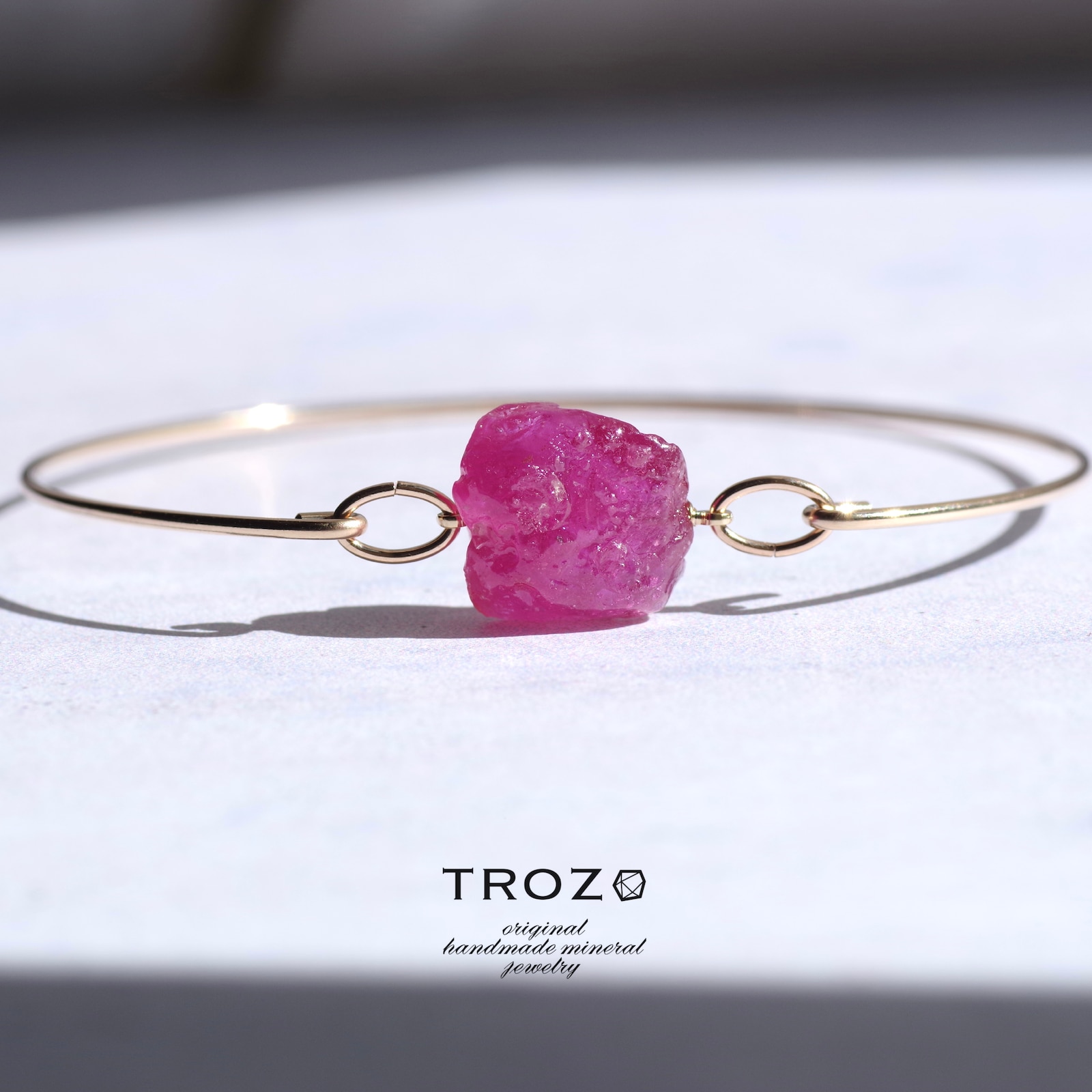
◆ Ruby Raw-Stone Jewelry
Handmade raw stone & mineral pieces — TROZO
◆ Frequently Asked Questions about Ruby
Q What does ruby symbolize?
Ruby is traditionally associated with passion, love, victory, courage, vitality, benevolence, beauty and allure. Called the “king of gems” (ratnaraja) in ancient India, its burning red was held a symbol of the sun and of passion. It is July’s birthstone and the gift for a 40th “ruby” wedding anniversary.
Q Are ruby and sapphire the same mineral?
Yes — both are exactly the same mineral, corundum (Al₂O₃). They differ only in color, from the trace element they hold: chromium (Cr) at about 1% gives the deep-red “ruby”, while iron (Fe) and titanium (Ti) give blue “sapphire”. The basic rule is “red corundum is ruby; all other corundum is sapphire”.
Q How hard is ruby?
Its Mohs hardness is 9, among the hardest natural minerals, second only to diamond (10). It is an exceptionally durable material for everyday jewelry, resistant to scratching. That said, it can break along certain crystal directions under a hard blow, so take care with strong impacts and abrasion.
Q What is “pigeon’s blood”?
It is the name for ruby’s finest quality, meaning the color of pigeon’s blood — a pure, vivid red of very high saturation with strong fluorescence. It is said to come from a 1348 description by an Arabian gem merchant of fresh pigeon’s blood on a silver plate, and the finest rubies of Myanmar’s Mogok valley have been held worthy of the name.
Q What is ruby heat treatment?
It is the custom of heating ruby in an electric furnace at around 1,000 °C for many hours to improve clarity and brighten the color: the treatment melts the inclusion “silk”, increasing transparency and reviving a once-dull color. A common, long-standing treatment, it is applied to most ruby on the market. Untreated “no-heat” stones are rare and can carry higher value.
Q What kinds of jewelry can ruby become?
As natural-stone jewelry, ruby is used for raw-stone earrings, necklaces, rings, brooches and ear cuffs. TROZO makes ruby jewelry that keeps the raw stone unpolished so its red and inclusions lead the design — both pieces you can choose by depth of red and size from stock, and pieces where the meeting with the stone is left to chance.
Q Where does ruby come from?
Myanmar (the Mogok valley) has long been known for the world’s finest quality, followed by Sri Lanka (a slightly brighter red), Thailand and Cambodia (a brownish deep red), Tanzania and Mozambique (East African material, of high quality in recent years), Madagascar, Greenland and Afghanistan.
EXPLORE THE SHOP
Explore the world of Ruby
Discover more pieces than we can show here at the TROZO shop.
Shop Ruby