
Sphene
A “fire” beyond diamond — a July birthstone.
Sphene (titanite) is a calcium-titanium silicate, CaTiSiO₅, monoclinic, Mohs 5–5.5. Its great distinction is a dispersion of 0.051, surpassing diamond’s 0.044 — a fierce “fire” that scatters rainbow sparks at every turn. Its mineral name “titanite” reflects its titanium; the gem name “sphene” is from the Greek *sphenos* (“wedge”), for its wedge-shaped crystals. Colorful and strongly pleochroic, it is a rare stone and a modern July birthstone.
Sphene is the July birthstone. See all July birthstones →
◆ Sphene — Stone Meanings
- The everlasting
- Reform
- Strengthening bonds
- Purity
- Intuition
- Creativity
- Talent
- Brilliance
◆ About Sphene
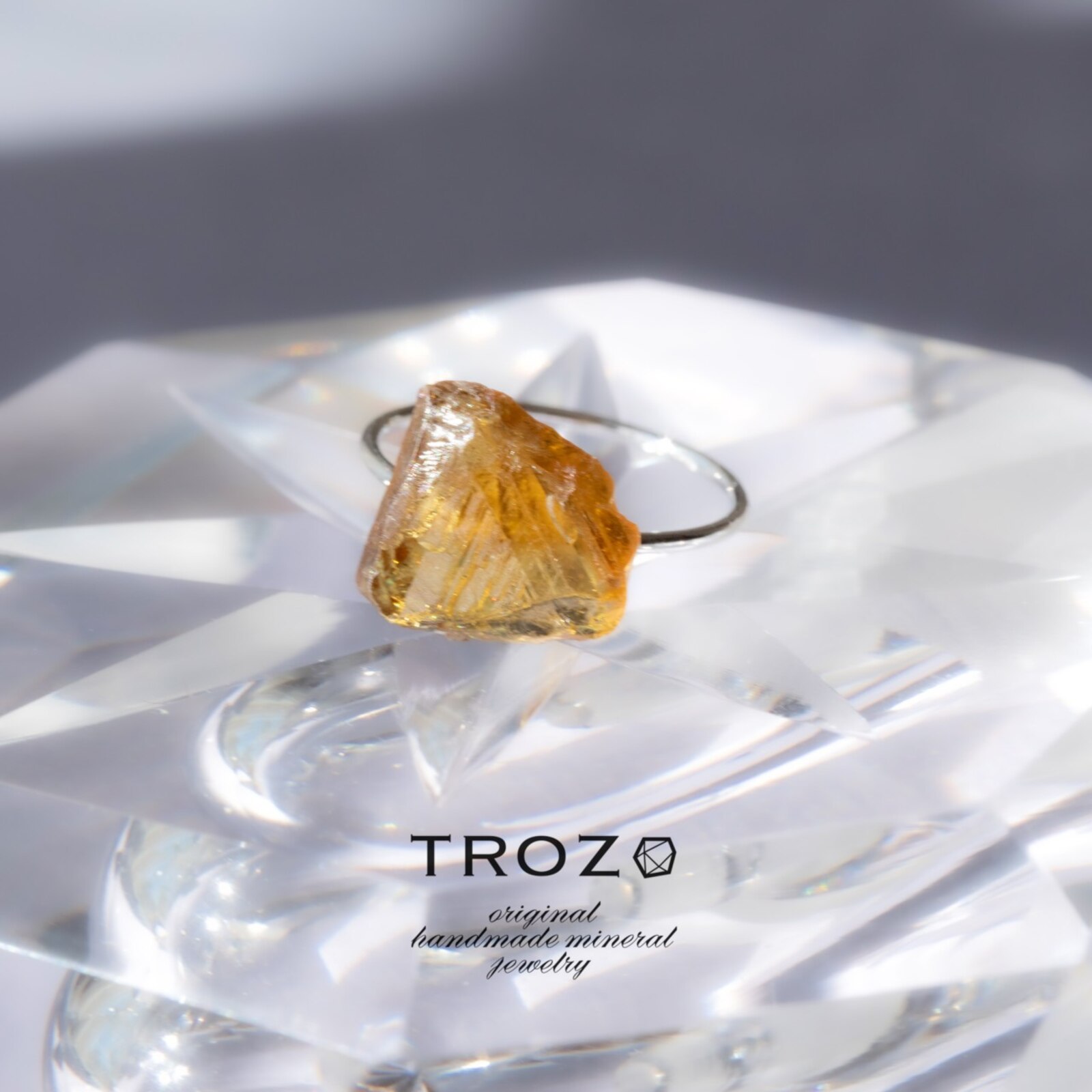
Sphene (titanite) is a calcium-titanium silicate, CaTiSiO₅. It is monoclinic, Mohs 5–5.5, with a very high refractive index of 1.84–2.11 and a vitreous-to-adamantine luster. Its formal mineral name (IMA) is titanite, for its titanium; the gem name sphene is from the Greek *sphenos* (“wedge”), and the wedge-shaped growth of its crystals.
Sphene’s greatest appeal is a fire that surpasses diamond — its dispersion (the power to split light into rainbow colors) is 0.051, higher than diamond’s 0.044. This is among the highest in all gemstones, and at every turn the surface throws off rainbow sparks. Sphene also has strong pleochroism, showing yellow-green, green, brown and red-brown at different angles; together with its high refractive index, this gives raw sphene a richness of crystal expression and a sharpness of flash that gem lovers and collectors prize.
Sphene comes in many colors — yellow-green, green, yellow, brown, red and black — shifting with trace iron, manganese and chromium. Chromium-bearing green sphene (notably from Madagascar and Pakistan) is prized as a rare stone rivaling emerald in vividness. There are yellow sphene, cinnamon-brown sphene and the rare red sphene as well. Its sources include the Alps (Austria, Switzerland), the Skardu valley of Pakistan, Madagascar, Mexico, the Kola Peninsula of Russia and Ontario, Canada.
Sphene is loved today as a modern July birthstone. There is a fine story behind it: sphene was established as a new mineral in 1787 by the Geneva physicist and geologist Marc-Auguste Pictet (born 23 July 1752), and in Japan’s 2021 gemstone revision it was adopted as a July birthstone in his honor — his birth month being July. The main July stone is ruby, with sphene alongside. At Mohs 5–5.5 it is soft and not very tough, so it needs care — but in return it offers the natural form of a raw crystal and a rainbow fire all its own.
◆ Mineral Data
- English name
- Sphene (from the Greek *sphenos*, “wedge”) / Titanite (mineral name, for its titanium; the IMA name)
- Chemical formula
- CaTiSiO₅ (calcium-titanium silicate, often with Fe, Al, Mn or Cr)
- Mineral class
- Nesosilicate mineral — the titanite group
- Crystal system
- Monoclinic (forms wedge-shaped crystals)
- Mohs hardness
- 5 – 5.5 (soft; handle with care)
- Specific gravity
- 3.45 – 3.55
- Main sources
- Madagascar, Pakistan (Skardu valley), Mexico, Austria (Tyrol), Switzerland (the Alps), Russia (Kola Peninsula), Canada (Ontario), Brazil, USA
- Color range
- Yellow-green, green (chromium-bearing green sphene is highly valued), yellow, brown, red, black; strong pleochroism shifts the color with the angle
- Notable trait
- A dispersion of 0.051 (surpassing diamond’s 0.044) gives a fire among the highest of all gems; high refractive index 1.84–2.11 with adamantine luster. Established as a new mineral by M.A. Pictet in 1787; a modern July birthstone (for his July birth month)
- Birthstone
- July (modern addition; the main July stone is ruby)
◆ A “fire” beyond diamond — a rare stone of dispersion 0.051
At every turn, rainbow sparks pour out.
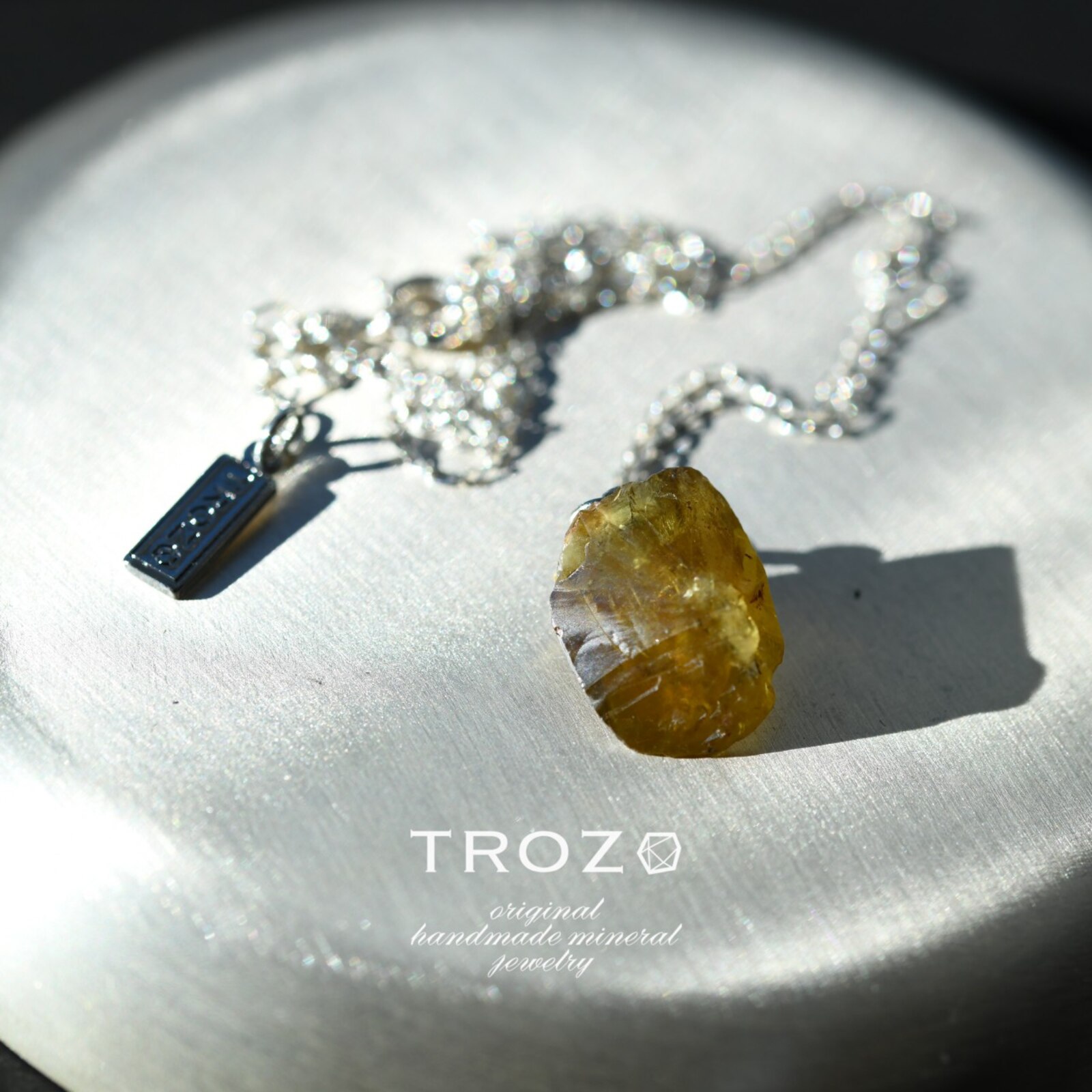
Sphene’s greatest appeal is a fire among the very highest of gems — its dispersion (the power to split white light into the spectrum) is 0.051, above diamond’s 0.044. Rainbow sparks burst from its surfaces and facets, and a cut sphene has the beauty of a “moving gem” that changes with every shift of light. Its high refractive index of 1.84–2.11 gives an adamantine luster beyond mere glass, and even in the rough a deep, distinctive glow appears. Sphene also has strong pleochroism, showing yellow-green, green, brown and red-brown at different angles — the three together, fire, pleochroism and adamantine luster, make it a rare stone beloved of gem and mineral collectors.
◆ Pictet’s discovery — from a Geneva laboratory in 1787
A July birthday, and a birthstone 230 years later.
Sphene (titanite) was established as a new mineral in 1787, when the Geneva-born physicist and geologist Marc-Auguste Pictet de la Rive (23 July 1752 – 19 April 1825) analyzed its chemical properties and described it as a distinct mineral. The mineral name “titanite” comes from its main component, titanium. More than 230 years later, in Japan’s 2021 gemstone revision, sphene was adopted as a July birthstone — and behind the choice lay the fact that Pictet’s birth month was July. A stone with a rare backstory in the annals of gems: it joined the birthstones in honor of its discoverer’s birth month.
◆ Choosing raw sphene jewelry
Read the color, the source and the wedge-shaped crystal.
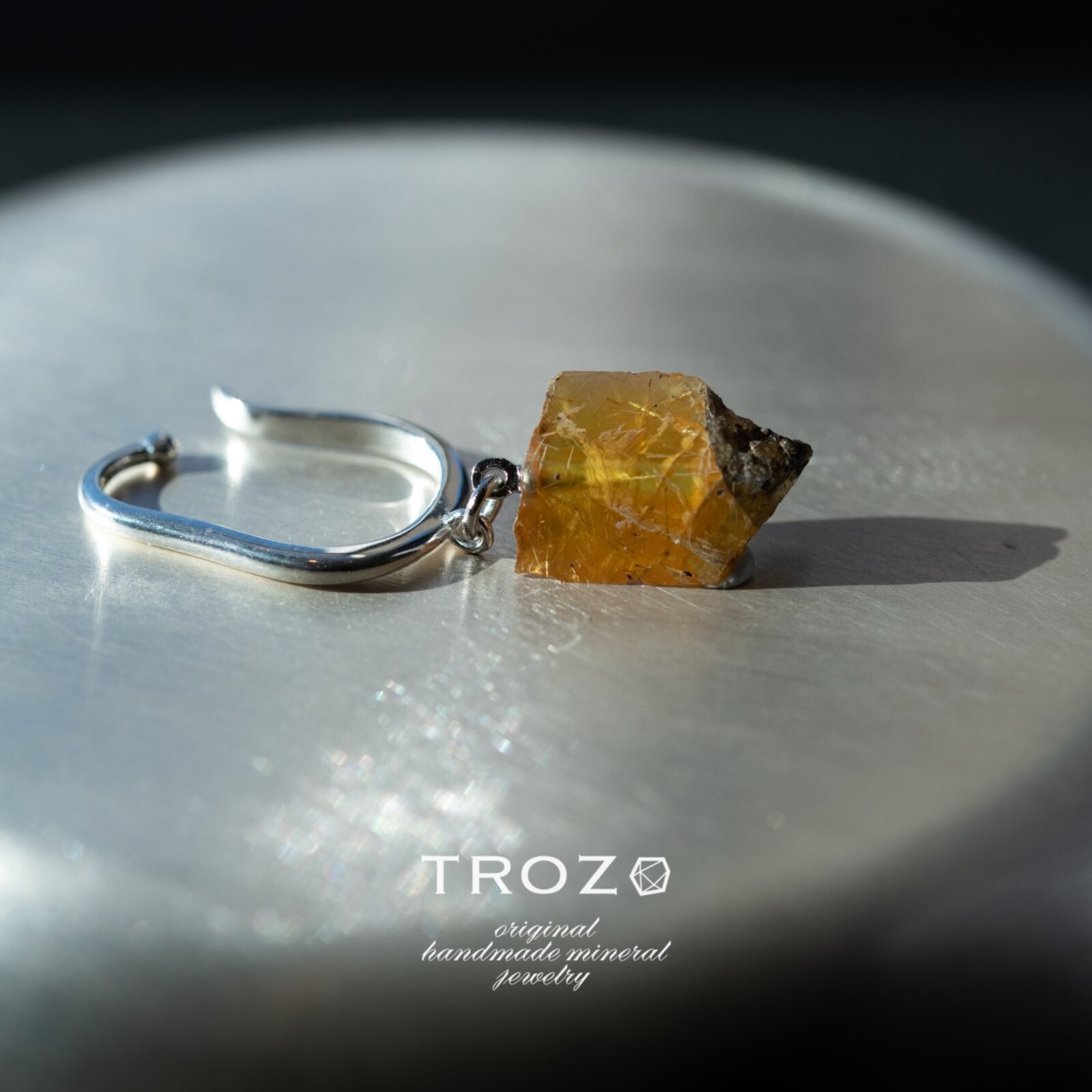
The pleasure of choosing raw sphene jewelry lies in its range of color and the strength of its fire. Yellow-green and green (chromium-bearing green sphene from Madagascar and Pakistan is the prized peak), yellow, cinnamon brown and the rare red — the color sets much of the character. The wedge-shaped (monoclinic) crystal also gives raw sphene a natural form worth comparing for angle, size and clarity. One note: at Mohs 5–5.5 it is relatively soft and not very tough, so an edge can chip under a hard blow — it is safest to take it off where it might be knocked.
TROZO sets sphene without polishing away its character, letting the natural wedge-shaped crystal form and the fire lead the design. As a gift for those born in July, a sphene that throws a “rainbow flash” quite unlike the red of ruby — a rare stone with character and story, in the pieces TROZO makes.
◆ Sphene Raw-Stone Jewelry
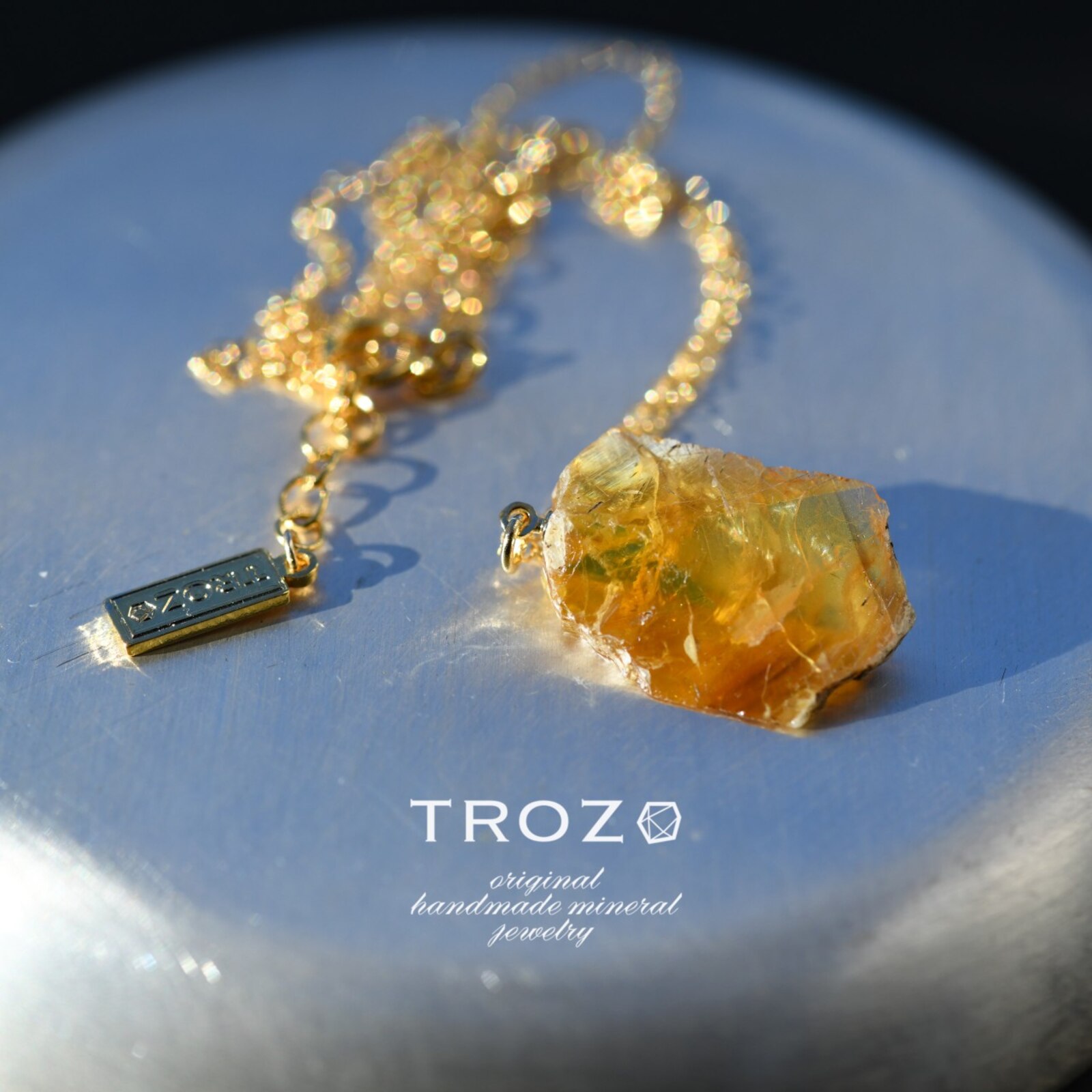
Handmade raw stone & mineral pieces — TROZO
◆ Frequently Asked Questions about Sphene
Q What does sphene symbolize?
Sphene is traditionally associated with the everlasting, reform, strengthening bonds, purity, intuition, creativity, talent and brilliance. From its rainbow fire beyond diamond and its story of joining the birthstones 230 years on, words like “brilliance”, “talent” and “creativity” gather around this rare stone.
Q What month’s birthstone is sphene?
It is a modern July birthstone. In Japan’s 2021 gemstone revision it was adopted as a July birthstone, in honor of the Geneva physicist and geologist Marc-Auguste Pictet (born 23 July 1752), who established sphene as a new mineral in 1787 — his birth month being July. The main July stone is ruby, with sphene alongside.
Q Are sphene and titanite the same?
Yes — they are two names for the same mineral. Titanite is the name recognized by the International Mineralogical Association (IMA), for its main component, titanium. Sphene is the gem name, from the Greek *sphenos* (“wedge”), for the wedge-shaped growth of its crystals. Technical works tend to say titanite; the jewelry world tends to say sphene.
Q Does sphene really sparkle more than diamond?
In terms of “fire”, yes. In dispersion (the power to split light into rainbow colors), sphene is 0.051 and diamond 0.044 — sphene is higher, so its surfaces throw off stronger rainbow sparks, which gemology calls “fire”. But diamond is the strongest gem overall (Mohs 10, dispersion 0.044, refractive index 2.42), while sphene is a soft rare stone at Mohs 5–5.5 — they are two different kinds of beauty.
Q What colors does sphene come in?
Sphene comes in yellow-green, green, yellow, brown, red and black, shifting with trace iron, manganese and chromium. Chromium-bearing green sphene (notably from Madagascar and Pakistan) is highly valued as a rare stone rivaling emerald in vividness. With its strong pleochroism, a single stone can show yellow-green, green and brown at different angles — a richly expressive natural stone.
Q How hard is sphene, and what care does it need?
Its Mohs hardness is 5–5.5, soft for a gem, and it is not very tough, so it needs care: an edge can chip under a hard blow, and it is safest to take it off where it might be knocked. Avoid contact with hard objects, and avoid ultrasonic and steam cleaners; wipe gently with a soft cloth. It also has cleavage, so store it separately from other gems so they do not touch.
Q Where does sphene come from?
Madagascar (the leading source of green sphene), Pakistan (the Skardu valley), Mexico, Austria (Tyrol) and Switzerland (the Alps), Russia (the Kola Peninsula), Canada (Ontario), Brazil and the USA. Color tends to vary by source — green from Madagascar and Pakistan, yellow from Canada, and strong-fire material from Mexico.
EXPLORE THE SHOP
Explore the world of Sphene
Discover more pieces than we can show here at the TROZO shop.
Shop Sphene