
Coral
A red the sea grew. March’s birthstone.
Coral is one of humankind’s oldest organic gems — the polished calcareous skeleton of colonies of the soft-coral order, marine cnidarians. It is about 85–92% calcium carbonate (CaCO₃, mainly aragonite), 4–10% organic matter (the protein conchiolin and carotenoid pigment) and 1–3% water, soft at Mohs 3.5–4. Its history as a gem reaches back to 8000 BC. Japanese red coral (Corallium japonicum) is held the world’s finest, called “TOSA” by European buyers — the byword for beautiful red coral. It is March’s birthstone and the gift for a 35th “coral” wedding anniversary.
Coral is the March birthstone. See all March birthstones →
◆ Coral — Stone Meanings
- Longevity
- Health
- Happiness
- Renewal
- Protection from evil
- Family harmony
- Marriage
- Intuition
◆ About Coral
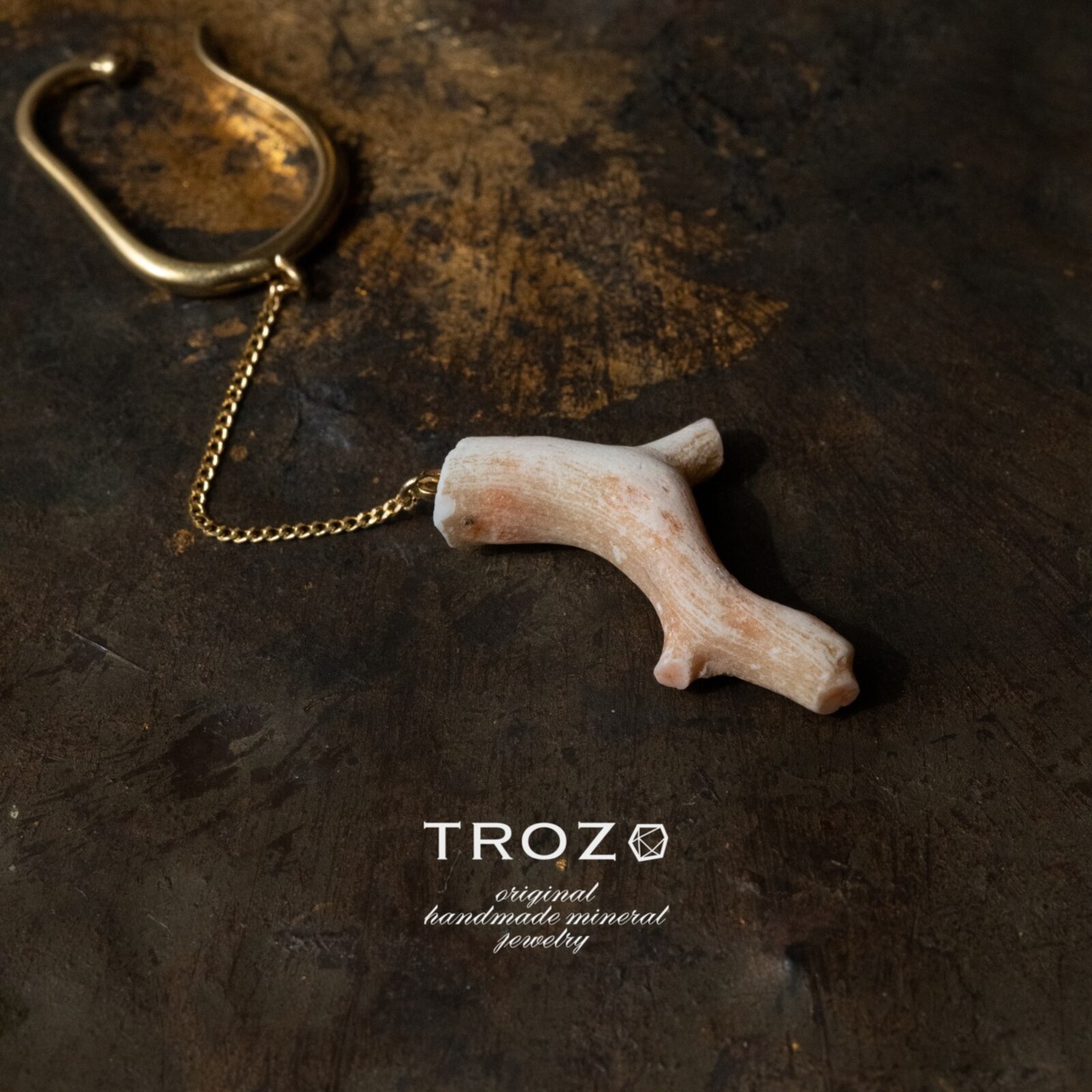
Coral is, like the pearl of a shellfish, an organic gem — the polished calcareous skeleton secreted by colonies of the soft-coral order (Alcyonacea), marine cnidarians. It falls outside the definition of a mineral (inorganic, natural, with a definite crystal structure): a gem born of a living thing. Its makeup is about 85–92% calcium carbonate (CaCO₃, mainly aragonite, some calcite), 4–10% organic matter (the protein conchiolin and carotenoid pigment) and 1–3% water. A network of tiny spine-like crystals (sclerites) interlock, and polished it takes on a waxy, glassy luster.
Coral has great character by color and type. Red coral (oxblood coral, Corallium japonicum) is the deep-red-to-salmon-red peak, and Japanese material is the world’s finest — called “TOSA” by European buyers, the byword for beautiful red coral. Pink coral (Corallium elatius) is a pale pink-to-salmon, and the palest, most restrained pink is the prized “angel skin”. There are also white coral, Mediterranean red coral (Corallium rubrum), deep-sea (Midway) coral and black coral (Antipatharia, a separate lineage) — each type its own color, source and value.
Coral is one of humankind’s oldest organic gems, with coral ornaments excavated from Neolithic sites of around 8000 BC. In ancient Rome it served as a charm against evil and for health, and it reached Heian-era Japan as one of the “seven treasures” of Buddhism. The gem-coral soft corals are gathered from the warm seas of the Mediterranean (Italy, Tunisia, Algeria), Japan (Tosa Bay and off Kōchi, the Ogasawara Islands), off Taiwan, and off Hawaii and Midway. Japanese red coral “TOSA” is held the world’s finest, set apart even within the Italian merchants’ traditional ranking of “1. pink coral, 2. red coral, 3. white / Mediterranean red”.
Coral is loved as March’s birthstone (with aquamarine, bloodstone and iolite) and has served as the gift for a 35th “coral” wedding anniversary. Soft at Mohs 3.5–4, it is sensitive to sweat, cosmetics, perfume, acid, alkali and heat, so a dry wipe with a soft cloth after wear is the secret to its longevity. As a charm to “turn away fire, evil and illness”, worn for thousands of years across both Europe and Asia, coral tells the appeal of an organic gem.
◆ Mineral Data
- English name
- Coral
- Chemical makeup
- About 85–92% CaCO₃ (calcium carbonate, mainly aragonite, some calcite) + 4–10% organic matter (conchiolin + carotenoid pigment) + 1–3% water
- Classification
- Organic gem — not a mineral; the polished calcareous skeleton secreted by colonies of the soft-coral order (Alcyonacea), marine cnidarians
- Structure
- A calcareous structure of interlocking tiny spine-like crystals (sclerites); polished, it shows a waxy, glassy luster
- Mohs hardness
- 3.5 – 4 (very soft; handle with care)
- Specific gravity
- 2.60 – 2.70
- Main sources
- Japan (Tosa Bay and off Kōchi, the Ogasawara Islands — the world’s finest red coral “TOSA”), the Mediterranean (Italy, Tunisia, Algeria — Corallium rubrum), off Taiwan, off Hawaii and Midway (deep-sea coral)
- Types
- Red coral (oxblood, Corallium japonicum, Japanese “TOSA” the finest) / pink coral (Corallium elatius, the peak being “angel skin”) / white coral / Mediterranean red coral (Corallium rubrum) / deep-sea (Midway) coral / black coral (Antipatharia, a separate lineage)
- Color range
- Oxblood (deep red) / red / salmon / pink (angel skin) / white / bright red (Mediterranean) / black
- Notable trait
- One of humankind’s oldest organic gems, prized since the Neolithic of 8000 BC. The 35th “coral” wedding-anniversary stone. Japanese red coral “TOSA” is the world’s finest, named by European buyers
- Birthstone
- March (with aquamarine, bloodstone and iolite)
◆ An organic gem the sea grew — what coral really is
Not an inorganic gem, but a red born of a living thing.
Coral is a gem born of a living thing, outside the definition of a “mineral” (inorganic, natural, with a definite crystal structure) — a leading organic gem, alongside the pearl. It is the polished calcareous skeleton secreted over centuries on the warm seabed by colonies of the marine cnidarian soft-coral order (Alcyonacea), made of about 85–92% calcium carbonate (CaCO₃, mainly aragonite, some calcite), 4–10% conchiolin protein and carotenoid pigment, and 1–3% water. With a network of tiny spine-like crystals (sclerites) interlocking, polished it takes a waxy luster. Unlike a mineral gem, coral’s essence is a story of red spun by the time of life.
◆ Oxblood and pink — types, rank, and the world’s peak “TOSA”
Red coral, pink coral, angel skin.
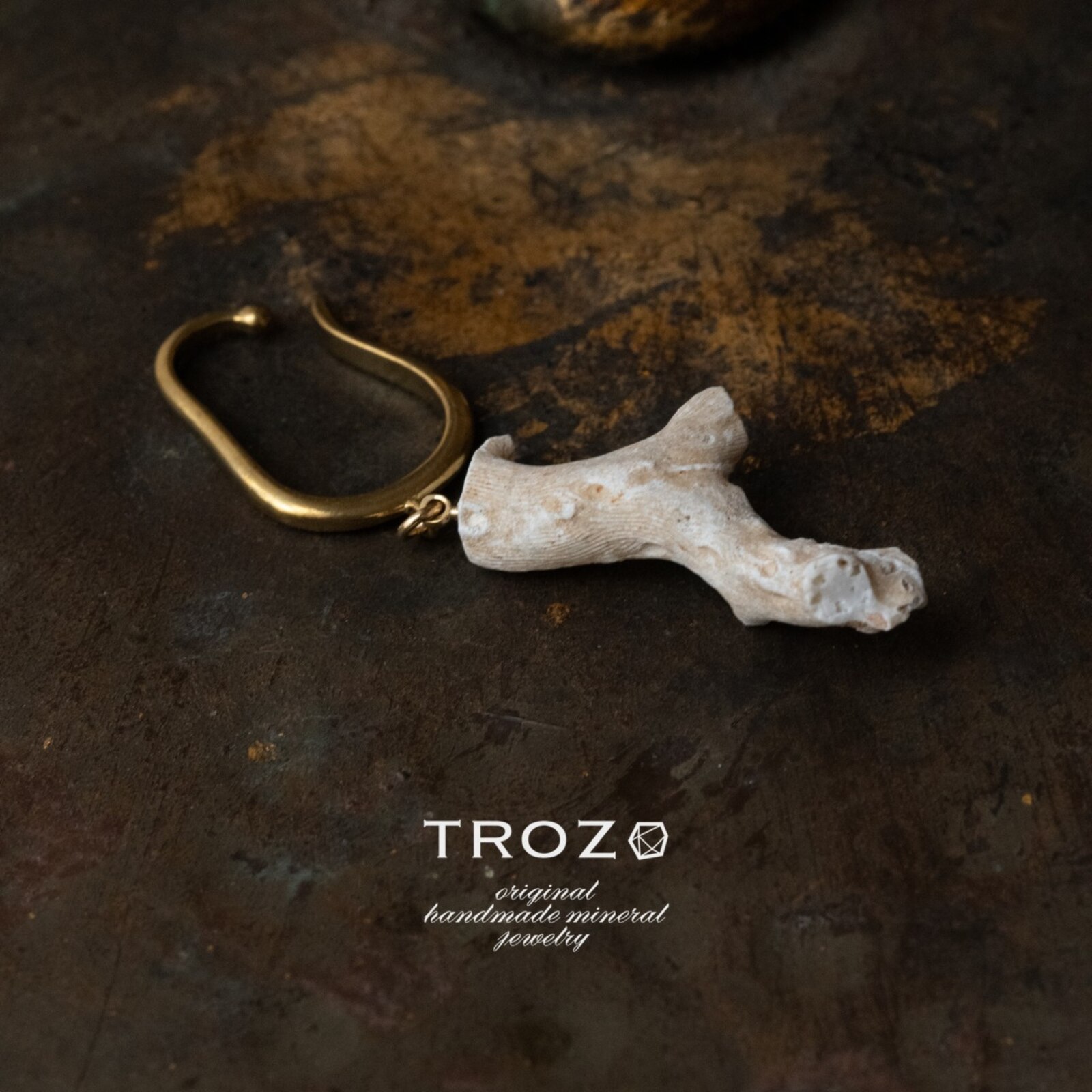
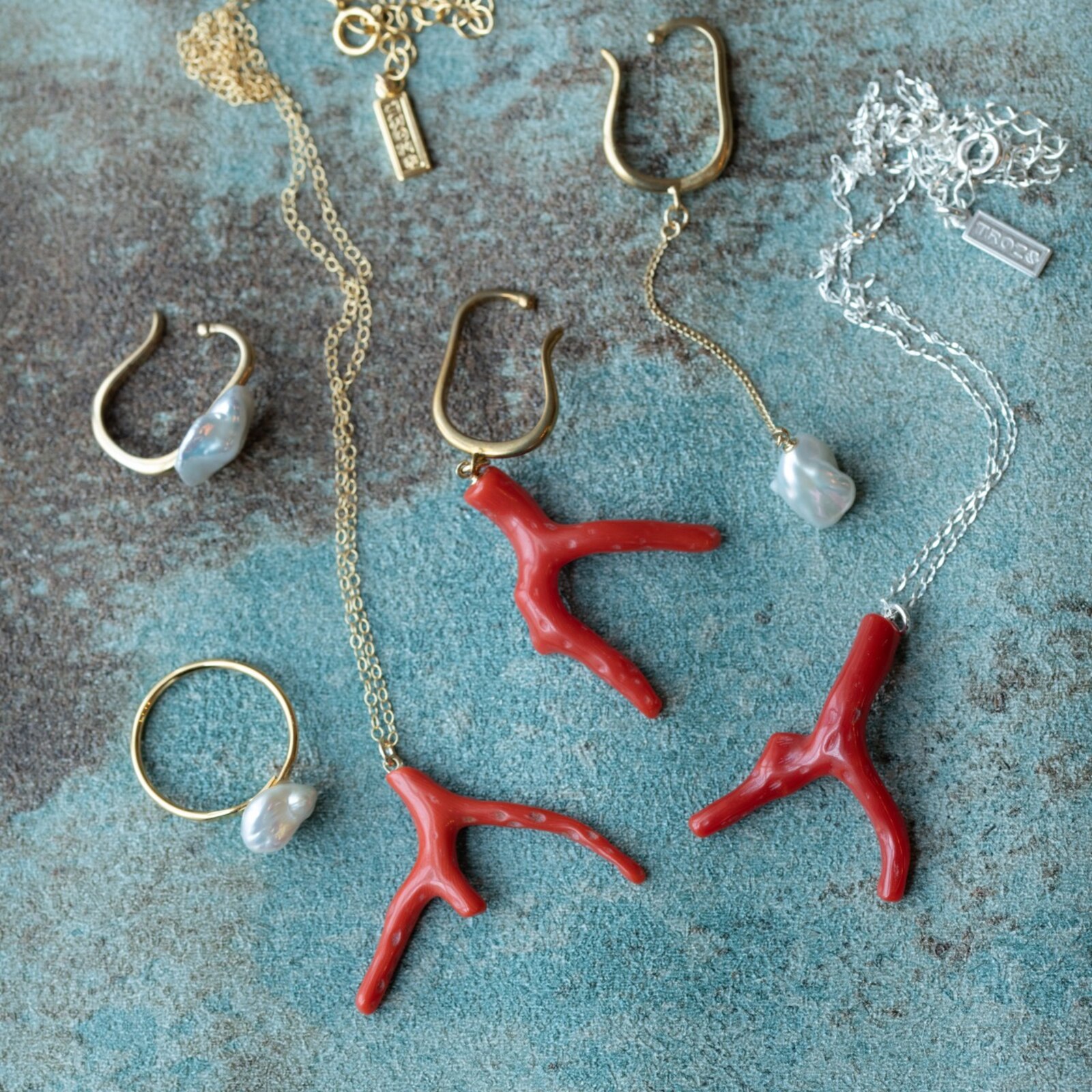
Coral has great character by color and type. Red coral (oxblood, Corallium japonicum) is the deep-red-to-salmon-red peak, and Japanese material (Tosa Bay and off Kōchi, the Ogasawara Islands) is the world’s finest. European buyers came to call beautiful Japanese red coral “TOSA”, prized as the byword for fine red coral. Pink coral (Corallium elatius) is an elegant pale pink, and its restrained, milky peak is the rare “angel skin”. There are also white coral, Mediterranean red coral (Corallium rubrum, a bright red), deep-sea (Midway) coral and black coral (Antipatharia, a horny, separate lineage) — each type its own value and character.
◆ March’s birthstone — choosing coral jewelry
The 35th “coral” anniversary, a gem worn since 8000 BC.
Coral is loved as March’s birthstone (with aquamarine, bloodstone and iolite) and has served as the gift for a 35th “coral” wedding anniversary. A charm against evil and for health in ancient Rome, one of the “seven treasures” of Buddhism in Heian-era Japan — it has been worn for thousands of years across both Europe and Asia. It is a traditional natural coral, perfect as a gift for those born in March or for a wedding anniversary.
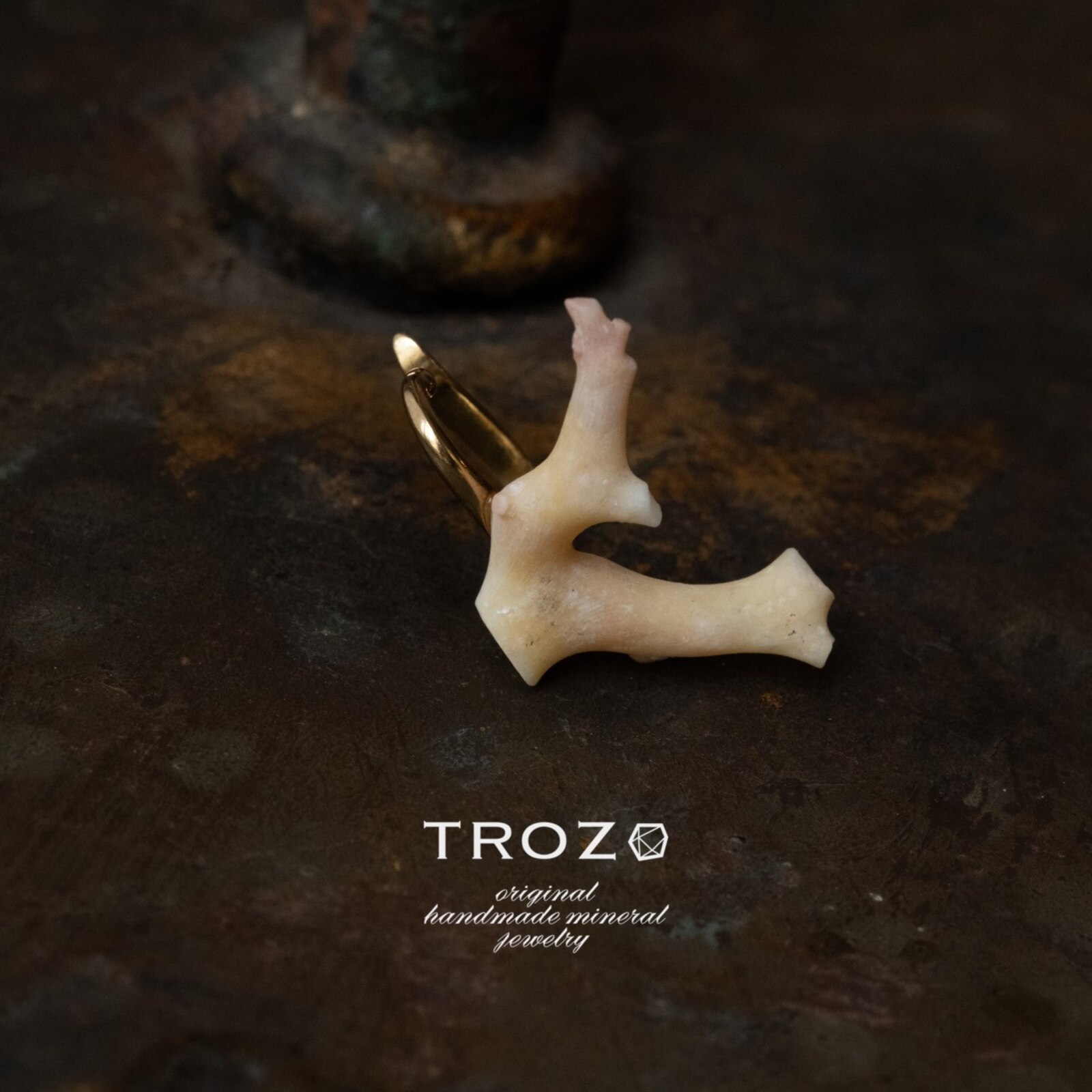
TROZO works coral so that the natural color and the character of the skeleton, grown by a marine cnidarian, lead the design. We offer pieces for those who would like to choose color, size and type from stock, as well as pieces where we entrust the meeting to chance. Soft at Mohs 3.5–4 and sensitive to sweat, cosmetics, perfume and acid, a dry wipe with a soft cloth after wear is the secret to its longevity. As a gem to wear for a lifetime, choose TROZO’s natural coral jewelry for a March birthday gift or a 35th-anniversary “coral” piece.
◆ Coral Raw-Stone Jewelry
Handmade raw stone & mineral pieces — TROZO
◆ Frequently Asked Questions about Coral
Q What does coral symbolize?
Coral is traditionally associated with longevity, health, happiness, renewal, protection from evil, family harmony, marriage and intuition. Prized since antiquity as a charm to “turn away fire, evil and illness”, and the 35th “coral” wedding-anniversary stone, it is a symbol of life and of bonds.
Q What month’s birthstone is coral?
It is March’s birthstone. The March birthstones are four — aquamarine, coral, bloodstone and iolite (iolite added in the 2021 revision). It is also a traditional gem for the 35th “coral” wedding anniversary.
Q Is coral a mineral?
No — coral is not a mineral but is classed as an organic gem. It is the polished calcareous skeleton secreted by colonies of the soft-coral order (Alcyonacea), marine cnidarians, and falls outside the mineral definition (inorganic, natural, with a definite composition and crystal structure) — a gem born of a living thing. It belongs to the “organic gem” category with pearl, amber and jet.
Q What are red coral, pink coral and angel skin?
They are the main types of coral. Red coral (oxblood, Corallium japonicum) is the deep-red-to-salmon-red peak, and Japanese material is the world’s finest — called “TOSA” by European buyers, the byword for beautiful red coral. Pink coral (Corallium elatius) is an elegant pale pink, and its restrained, milky peak is the prized “angel skin”. There are also white coral, Mediterranean red coral (Corallium rubrum), deep-sea (Midway) coral and black coral (Antipatharia, a separate lineage).
Q Why is Japanese red coral “TOSA” the world’s finest?
Japanese red coral (Corallium japonicum), grown in the deep waters of Tosa Bay, off Kōchi and the Ogasawara Islands, has been held to surpass the world’s coral in density of structure, depth of color and thickness of skeleton. European buyers came to call it “TOSA” in respect for its beauty, and it remains the byword for fine red coral, fetching top prices at the world’s coral auctions. Mediterranean red coral (Corallium rubrum) has historically dominated the trade from Italy, but the finest oxblood is said to be a Japanese monopoly.
Q What care does coral need?
Its Mohs hardness is 3.5–4, very soft and among the gems that need care. It is sensitive to sweat, cosmetics, perfume, acid (including fruit juice), alkali, heat and direct sun, which can cause discoloration and loss of luster. Always wipe it dry with a soft cloth after wear, put it on last after applying cosmetics, store it in its own pouch somewhere with little humidity, and never use an ultrasonic or steam cleaner — and it is a gem to wear for decades and across generations.
Q Where does coral come from?
Japan (Tosa Bay and off Kōchi, the Ogasawara Islands) is the source of the world’s finest oxblood red coral, “TOSA”. Other gem sources are Mediterranean red coral from the Mediterranean (Italy, Tunisia, Algeria), and deep-sea coral from off Taiwan and off Hawaii and Midway. All are gathered from colonies of the soft-coral order grown on warm seabeds.
EXPLORE THE SHOP
Explore the world of Coral
Discover more pieces than we can show here at the TROZO shop.
Shop Coral