
Iolite
The Viking compass — a March birthstone.
Iolite (cordierite) is a magnesium-aluminium silicate, Mg₂Al₃(AlSi₅O₁₈), orthorhombic, Mohs 7–7.5. Its great distinction is very strong pleochroism — the color shifts clearly with the angle, from deep blue-violet to gray to pale yellow-brown. Its other name “dichroite” reflects this, and “water sapphire” its sapphire-like blue. With a legend that Vikings used it as a “sunstone” to find the sun through cloud, it is a modern March birthstone.
Iolite is the March birthstone. See all March birthstones →
◆ Iolite — Stone Meanings
- Serenity
- Intuition
- Grace
- Sincerity
- Constancy
- Wisdom
- Reflection
- A compass
◆ About Iolite
Iolite (cordierite) is a magnesium-aluminium silicate, Mg₂Al₃(AlSi₅O₁₈), orthorhombic, Mohs 7–7.5, with a refractive index of 1.53–1.55. As a mineral it is also called cordierite, named in 1813 for the French mineralogist and geologist Pierre Louis Antoine Cordier (1777–1861). The gem name “iolite” comes from the Greek *ios* (“violet”), and its Japanese name means, literally, “violet-blue stone”.
Essential to any account of iolite is its very strong pleochroism: along its crystal axes it shows deep blue-violet (a), gray-to-pale-blue (b) and pale yellow-brown to colorless (c), changing clearly with the angle. From this it is also called dichroite (Greek *di-*, two, + *chroia*, color), and a stone whose face changes with the cut. With a blue resembling sapphire and a habit of being found among river gravels, it bears the further name water sapphire — a “blue that changes with the angle” unlike topaz, sapphire or ruby.
Iolite is also known for the legend of the Viking compass (Viking sunstone): that the seafarers of the 9th–11th centuries used a thin slice of iolite (or another candidate sunstone mineral) to locate the sun on cloudy days or at twilight. As a result of its strong pleochroism iolite has a polarizing-filter effect, and the story holds that the polarization pattern of the sky let them read the sun’s direction through cloud. The historical case is not fully settled, but it is a captivating episode, told in both jewelry and the history of science, as a leading candidate for the “sunstone” recorded in the Norse sagas.
Iolite is loved today as a modern March birthstone. (In Japan’s 2021 gemstone revision it was adopted as a March birthstone, in honor of Cordier — for whom cordierite is named — whose birth month was March, born 31 March 1777.) The main March stones are aquamarine, coral and bloodstone, with iolite alongside. Its angle-shifting blue and spring feeling have made it increasingly popular in recent years.
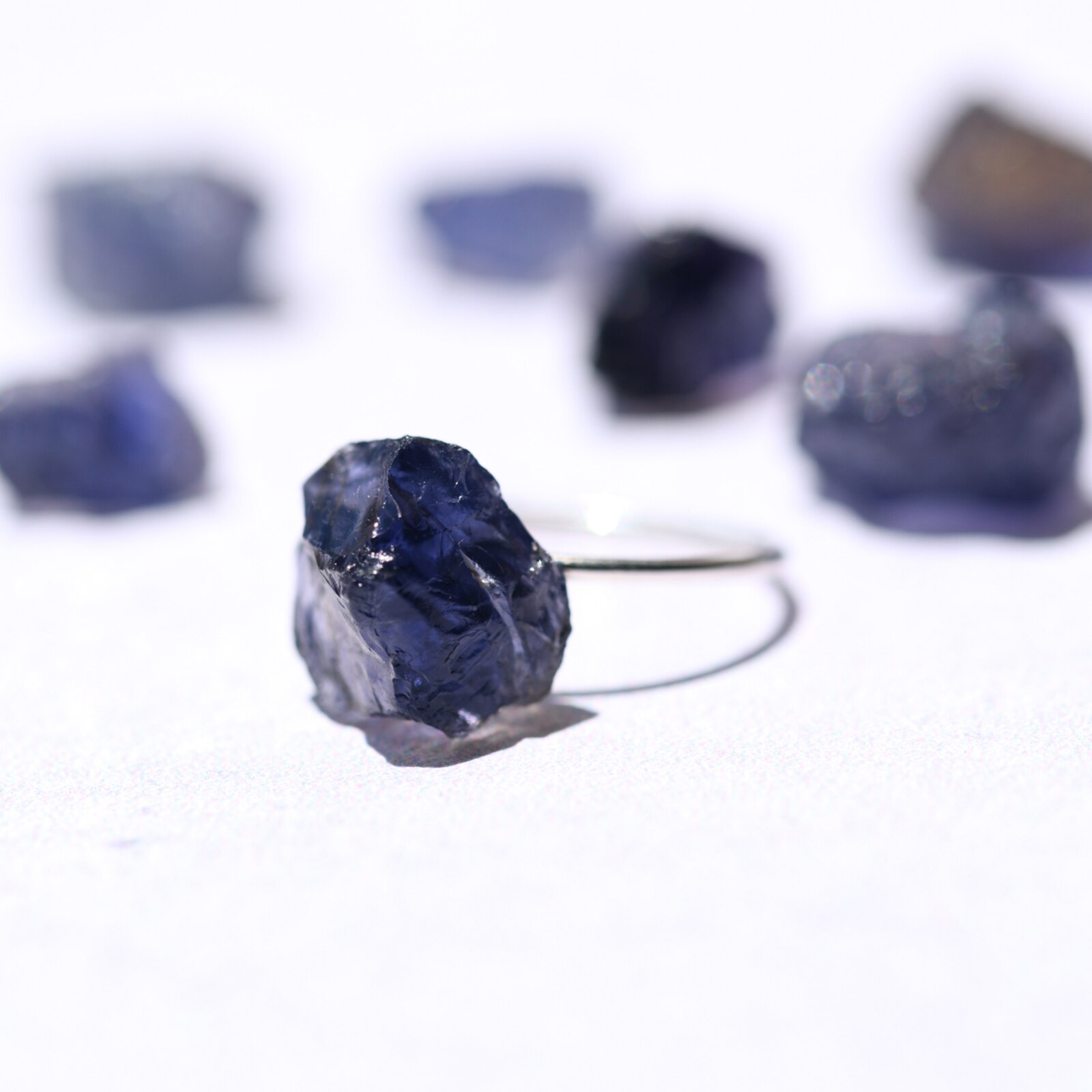
◆ The Many Faces of Iolite
Every piece differs in hue and inclusion — the unrepeatable character of raw stone.


◆ Mineral Data
- English name
- Iolite (from the Greek *ios*, “violet”) / Cordierite (mineral name, for P.L.A. Cordier) / Dichroite (for its pleochroism) / Water Sapphire (for its sapphire-like blue)
- Chemical formula
- Mg₂Al₃(AlSi₅O₁₈) (a magnesium-aluminium silicate, often with iron)
- Mineral class
- Cyclosilicate (six-membered ring) — the cordierite group
- Crystal system
- Orthorhombic (often pseudo-hexagonal)
- Mohs hardness
- 7 – 7.5
- Specific gravity
- 2.55 – 2.66
- Main sources
- India, Sri Lanka, Madagascar, Myanmar, Brazil, Tanzania, Namibia, Norway, Canada
- Color range
- Deep blue-violet ⇔ gray to pale blue ⇔ pale yellow-brown to colorless (strong pleochroism — the color changes along the crystal axes)
- Notable trait
- Very strong pleochroism — three colors by angle. Also called dichroite and water sapphire. Carries the “Viking compass” legend of finding the sun. A modern March birthstone (for Cordier’s March birth month)
- Birthstone
- March (modern addition; the main March stones are aquamarine, coral and bloodstone)
◆ A blue that changes with the angle — strong pleochroism and dichroite
A stone of three colors along its crystal axes.
Iolite’s greatest appeal is very strong pleochroism, the color changing clearly with the angle: deep blue-violet along the a-axis, gray to pale blue along the b-axis, and pale yellow-brown to colorless along the c-axis — a single raw stone showing three faces as you turn it. From this it is also called dichroite (Greek *di-*, two, + *chroia*, color). When cutting iolite, the lapidary must orient the table to the axis that gives the most vivid blue-violet — a stone that demands reading the rough’s direction. With a blue resembling sapphire and a habit of being found among river gravels, it bears the poetic further name water sapphire.
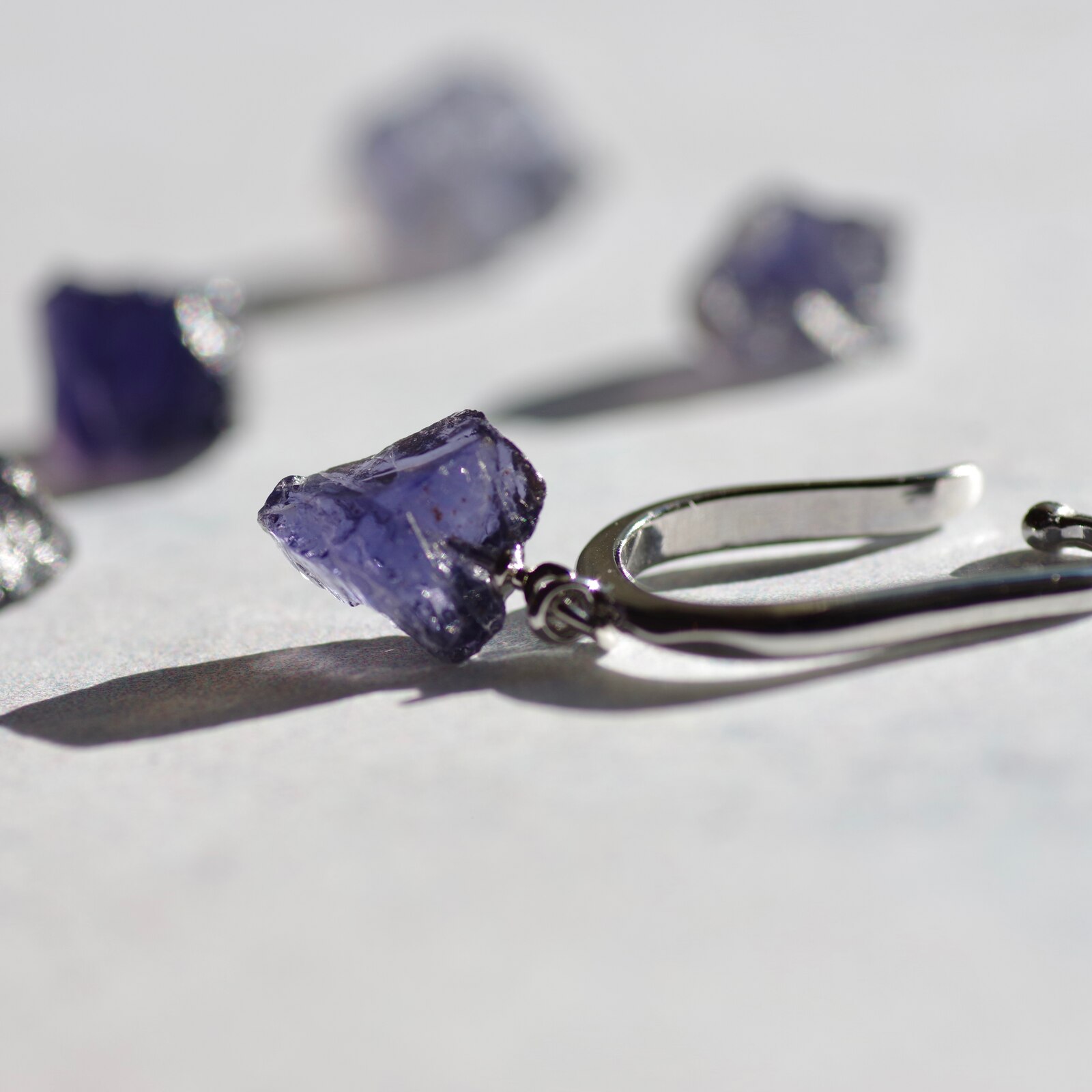
◆ The Viking compass — the truth behind the sunstone legend
Reading the sun’s direction through cloud, a Norse navigation craft.
The Norse sagas and old records tell that the seafarers of the 9th–11th centuries, in an age before the magnetic compass, used a crystal called the sólarsteinn (sunstone) to find the sun on cloudy days or at twilight. A leading candidate for this “sunstone” is iolite: held to the sky, a thin slice of iolite — with the polarizing-filter effect that comes of its strong pleochroism — let one see the sky’s polarization pattern (radiating from the sun) and read the sun’s direction through cloud. Other candidate minerals (calcite, tourmaline) are also proposed, but recent research supports that polarization navigation is theoretically possible near the Arctic — and the Viking compass remains an episode, told in both jewelry and the history of science, that has become iolite’s symbol.
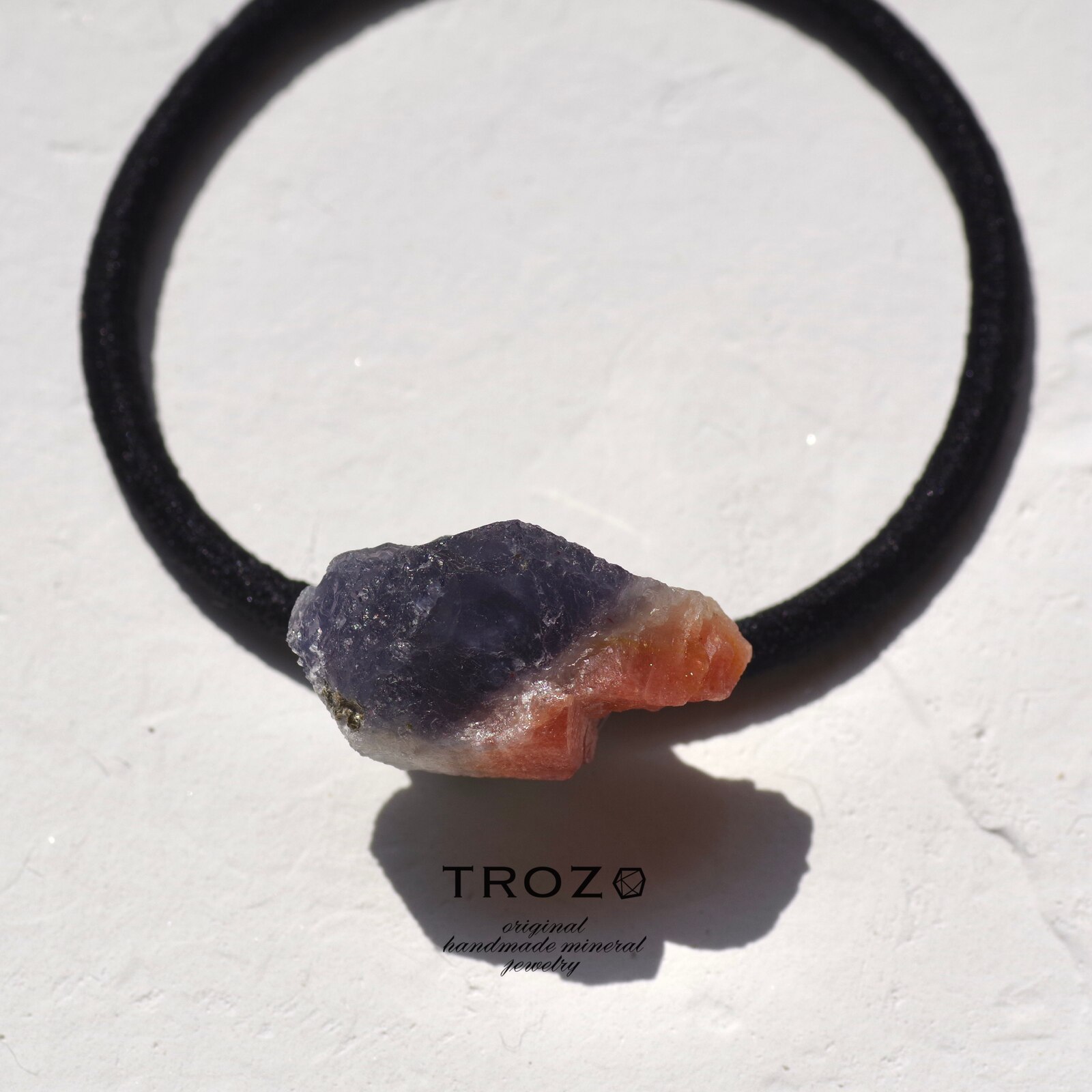
◆ Choosing raw iolite jewelry — for Cordier’s birth month
A modern March birthstone, alongside aquamarine, coral and bloodstone.
In Japan’s 2021 gemstone revision iolite was adopted as a March birthstone, in honor of the mineralogist Pierre Louis Antoine Cordier — for whom cordierite is named — whose birth month was March (born 31 March 1777). The main March stones are aquamarine, coral and bloodstone, with iolite alongside.
TROZO sets iolite without polishing away its character, letting the natural strong pleochroism and the form of the crystal lead the design. For those who would enjoy a blue that changes with the angle, who are drawn to the poetry of “water sapphire”, or who are charmed by the story of the Viking compass — as a gift for those born in March or as everyday natural-stone jewelry, iolite offers the delight of “a face that shifts with the angle”.
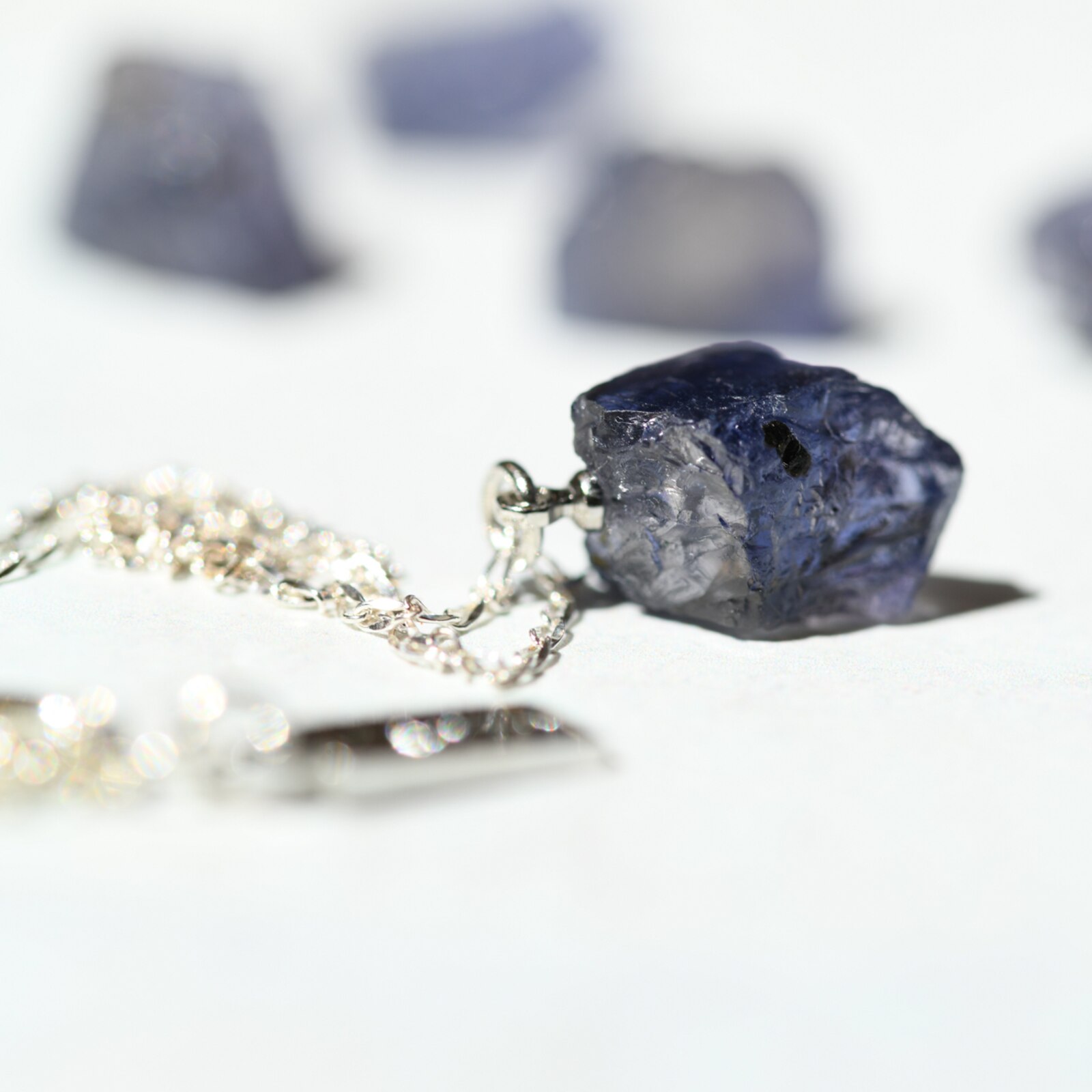
◆ Iolite Raw-Stone Jewelry
Handmade raw stone & mineral pieces — TROZO
◆ Frequently Asked Questions about Iolite
Q What does iolite symbolize?
Iolite is traditionally associated with serenity, intuition, grace, sincerity, constancy, wisdom, reflection and the idea of a compass. The “compass” comes from the Viking-compass legend, and words like “reflection” and “intuition” from its strong pleochroism — meanings tied to iolite’s history and properties.
Q What month’s birthstone is iolite?
It is a modern March birthstone. In Japan’s 2021 gemstone revision it was adopted as a March birthstone, in honor of the mineralogist Pierre Louis Antoine Cordier — for whom cordierite is named — whose birth month was March. The main March stones are aquamarine, coral and bloodstone, with iolite alongside.
Q Are iolite, cordierite, dichroite and water sapphire all the same?
Yes — all names for the same mineral. Cordierite is the mineral name (coined 1813), iolite the gem name (Greek *ios*, “violet”), dichroite an old name for its strong pleochroism, and water sapphire a name for its sapphire-like blue and its occurrence among river gravels.
Q What is iolite’s pleochroism?
Iolite has very strong pleochroism: deep blue-violet along the a-axis, gray-to-pale-blue along the b-axis, and pale yellow-brown to colorless along the c-axis — a single raw stone showing three colors by angle. From this it is also called dichroite. The lapidary must orient the table to the axis that gives the most vivid blue-violet, so it is a stone that demands reading the rough’s direction.
Q Is the Viking compass real?
The Norse sagas and old records describe using a crystal called the “sunstone” (sólarsteinn) to find the sun on cloudy days, and a leading candidate is iolite. Its strong pleochroism comes with a polarizing-filter effect, and the story holds that the sky’s polarization pattern (radiating from the sun) let one read the sun’s direction through cloud. Other candidate minerals (calcite, tourmaline) are proposed too, but recent research supports that polarization navigation is theoretically possible near the Arctic; TROZO presents it as a historical episode that speaks to iolite’s character.
Q How hard is iolite, and what care does it need?
Its Mohs hardness is 7–7.5, hard among natural stones, but it has cleavage (a tendency to part along a certain direction), so an edge can chip under a hard blow. It is safest to take it off where it might be knocked, to avoid contact with hard objects, and to avoid ultrasonic and steam cleaners as a precaution.
Q Where does iolite come from?
India, Sri Lanka, Madagascar and Myanmar are the long-known main sources, with further material from Brazil, Tanzania, Namibia, Norway and Canada. The shade of blue varies with the ratio of magnesium and iron, giving each source its own character.
EXPLORE THE SHOP
Explore the world of Iolite
Discover more pieces than we can show here at the TROZO shop.
Shop Iolite